





Startup Marketing
Launch the Product. Enter the Market. Build Demand. Acquire Customers. Communicate the Opportunity. Turn an Early-Stage Business into a Scalable Brand.
Startups operate under very different marketing conditions from established companies.
An established business may already have brand recognition, historical customer data, mature sales channels, predictable demand and established marketing infrastructure. A startup may be building all of these simultaneously often while the product, market, pricing, customer profile and business model are still developing.
That makes startup marketing more than advertising.
A startup may need to determine who its most valuable initial audience is, explain a new product, establish credibility, launch into the market, acquire early customers, test channels, communicate with investors, build a community, create a repeatable growth engine and prepare marketing systems that can scale with the company.
The challenge is not simply:
How Do We Get More Traffic?
It is:
How Do We Turn an Emerging Product or Business Idea into a Recognizable Brand, a Credible Market Proposition, a Customer Acquisition Engine and a Scalable Growth Opportunity?
At Brand Messenger, our Startup Marketing service combines startup brand strategy, product positioning, go-to-market strategy, product launches, market entry, growth marketing, customer acquisition, demand generation, investor communications, content, performance marketing, AdTech, MarTech, CRM, automation, analytics and AI-assisted growth intelligence.
Our core capabilities include:
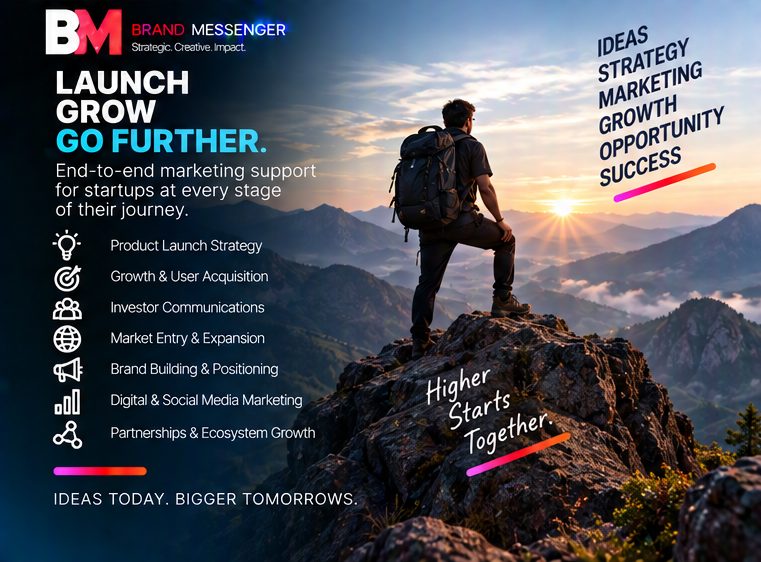
Product Launch
Growth Marketing
Investor Communications
Market Entry
Our wider capabilities can support pre-launch startups, newly launched companies, funded startups, technology ventures, SaaS companies, digital platforms, apps, marketplaces, consumer startups, B2B ventures and startups preparing to transition into scale-up growth.
The architecture becomes:
Idea → Market → Positioning → Product → Launch → Customer → Validation → Growth → Revenue → Investment → Expansion → Scale
The objective is not simply:
Launch a Startup.
It is:
Build the Marketing Foundation That Can Help the Startup Find Its Market, Win Customers, Learn Quickly and Prepare for Sustainable Growth.
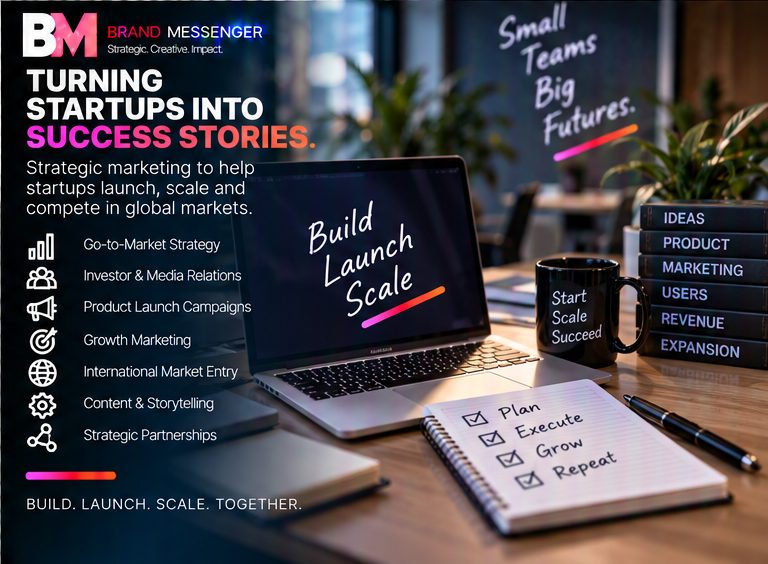
What Is Startup Marketing?
Startup Marketing is marketing designed specifically for businesses operating in the early stages of company and market development.
It can connect:
Business Strategy
Market Research
Brand
Product
Customer
Go-to-Market
Acquisition
Revenue
Data
Investment Communication
Growth
Unlike mature-company marketing, startup marketing frequently operates while important assumptions are still being tested.
The marketing system therefore needs to be:
Focused
Measurable
Adaptable
Experiment-Driven
Cost-Aware
Scalable
Startup Marketing Is Not Simply Small-Business Marketing
A small business and a startup can both begin with limited resources, but their growth models may be very different.
A traditional small business may prioritize:
Local Market → Customers → Sustainable Operations
A growth-oriented startup may be pursuing:
Market Opportunity → Product → Validation → Customer Acquisition → Repeatable Growth → Investment → Expansion → Scale
Startup Marketing therefore needs to support both immediate market entry and the company's potential future growth architecture.
Startup Marketing Is Also Different from Scale-Up Marketing
This distinction is important within the Brand Messenger service structure.
Startup Marketing
Focuses primarily on:
Market Understanding
Positioning
Initial Brand Development
Go-to-Market
Product Launch
Early Customer Acquisition
Validation
Investor Communication
Initial Growth Systems
High-Growth & Scale-Up Marketing
Focuses on businesses already moving into rapid expansion and needing:
Larger Acquisition Systems
Multi-Market Expansion
Marketing Infrastructure
Advanced Automation
Revenue Optimization
Customer Retention at Scale
Marketing Operations
Growth Intelligence
The transition can become:
Startup → Validation → Repeatable Growth → Scale-Up → Expansion
Brand Messenger can support the marketing journey across these stages.
Brand Messenger Startup Marketing Services
Our capabilities can include:
Startup Marketing Strategy
Startup Brand Strategy
Startup Branding
Market Research
Customer Research
Competitive Analysis
Market Opportunity Analysis
Customer Segmentation
Ideal Customer Profile Development
Value Proposition Development
Product Positioning
Messaging Strategy
Category Positioning
Go-to-Market Strategy
Product Launch Strategy
Pre-Launch Marketing
Launch Campaigns
Post-Launch Marketing
Market Entry Strategy
New Market Launch
Geographic Expansion
International Market Entry
Demand Generation
Customer Acquisition
Growth Marketing
Performance Marketing
Lead Generation
B2B Lead Generation
Account-Based Marketing
Paid Search
Paid Social
Programmatic Advertising
Display Advertising
Video Advertising
Native Advertising
Remarketing
SEO
Startup Content Marketing
Social Media Marketing
Community Marketing
Creator & Influencer Marketing
Partnership Marketing
Referral Marketing
Product-Led Growth Support
Landing Page Development Strategy
Conversion Rate Optimization
Funnel Optimization
Lead Management
Lead Scoring
CRM Strategy
Marketing Automation
Email Marketing
Omnichannel Marketing
Customer Journey Orchestration
First-Party Data Strategy
Customer Retention
Customer Lifecycle Marketing
Investor Communications
Investor Presentation Communication
Pitch Deck Creative & Messaging Support
Investor-Facing Brand Materials
Startup Website Strategy
Product Demo Content
Explainer Videos
Product Videos
Animation
Startup Events
Launch Events
Investor Events
Community Events
Marketing Analytics
Growth Dashboards
Customer Acquisition Analytics
Revenue Marketing
Attribution
Growth Experimentation
AI-Assisted Startup Marketing Intelligence
The Startup Marketing Architecture
A connected startup marketing system can follow:
Business Idea
↓
Market Opportunity
↓
Customer Problem
↓
Product / Solution
↓
Positioning
↓
Brand
↓
Go-to-Market
↓
Product Launch
↓
Demand
↓
Customer Acquisition
↓
Conversion
↓
Customer Experience
↓
Retention
↓
Revenue
↓
Learning
↓
Growth
↓
Investment / Expansion
The objective is:
Turn Assumptions into Testable Marketing Decisions and Turn Evidence into Better Growth Decisions.
Market Research
Understand the Market Before Trying to Dominate It
Startup marketing should begin with understanding.
Brand Messenger can help examine:
Market Structure
Customer Needs
Existing Alternatives
Competitors
Categories
Search Demand
Customer Behavior
Pricing Context
Distribution Channels
Market Barriers
Emerging Opportunities
The objective is not to produce research that simply confirms the founder's original idea.
It is:
Use Market Evidence to Improve the Marketing Strategy.
Customer Research
A startup needs to understand:
Who Has the Problem?
How Important Is the Problem?
How Is It Currently Solved?
Who Influences the Purchase?
Who Makes the Decision?
Why Would Someone Change?
Brand Messenger can turn these questions into a clearer audience and marketing architecture.
Ideal Customer Profile
For B2B and other appropriate startup models, Brand Messenger can help define an Ideal Customer Profile around relevant characteristics such as:
Industry
Organization Type
Business Need
Use Case
Buying Environment
Company Stage
Geography
The objective is not to declare that everyone could use the product.
It is:
Identify Where the Startup Has the Strongest Initial Reason to Win.
Startup Audience Segmentation
Startups can divide broad markets into meaningful groups based on appropriate:
Needs
Use Cases
Behavior
Business Type
Product Interest
Geography
Customer Lifecycle
This allows the startup to prioritize rather than spreading limited resources across every possible audience.
Product Positioning
Explain Why the Product Should Exist in the Customer's World
A startup can have advanced technology and still struggle if customers cannot quickly understand:
What It Is
Who It Is For
What Problem It Solves
Why It Is Different
Why It Matters
Brand Messenger can develop:
Positioning
Value Proposition
Product Messaging
Audience-Specific Messaging
Website Messaging
Sales Messaging
Campaign Messaging
The architecture becomes:
Customer Problem → Product Value → Differentiation → Evidence → Action
Product Positioning Is Not a Feature List
Startups often describe themselves through:
Technology
Features
Architecture
Specifications
Customers may instead ask:
What Does This Help Me Do Better?
Brand Messenger can connect:
Feature → Capability → Customer Benefit → Business Value
without making claims the product cannot support.
Category Positioning
Some startups enter established categories.
Others introduce products that do not fit neatly into existing categories.
Brand Messenger can help determine whether the company should:
Compete Within an Existing Category
Differentiate Within a Category
Combine Existing Categories
Explain an Emerging Category
Creating a new category can require substantial education.
A new label alone does not create a new market.
Startup Brand Strategy
Build Recognition Before Scale Makes Inconsistency Expensive
Brand Messenger can help startups establish:
Brand Name Strategy
Positioning
Brand Identity
Visual System
Brand Voice
Messaging
Brand Guidelines
Digital Identity
The objective is not to over-engineer the brand before the business has learned anything.
It is to create:
Enough Structure to Be Recognizable. Enough Flexibility to Evolve.
Startup Website Strategy
For many startups, the website becomes the central explanation of the business.
It should quickly communicate:
What Is It?
Who Is It For?
Why Does It Matter?
How Does It Work?
What Should I Do Next?
Brand Messenger can structure startup websites around:
Positioning
Product
Solutions
Use Cases
Industries
Evidence
Pricing where appropriate
Demo / Trial / Purchase
Resources
Company
Contact
Go-to-Market Strategy
Connect the Product with the Market
A startup's Go-to-Market strategy can coordinate:
Market
Audience
Positioning
Pricing Context
Channels
Sales
Marketing
Partnerships
Customer Journey
Launch
The architecture becomes:
Product → Market → Audience → Value Proposition → Channel → Customer → Revenue
Brand Messenger can develop the marketing layer around this architecture.
Go-to-Market Is More Than Launch Day
A launch is a moment.
Go-to-market is a system.
It determines:
Who Are We Selling To?
What Are We Offering?
How Will They Discover It?
How Will They Buy?
How Will We Measure Whether the Model Is Working?
Product Launch Marketing
Turn a Product Release into a Coordinated Market Entry
Brand Messenger can develop product-launch campaigns across:
Pre-Launch
Announcement
Reveal
Launch
Customer Acquisition
Post-Launch
Optimization
The launch lifecycle becomes:
Research → Position → Build Anticipation → Launch → Acquire → Learn → Optimize → Grow
Pre-Launch Marketing
Before launch, startups can build:
Brand Awareness
Landing Pages
Waitlists
Early Communities
Educational Content
Product Teasers
Founder Content
Beta Interest
Event Interest
where appropriate.
The objective is not simply to generate a large waiting list.
It is to begin identifying:
Who Actually Cares About the Product and Why?
Launch Campaign Strategy
Brand Messenger can coordinate:
Launch Creative
Website
Landing Pages
Social Media
Content
Video
Search
Paid Media
Creator Campaigns
Community
Events
Partnerships
around one launch architecture.
Launch Creative
A startup launch may require:
Campaign Identity
Product Visuals
Explainer Content
Product Demonstrations
Launch Films
Animation
Social Assets
Advertising Creative
Investor / Media Materials
Brand Messenger can connect creative production with the wider marketing strategy.
Product Explainer Marketing
New products often require education before conversion.
Brand Messenger can create:
Explainer Videos
Animation
Product Demonstrations
How-It-Works Content
Use Cases
Comparison Content
FAQs
The objective is:
Reduce the Distance Between “What Is This?” and “I Understand Why I Need It.”
Post-Launch Marketing
The launch does not end when the product goes live.
Post-launch marketing can analyze:
Traffic
Sign-Ups
Leads
Purchases
Customer Feedback
Conversion
Acquisition Cost
Retention
Channel Performance
The architecture becomes:
Launch → Evidence → Learning → Optimization
Product-Market Learning
Marketing can provide useful signals about:
Audience Interest
Messaging
Channel Response
Conversion
Customer Objections
Product Demand
These signals can contribute to product-market learning.
But:
Marketing Performance Alone Does Not Prove Product-Market Fit.
Product usage, retention, customer value, economics and other business evidence also matter.
Growth Marketing
Build a System for Continuous Acquisition, Conversion and Retention
Brand Messenger's Startup Growth Marketing can connect:
Acquisition
Activation
Conversion
Retention
Referral
Revenue
rather than focusing only on traffic.
The growth architecture becomes:
Audience → Acquisition → Activation → Conversion → Retention → Referral → Revenue → Learning
Growth Marketing Is More Than Advertising
Paid media can accelerate acquisition.
But sustainable growth may also require:
SEO
Content
Community
Partnerships
Referral
Product Experience
CRM
Retention
Conversion Optimization
Brand Messenger can develop a multi-channel growth system rather than making one advertising platform the entire growth strategy.
Customer Acquisition
Startup acquisition can combine:
Paid Search
Paid Social
Programmatic
Display
Video
SEO
Content
Social
Community
Creators
Partnerships
Referral
Events
The objective is:
Acquire Relevant Customers not Simply Cheap Traffic.
Performance Marketing
Brand Messenger can manage performance-focused campaigns around appropriate:
Leads
Sign-Ups
Trials
Purchases
Bookings
Demo Requests
Other Defined Conversions
Performance should be evaluated against the startup's actual business model.
Startup AdTech
Brand Messenger's AdTech capabilities can support:
Programmatic Advertising
Audience Targeting
Ad Serving
Paid Media
Dynamic Creative
Remarketing
Bid Optimization
Advertising Measurement
Advertising Data & Identity
AdTech Integration
This provides startups with a pathway from basic advertising toward more sophisticated paid-media infrastructure as they grow.
Startup MarTech
Brand Messenger's MarTech ecosystem can support:
CRM
CDP
Marketing Automation
Omnichannel Marketing
Journey Orchestration
Campaign Management
Customer Intelligence
Analytics
The objective is not to install every marketing technology available.
It is:
Build the Technology Stack the Startup Actually Needs at Its Current Stage and Make It Capable of Growing Later.
CRM for Startups
Do Not Let Early Customer Relationships Disappear into Spreadsheets and Inboxes
A startup CRM can help organize:
Leads
Prospects
Customers
Accounts
Opportunities
Communication
Follow-Up
The architecture becomes:
Lead → CRM → Qualification → Opportunity → Customer → Relationship
Marketing Automation
Automation can support:
Welcome Journeys
Lead Nurturing
Trial Communication
Onboarding
Re-Engagement
Renewal
Customer Education
The principle is:
Automate Repetition. Keep the Customer Experience Human.
Lead Generation
For B2B startups, Brand Messenger can develop:
Search Campaigns
Content
Landing Pages
Lead Magnets
Webinars
Events
LinkedIn Campaigns
Account-Based Marketing
Email Nurturing
The journey becomes:
Audience → Interest → Lead → Qualification → Opportunity → Customer
Lead Scoring
Where sufficient appropriate data exists, leads can be evaluated using:
Engagement
Business Fit
Product Interest
Buying Signals
to support prioritization.
A score is a decision-support signal—not certainty that someone will purchase.
B2B Startup Marketing
Brand Messenger can support B2B startups through:
Positioning
Demand Generation
Lead Generation
ABM
Thought Leadership
Content
Search
Webinars
CRM
Sales Alignment
Revenue Analytics
The architecture becomes:
Market → Account → Decision-Maker → Demand → Lead → Opportunity → Revenue
B2C Startup Marketing
Consumer startups can require:
Brand Awareness
Social Media
Creators
Paid Acquisition
Content
Community
Conversion
CRM
Loyalty
Referral
The architecture becomes:
Consumer → Discovery → Interest → Conversion → Experience → Retention → Advocacy
SaaS Startup Marketing
SaaS startups can connect:
Product Education
Demo Marketing
Free Trial
Lead Generation
Product-Led Growth
Onboarding
Activation
Subscription
Retention
Expansion
The lifecycle can become:
Visitor → Lead / User → Trial → Activation → Subscription → Retention → Expansion
App Marketing
Brand Messenger can support app startups through:
Pre-Launch
App Positioning
Paid User Acquisition
Social
Creator Marketing
Content
App Landing Pages
Onboarding Communication
Re-Engagement
Marketing should be connected with actual product usage and retention—not installs alone.
Marketplace Marketing
Marketplaces face a particular challenge:
Build Demand and Supply at the Same Time.
Brand Messenger can develop separate but connected strategies for:
Supply-Side Acquisition
and
Demand-Side Acquisition
while monitoring marketplace activity and growth.
E-Commerce Startup Marketing
Brand Messenger can support:
Product Launch
Paid Media
SEO
Social
Creators
Product Pages
CRO
Cart Recovery
CRM
Retention
Loyalty
The journey becomes:
Discovery → Product → Cart → Purchase → Experience → Repeat Purchase
Startup Content Marketing
Build Demand Before the Customer Is Ready to Buy
Content can help startups:
Explain New Categories
Educate Markets
Answer Questions
Build Search Visibility
Demonstrate Expertise
Support Sales
Build Trust
Content can include:
Articles
Guides
Reports
Case Studies
Videos
Webinars
Product Education
Founder Content
Founder-Led Marketing
In early-stage companies, founders can sometimes be powerful communication assets.
Founder content can include:
Industry Insights
Product Vision
Company Journey
Expertise
Educational Content
The objective should be:
Use the Founder to Strengthen the Company Brand not Make the Company Permanently Dependent on One Personality.
Startup Social Media Marketing
Social media can support:
Brand Discovery
Product Education
Community
Founder Visibility
Launches
Customer Support
Recruitment
Partnerships
Brand Messenger can develop content systems that fit the startup's audience rather than requiring the company to be active on every platform.
Startup Community Marketing
Build Early Relationships Around the Problem and Product
Community can help startups create:
Feedback
Education
Product Discussion
Early Advocacy
User Relationships
Brand Messenger's Community Marketing capabilities can support:
Online Communities
User Groups
Forums
Ambassador Communities
Beta Communities
The objective is:
Build Participation not an Artificial Audience Count.
Referral Marketing
Satisfied customers can sometimes become an acquisition channel.
Brand Messenger can develop appropriate:
Referral Programs
Customer Invitations
Ambassador Programs
Advocacy Campaigns
The incentive structure should encourage genuine participation rather than misleading endorsements.
Partnership Marketing
Startups can accelerate market access through:
Technology Partnerships
Distribution Partnerships
Channel Partnerships
Co-Marketing
Industry Partnerships
Strategic Alliances
The architecture becomes:
Startup + Relevant Partner → Shared Audience / Capability → Market Opportunity
Market Entry
Enter New Markets with Evidence, Positioning and Local Relevance
Market entry can involve:
First Commercial Market
New City
New Region
New Country
New Industry
New Customer Segment
Brand Messenger can help develop:
Market Research
Competitive Analysis
Audience Strategy
Localization
Positioning
Launch Campaigns
Media
Partnerships
Local SEO
Multicultural Marketing
The architecture becomes:
Market Opportunity → Entry Strategy → Localization → Launch → Customer Acquisition → Learning → Expansion
New Geographic Market Entry
Entering a new geography can require changes to:
Language
Messaging
Pricing Communication
Search Strategy
Media
Content
Partnerships
Customer Journey
A campaign that succeeds in one country does not automatically transfer unchanged into another.
International Startup Marketing
Brand Messenger can connect Startup Marketing with our Multicultural Marketing capabilities for international expansion.
The architecture becomes:
Startup Brand
↓
Country
↓
Market
↓
Language
↓
Audience
↓
Localized Go-to-Market
The principle is:
Keep the Core Brand. Adapt the Market Execution.
Market Entry Testing
A startup does not always need to commit the entire marketing budget immediately.
Where appropriate, Brand Messenger can structure:
Market Hypothesis → Limited Campaign → Customer Response → Measurement → Learning → Expansion Decision
This can help reduce the cost of incorrect assumptions.
Investor Communications
Communicate the Business Opportunity Clearly, Credibly and Consistently
Startup marketing can also support communication with:
Angel Investors
Venture Capital Firms
Strategic Investors
Corporate Partners
Accelerators
Incubators
Other Relevant Funding Audiences
Brand Messenger can help develop the communication, brand and presentation layer around the startup's investor story.
Investor Communications Are Not Investor Relations Advice
Brand Messenger can support:
Messaging
Brand Presentation
Pitch Deck Creative
Founder Presentation Materials
Product Demonstrations
Market Communication
Investor-Facing Websites
Videos
Data Visualization
We do not replace appropriate:
Financial Advice
Securities Advice
Legal Advice
Accounting
Due Diligence
Investment Banking
The company's financial and investment claims should be supported by its own appropriate evidence and professional review.
Startup Investor Story
A clear investor communication structure may include:
Problem
↓
Solution
↓
Product
↓
Market
↓
Business Model
↓
Traction
↓
Growth Strategy
↓
Team
↓
Financial / Funding Information
↓
Opportunity
Brand Messenger can help make this story visually and strategically coherent without inventing traction, market size or financial projections.
Pitch Deck Strategy & Creative
Brand Messenger can support:
Story Architecture
Messaging
Presentation Design
Charts
Infographics
Product Visuals
Brand Consistency
The objective is:
Make the Opportunity Easier to Understand not Make the Numbers Look Better Than They Are.
Investor-Facing Brand Credibility
Potential investors may encounter:
Website
Founder Profiles
Product
Press
Social Channels
Customer Evidence
Pitch Materials
Brand Messenger can help create consistency across these touchpoints.
Marketing polish cannot substitute for business fundamentals, but inconsistent communication can make a genuine opportunity harder to understand.
Traction Communication
Startups can communicate appropriate evidence such as:
Customers
Users
Revenue
Growth
Partnerships
Product Usage
Market Activity
where verified and appropriately contextualized.
The principle is:
Communicate Real Traction. Never Manufacture Momentum.
Market Size Communication
Market-size claims can be persuasive but are frequently oversimplified.
Brand Messenger can help present approved:
TAM
SAM
SOM
Market Research
Category Data
clearly.
The underlying assumptions and data should remain defensible.
Startup Growth Marketing
Growth Marketing can connect:
Acquisition
Conversion
Retention
Revenue
Experimentation
↓
Startup Growth Engine
Brand Messenger can build systems around the full customer lifecycle rather than acquisition alone.
Growth Experimentation
Startups often need to learn quickly.
Experiments can test:
Audience
Message
Offer
Creative
Channel
Landing Page
Pricing Communication
Funnel
The process becomes:
Hypothesis → Experiment → Data → Learning → Decision
The objective is not to run endless tests.
It is:
Reduce Uncertainty and Find Repeatable Growth Opportunities.
A/B Testing
Brand Messenger can test appropriate variations of:
Headlines
Creative
Landing Pages
Calls to Action
Offers
A test result should be interpreted within its actual sample, context and duration rather than treated as a universal marketing truth.
Conversion Rate Optimization
Startup CRO can improve:
Landing Pages
Sign-Up Flows
Demo Requests
Trial Journeys
Checkout
Forms
The architecture becomes:
Traffic → Experience → Action → Conversion
Improving conversion can sometimes create more growth without increasing advertising spend.
Funnel Optimization
Brand Messenger can analyze:
Awareness
↓
Traffic
↓
Lead / Sign-Up
↓
Activation
↓
Conversion
↓
Retention
to identify where growth is being lost.
The principle is:
Do Not Solve Every Funnel Problem by Buying More Traffic.
Customer Activation
Acquisition is not always enough.
For many startups, the customer needs to experience meaningful product value before becoming a successful user.
Marketing can support activation through:
Onboarding Communication
Education
Product Content
CRM
In-App Communication where integrated
Customer Retention
Growth Does Not End at Acquisition
Startups can lose substantial value if they acquire customers faster than they retain them.
Brand Messenger can support:
Onboarding
Customer Education
Lifecycle Marketing
Re-Engagement
Renewal
Loyalty
Community
The lifecycle becomes:
Acquire → Activate → Retain → Expand → Advocate
Churn & Retention Intelligence
Where sufficient appropriate data exists, Brand Messenger can analyze patterns around:
Engagement Decline
Renewal
Repeat Purchase
Customer Activity
to support retention strategy.
These signals indicate patterns.
They do not guarantee that a specific customer will leave.
Revenue Marketing
Startup marketing should eventually connect with business economics.
Brand Messenger can analyze appropriate:
Leads
Opportunities
Customers
Revenue
Acquisition Cost
Conversion
Retention
Customer Value
ROAS
depending on the startup's business model and available data.
Customer Acquisition Cost
CAC can help startups understand how much acquisition activity costs according to a consistently defined methodology.
But:
Cheap Acquisition Is Not Valuable If Customers Do Not Stay, Buy or Generate Sustainable Economics.
Customer Lifetime Value
Where sufficient historical data exists, startups can estimate customer lifetime value.
Early-stage companies should interpret these estimates cautiously because limited history can make long-term assumptions uncertain.
The architecture becomes:
Acquisition Cost + Retention + Customer Value → Growth Economics
ROAS for Startups
Return on Ad Spend can help evaluate advertising.
However:
High ROAS Does Not Automatically Mean the Startup Has a Sustainable Business Model.
Margins, retention, operating costs and customer value also matter.
Startup Marketing Analytics
Brand Messenger can measure:
Awareness
Reach
Search Demand
Brand Discovery
Acquisition
Traffic
Leads
Sign-Ups
Trials
Conversion
Conversion Rate
Purchases
Subscriptions
Demo Requests
Customer
Activation
Retention
Repeat Purchase
Renewal
Revenue
Customer Acquisition Cost
ROAS
Customer Value where measurable
Growth
Channel Performance
Market Performance
Experiment Results
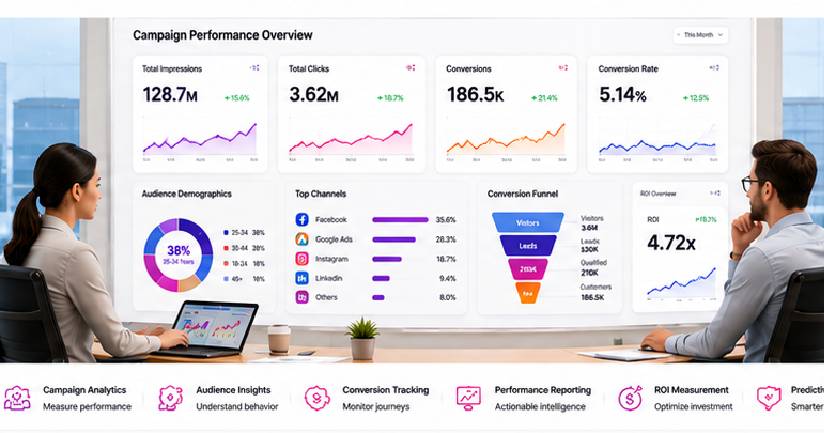
Startup Marketing Dashboards
A connected dashboard can bring together:
Website
Advertising
Social
Content
CRM
Sales
Product / Commerce Data where integrated
↓
Startup Growth Intelligence
This helps founders and marketing teams move beyond disconnected platform reports.
Founder & Executive Growth Dashboard
Leadership can receive a more focused view:
Demand
↓
Acquisition
↓
Conversion
↓
Customer
↓
Revenue
↓
Retention
↓
Growth
The objective is to make marketing information useful for business decisions.
Startup Marketing Attribution
A customer may move through:
Content → Social → Advertisement → Search → Website → Demo → Sales → Customer
Attribution can help assign contribution among marketing touchpoints according to a selected model.
But:
Attribution Assigns Contribution. It Does Not Automatically Prove Causation.
Growth Forecasting
Historical performance can support estimates around:
Traffic
Leads
Acquisition
Campaign Demand
Revenue Contribution
where sufficient data exists.
Forecasts are planning tools.
They are not guaranteed outcomes.
AI-Assisted Startup Marketing Intelligence
Turn Early Marketing Data into Faster, Better-Informed Decisions
AI can assist with appropriate analysis across:
Audience Patterns
Campaign Performance
Content Performance
Lead Behavior
Customer Journeys
Funnel Performance
Retention
Market Signals
Forecasting
The architecture becomes:
Startup Data → AI Analysis → Patterns → Insights → Human Review → Growth Decision
AI-Assisted Audience Intelligence
AI can help identify patterns across available:
Customer Data
Campaign Data
Content Engagement
CRM Activity
to support segmentation and marketing decisions.
But:
AI-Generated Segments Are Analytical Models not Absolute Definitions of Customers.
AI-Assisted Growth Does Not Mean Autonomous Growth
AI can help:
Analyze
Prioritize
Forecast
Personalize
Optimize
But startup strategy still requires:
Founder Judgment
Customer Understanding
Product Decisions
Financial Discipline
Human Creativity
The model becomes:
AI Intelligence + Human Strategy + Customer Evidence.
Startup Marketing Budget Intelligence
Limited resources make budget allocation especially important.
Brand Messenger can analyze:
Channel → Cost → Conversion → Customer Quality → Revenue Contribution
to help identify where marketing investment appears most productive.
The objective is:
Spend According to Evidence not According to Which Platform Is Most Popular.
When to Scale a Marketing Channel
A campaign working at a small budget does not automatically mean the same economics will continue at a much larger budget.
As spend increases:
Audience Quality Can Change
Frequency Can Increase
Acquisition Costs Can Rise
Inventory Can Become Less Efficient
Therefore:
Validate → Scale Carefully → Measure → Reallocate
Startup Reputation & Trust
New companies frequently need to build trust without decades of history.
Brand Messenger can strengthen credibility through:
Professional Brand Identity
Clear Website
Product Demonstrations
Customer Evidence where available
Founder Communication
Transparent Messaging
Consistent Digital Presence
The objective is not to make the startup appear older or larger than it is.
It is:
Make a New Company Look Credible Because Its Communication Is Clear, Professional and Supportable.
Startup Events
Brand Messenger's event capabilities can support:
Product Launches
Demo Events
Investor Presentations
Webinars
Community Events
Conferences
Exhibitions
The event architecture becomes:
Promotion → Registration → Experience → Follow-Up → CRM → Opportunity
Startup Launch Events
A product launch event can connect:
Brand
Product Demonstration
Founder Presentation
Media Content
Customers
Partners
Community
Brand Messenger can support physical, virtual and hybrid formats.
Startup Marketing + Multicultural Marketing
Startups entering culturally and linguistically diverse markets can connect Startup Marketing with Brand Messenger's Multicultural Marketing capabilities.
This can support:
Localization
Multilingual Campaigns
Regional Content
Cultural Adaptation
International Media
Startup Marketing + Lifestyle Marketing
Consumer startups operating across:
Fitness
Fashion
Food
Travel
Gaming
Wellness
can connect Startup Marketing with Brand Messenger's Lifestyle Marketing capabilities.
Startup Marketing + Purpose-Driven Marketing
Startups built around sustainability or social impact can connect Startup Marketing with our Purpose-Driven & ESG Marketing capabilities.
Purpose should remain connected to genuine company actions and product value.
Startup Marketing + Community Marketing
Early communities can provide:
Feedback
Education
Product Discussion
Advocacy
Customer Relationships
Community should not be treated merely as a free acquisition channel.
Privacy & Startup Marketing
Startups should establish responsible data practices before growth makes poor practices harder to correct.
Brand Messenger's marketing architecture can support:
Data Minimization
Defined Marketing Purposes
Appropriate Permissions
Preference Management
Security-Aware Integration
The principle is:
Build Responsible Marketing Infrastructure Early not After the Customer Database Becomes Difficult to Govern.
Startup Marketing Technology Architecture
A startup may evolve through:
Stage 01
Website + Analytics + Basic CRM
Stage 02
Paid Media + Email + Lead Management
Stage 03
CRM + Automation + Conversion Optimization
Stage 04
AdTech + MarTech + First-Party Data + Omnichannel
Stage 05
Revenue Analytics + Customer Intelligence
Stage 06
AI-Assisted Growth Intelligence
Technology should evolve with business complexity.
Startup Marketing Maturity Model
Level 01 — Market Discovery
Market + Customer + Problem + Positioning
Level 02 — Go-to-Market
Brand + Website + Product Launch + Initial Acquisition
Level 03 — Growth Marketing
Acquisition + Conversion + Content + CRM + Experimentation
Level 04 — Connected Startup Marketing
AdTech + MarTech + Automation + First-Party Data + Omnichannel
Level 05 — Revenue-Connected Growth
Customer → Retention → Revenue → Acquisition Economics → Growth Intelligence
Level 06 — Scale-Ready Marketing Intelligence
Connected Data + Predictive Analytics + AI Assistance + Marketing Operations + Executive BI
At this point, the organization may begin transitioning toward Brand Messenger's High-Growth & Scale-Up Marketing framework.
Complete Brand Messenger Startup Marketing Process
A comprehensive Startup Marketing engagement can follow:
Idea
↓
Market
↓
Customer Problem
↓
Research
↓
Positioning
↓
Brand
↓
Product
↓
Go-to-Market
↓
Pre-Launch
↓
Product Launch
↓
Customer Acquisition
↓
Conversion
↓
Activation
↓
CRM
↓
Retention
↓
Revenue
↓
Growth Experimentation
↓
Investor Communication
↓
Market Expansion
↓
Analytics
↓
AI-Assisted Growth Intelligence
↓
Scale Readiness
The lifecycle becomes:
Research → Position → Build → Launch → Acquire → Convert → Retain → Learn → Optimize → Expand → Scale
Across the Brand Messenger Startup Marketing Ecosystem
Market Research
Understand the Opportunity
↓
Customer Intelligence
Identify the Initial Audience
↓
Brand & Product Positioning
Define Why the Startup Matters
↓
Go-to-Market Strategy
Connect Product with Market
↓
Startup Marketing
Product Launch • Growth Marketing • Investor Communications • Market Entry
↓
Product Launch
Create Market Attention and Initial Demand
↓
Customer Acquisition
Build the Initial Customer Base
↓
Growth Marketing
Connect Acquisition, Conversion and Retention
↓
Content, Social & Community
Build Education, Discovery and Relationships
↓
AdTech
Scale Appropriate Paid Acquisition
↓
MarTech
Build Connected Customer Journeys
↓
CRM & Automation
Organize Leads and Customer Relationships
↓
Investor Communications
Present the Business Opportunity Clearly and Credibly
↓
Market Entry
Launch into New Customer and Geographic Markets
↓
Analytics & Revenue Intelligence
Connect Marketing with Business Performance
↓
AI-Assisted Startup Marketing Intelligence
Turn Early Data into Better Growth Decisions
↓
High-Growth & Scale-Up Marketing
Build the Next Stage of Marketing Infrastructure
The complete architecture becomes:
Idea → Product → Market → Customer → Revenue → Learning → Investment → Expansion → Scale
Startups We Can Support
Brand Messenger Startup Marketing can support appropriate applications across:
Technology Startups
SaaS Startups
AI Startups
Software Companies
Mobile Apps
Consumer Startups
B2B Startups
B2C Startups
E-Commerce Startups
Marketplaces
FinTech
HealthTech
EdTech
MediaTech
AdTech
MarTech
PropTech
TravelTech
FoodTech
Gaming Startups
Entertainment Startups
Sports Technology
Retail Technology
Logistics Technology
Enterprise Software
Subscription Businesses
Digital Platforms
Social Platforms
Creator Platforms
Consumer Brands
Sustainability Startups
Social Enterprises
Startups Preparing for International Expansion
Startups Transitioning toward Scale-Up Growth
Benefits of Startup Marketing
Brand Messenger can help startups:
Understand the market
Define initial target audiences
Strengthen product positioning
Build a professional startup brand
Develop value propositions
Create go-to-market strategies
Plan pre-launch marketing
Launch products
Build early demand
Acquire customers
Generate B2B leads
Develop growth marketing systems
Improve conversion funnels
Build startup CRM
Introduce marketing automation
Develop content and social strategies
Build startup communities
Create referral programs
Develop partnerships
Improve retention
Analyze acquisition economics
Connect marketing with revenue
Develop investor-facing communication
Create professional pitch materials
Prepare market-entry campaigns
Enter international markets
Build first-party customer data
Develop growth dashboards
Introduce AI-assisted marketing intelligence
Build marketing infrastructure capable of transitioning toward scale
Why Choose Brand Messenger?
Brand Messenger combines startup strategy, branding, product positioning, go-to-market, product launches, growth marketing, customer acquisition, investor communications, market entry, creative production, content, community, AdTech, MarTech, CRM, automation, analytics and AI-assisted intelligence within one connected Startup Marketing ecosystem.
We do not approach Startup Marketing as:
Create a Logo → Build Social Pages → Run Ads → Call It Growth.
We approach it as:
Understand the Market → Identify the Customer → Position the Product → Build the Brand → Design the Go-to-Market Strategy → Launch → Acquire → Convert → Retain → Measure → Learn → Communicate the Opportunity → Enter New Markets → Build for Scale.
The distinction matters.
Product Launch Marketing transforms a release into a coordinated market-entry campaign.
Growth Marketing connects acquisition, conversion, retention, experimentation and revenue.
Investor Communications help startups present their opportunity clearly and professionally without replacing financial, investment or legal expertise.
Market Entry adapts positioning, communication, media and customer acquisition for new markets.
Brand Strategy creates recognition and consistency.
Content & Community Marketing build education, trust and early relationships.
AdTech provides the infrastructure for scalable paid acquisition.
MarTech, CRM & Automation build connected customer journeys.
Revenue Marketing & Analytics connect marketing activity with customer and business outcomes.
AI-Assisted Startup Marketing Intelligence helps teams identify patterns, prioritize opportunities and make better-informed growth decisions.
And when the startup begins moving into rapid expansion, Brand Messenger High-Growth & Scale-Up Marketing can extend the architecture into larger markets, more channels, advanced marketing operations and scalable growth systems.
The result is not simply startup promotion.
It is a connected startup marketing ecosystem designed to help emerging companies move from market opportunity to product launch, from launch to customers, from customers to repeatable growth, and from early growth toward expansion and scale.
Find the Market. Position the Product. Launch the Brand. Acquire the Customer. Prove the Growth. Enter the Next Market. Build for Scale.
Product Launch. Growth Marketing. Investor Communications. Market Entry. One Connected Startup Marketing Ecosystem.