




Ambient Advertising
Turn Everyday Environments into Unexpected Brand Experiences. Capture Attention Beyond Traditional Media. Make the Surroundings Part of the Campaign.
Advertising does not always need to live inside a conventional advertising space.
Sometimes the environment itself can become the medium.
An elevator door can become part of a visual idea. An escalator can create movement within a campaign. A sidewalk can guide people toward a store, event or experience. A building façade can become a large-scale brand statement. A floor can become an interactive or directional communication surface.
This is the territory of Ambient Advertising.
Ambient Advertising uses physical spaces, architectural surfaces, public environments, retail locations, transportation areas, event venues and unexpected placements to create advertising experiences that interact with their surroundings.
At Brand Messenger, our Ambient Advertising service combines creative strategy, environmental advertising concepts, placement planning, graphic design, experiential thinking, production coordination, location strategy, campaign integration, digital extensions and measurement planning to transform ordinary environments into memorable brand touchpoints.
Our core capabilities include:
Elevator Ads
Escalator Ads
Sidewalk Graphics
Building Wraps
Floor Graphics
Our wider capabilities can include staircase advertising, wall graphics, door advertising, window graphics, mirror advertising, pillar wraps, ceiling graphics, parking-area advertising, street furniture activation, transit-environment advertising, retail environmental media, venue branding, temporary installations, projection-based activations and other context-driven advertising formats where appropriate and permitted.
The architecture becomes:
Environment → Context → Creative Idea → Placement → Interaction → Attention → Experience → Brand Memory → Action
The objective is not simply:
Find Another Surface for an Advertisement.
It is:
Use the Physical Environment Creatively So the Placement Becomes Part of the Advertising Idea.
What Is Ambient Advertising?
Ambient Advertising is a form of advertising that places brand communication within unconventional, contextual or creatively transformed physical environments.
Instead of separating the advertisement from its surroundings, Ambient Advertising can use the surroundings themselves.
A conventional poster may communicate:
Surface → Advertisement
Ambient Advertising can work as:
Environment + Placement + Context + Creative = Advertising Experience
The location is therefore not simply where the advertisement appears.
It can become part of what makes the advertisement meaningful.
Ambient Advertising Is Different from Traditional Outdoor Advertising
Traditional Out-of-Home advertising commonly uses established media formats such as:
Billboards
Posters
Transit Displays
Digital Screens
Street Furniture
Ambient Advertising can use less conventional or more context-dependent environments such as:
Floors
Walls
Elevators
Escalators
Stairs
Sidewalks
Doors
Windows
Buildings
Parking Areas
Venue Surfaces
Retail Environments
The distinction can be summarized as:
Traditional OOH
Advertising Placed in an Advertising Environment
Ambient Advertising
The Environment Becomes Part of the Advertisement
Brand Messenger can connect both approaches where a campaign benefits from them.
Ambient Advertising Is Also Different from Experiential Marketing
Ambient Advertising and Experiential Marketing can overlap, but they are not identical.
Ambient Advertising
Primarily uses:
Environment + Placement + Creative Context
Experiential Marketing
Primarily creates:
Brand + Participation + Interactive Experience
An ambient campaign can be passive yet highly creative.
An experiential campaign normally asks the audience to participate more directly.
When appropriate, Brand Messenger can combine both:
Ambient Placement → Attention → Interaction → Brand Experience
Brand Messenger Ambient Advertising Services
Our capabilities can include:
Ambient Advertising Strategy
Ambient Campaign Concepts
Environmental Advertising
Contextual Outdoor Advertising
Unconventional Advertising
Creative Placement Strategy
Location-Based Creative Strategy
Elevator Advertising
Elevator Door Advertising
Escalator Advertising
Escalator Panel Advertising
Escalator Step Advertising
Staircase Advertising
Sidewalk Graphics
Pavement Graphics
Floor Graphics
Building Wraps
Building Graphics
Façade Advertising
Wall Graphics
Window Graphics
Glass Graphics
Door Advertising
Mirror Advertising
Pillar & Column Wraps
Ceiling Graphics
Parking Garage Advertising
Parking Area Graphics
Retail Ambient Advertising
Shopping Mall Advertising
Office Building Advertising
Corporate Environment Advertising
Hospitality Ambient Advertising
Airport Environment Advertising
Transport Hub Advertising
Event Venue Advertising
Exhibition Ambient Advertising
Sports Venue Advertising
Campus Advertising
Temporary Environmental Installations
Projection-Based Advertising
Directional Advertising
Wayfinding Campaigns
Guerrilla-Style Creative Concepts where appropriate and authorized
QR-Connected Ambient Campaigns
Mobile-Connected Physical Campaigns
Social Media Extensions
User-Generated Content Campaigns
Campaign Photography & Video
Creative Production
Artwork Adaptation
Production Coordination
Installation Planning Support
Campaign Measurement
Footfall-Connected Analytics where available
QR & Digital Interaction Measurement
Location Performance Analytics
AI-Assisted Campaign Intelligence
The Brand Messenger Ambient Advertising Architecture
A connected Ambient Advertising campaign can follow:
Brand Objective
↓
Audience
↓
Environment
↓
Physical Behavior
↓
Creative Opportunity
↓
Placement
↓
Visual Interaction
↓
Attention
↓
Brand Experience
↓
Digital / Physical Action
↓
Measurement
↓
Optimization
The central principle is:
Design for the Environment not Simply for the Artwork Size.
Creative Ambient Advertising Strategy
Start with the Environment
Ambient Advertising works best when the creative idea has a meaningful relationship with its physical location.
Brand Messenger can evaluate:
Where People Walk
Where People Wait
What They See
What Direction They Move
What Surfaces Surround Them
How Long They May Be Exposed
What the Environment Already Communicates
What Physical Features Could Become Part of the Creative
The process becomes:
Observe → Understand → Imagine → Design → Place → Experience
Context Is the Creative Advantage
The same advertisement placed everywhere may create reach.
Ambient Advertising can instead ask:
What Can This Particular Environment Allow the Brand to Say or Do?
For example:
An elevator has:
Doors + Opening + Closing + Waiting
An escalator has:
Movement + Direction + Repetition
A staircase has:
Levels + Steps + Progression
A floor has:
Movement + Perspective + Proximity
A building has:
Scale + Architecture + Visibility
The physical characteristics can become part of the creative concept.
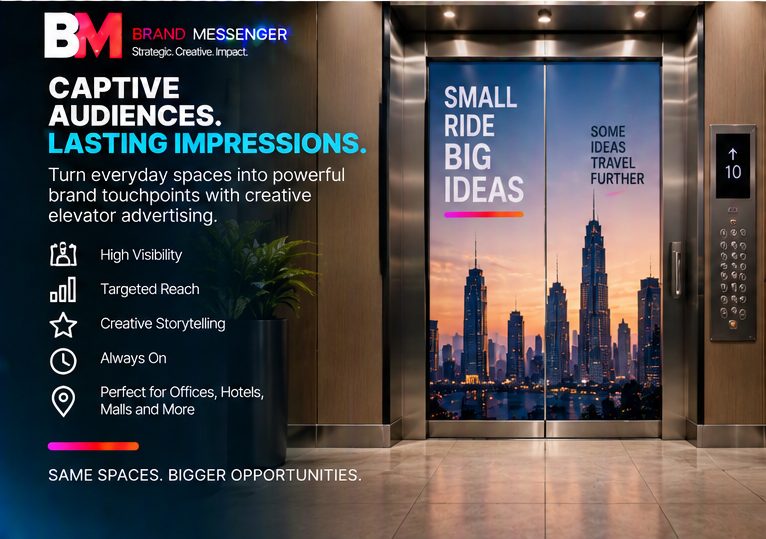
Elevator Advertising
Turn Waiting and Movement into Brand Attention
Elevators create concentrated physical environments where people may encounter advertising at close range.
Brand Messenger can develop:
Elevator Door Graphics
Interior Elevator Graphics
Elevator Wall Advertising
Lobby-to-Elevator Campaigns
Digital Elevator Creative
Interactive Elevator Concepts
The architecture can become:
Approach → Notice → Wait → Enter → Experience → Remember
Elevator Door Advertising
Elevator doors create a distinctive creative opportunity because they:
Open
and
Close.
Creative concepts can use that physical movement as part of the visual narrative where installation requirements permit.
The principle is:
Make the Movement Part of the Message.
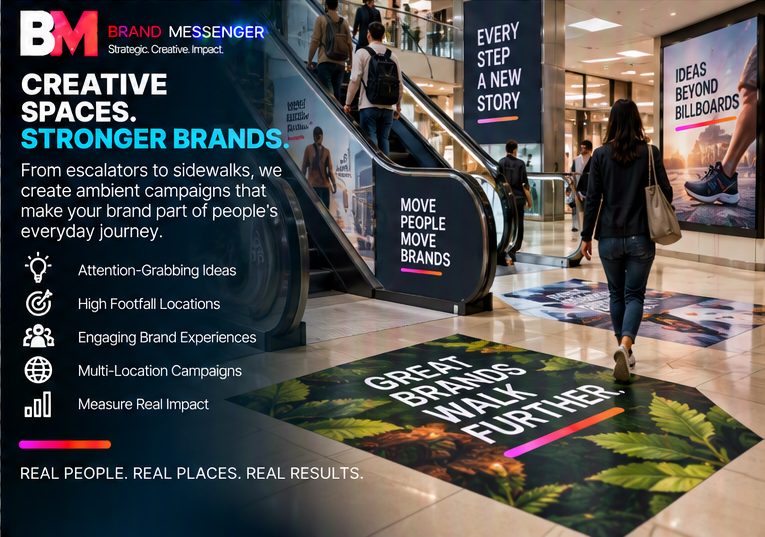
Escalator Advertising
Create Advertising That Moves with the Environment
Escalators can offer multiple potential advertising surfaces:
Side Panels
Balustrades
Nearby Walls
Entry / Exit Areas
Steps where approved
Digital Screens
Brand Messenger can develop concepts that use:
Direction
Movement
Sequence
Repetition
Perspective
The architecture becomes:
Movement → Sequence → Message → Destination
Sequential Escalator Creative
An escalator can allow a campaign to reveal a message progressively.
For example:
Visual 01 → Visual 02 → Visual 03 → Brand Message → CTA
This can transform a single advertisement into a short physical journey.
Staircase Advertising
Stairs naturally create sequential visual opportunities.
Brand Messenger can develop:
Stair-Riser Graphics
Landing Graphics
Wall Integration
Directional Campaigns
A campaign can use:
Step → Progress → Reveal → Brand
where appropriate to the concept.
Safety, visibility and surface requirements should always take priority over creative ambition.
Sidewalk Graphics
Put the Campaign Directly into the Customer's Path
Sidewalk and pavement graphics can support:
Brand Awareness
Store Direction
Event Promotion
Product Launches
Retail Campaigns
Experiential Campaigns
The journey becomes:
Walk → Notice → Follow → Discover → Act
Directional Sidewalk Advertising
Ambient advertising can combine creative communication with navigation.
For example:
Brand Message
↓
Directional Cue
↓
Destination
↓
Store / Event / Experience
This can be particularly useful around:
Retail Locations
Exhibitions
Events
Entertainment Venues
Tourism Attractions
Floor Graphics
Use the Space People Naturally Look and Walk Across
Floor advertising can operate across:
Shopping Centers
Retail Stores
Exhibitions
Airports
Stations
Events
Corporate Buildings
Brand Messenger can create:
Directional Graphics
Product Campaigns
Promotional Graphics
Interactive Floor Concepts
Perspective-Based Creative
The objective is:
Turn an Overlooked Surface into a Relevant Brand Touchpoint.
Perspective & 3D-Style Floor Creative
Some environments may support perspective-based artwork designed to create a three-dimensional visual effect from a particular viewing position.
These concepts can be particularly useful for:
Product Launches
Entertainment Campaigns
Events
Social Content
The physical viewing environment must be considered during design.
Building Wraps
Turn Architecture into Large-Scale Brand Communication
Building wraps can transform substantial architectural surfaces into campaign media.
Brand Messenger can develop:
Full Building Wrap Concepts
Partial Façade Graphics
Construction Wraps
Temporary Brand Installations
Launch Campaigns
Event Campaigns
Entertainment Campaigns
The architecture becomes:
Building → Landmark-Scale Creative → Visibility → Attention → Brand Impact
Architecture-Aware Building Creative
The strongest building campaigns do not necessarily ignore the architecture.
They can use:
Windows
Corners
Columns
Height
Shape
Perspective
as part of the creative concept.
Design with the Building not Simply Over It.
Wall Advertising
Walls can become:
Large-Format Brand Canvases
Murals
Product Displays
Campaign Installations
Interactive Visual Environments
Brand Messenger can develop creative appropriate to both indoor and outdoor spaces.
Window & Glass Advertising
Glass environments can support:
Window Graphics
Transparent Graphics
Retail Campaigns
Product Launches
Promotional Displays
Creative can integrate with the interior environment rather than completely separating the advertisement from the space behind it.
Door Advertising
Doors naturally contain movement and transition.
Ambient concepts can use:
Closed → Open
or:
Outside → Inside
as part of the campaign narrative.
Mirror Advertising
Appropriate mirror environments can create highly contextual advertising.
Potential environments can include:
Hospitality
Retail
Entertainment
Events
Creative should avoid unnecessarily intrusive or uncomfortable interactions.
Pillar & Column Advertising
Architectural columns can become:
Product-Shaped Creative
Repeating Brand Elements
Directional Advertising
Event Branding
Brand Messenger can design campaigns around the physical dimensions of the structure.
Ceiling Advertising
Some environments create natural upward sightlines.
Ceiling creative can be considered in appropriate:
Retail
Exhibition
Entertainment
Hospitality
environments.
The placement should always be evaluated according to actual audience behavior rather than novelty alone.
Parking Environment Advertising
Parking areas can provide potential touchpoints across:
Entrances
Exits
Pillars
Walls
Pedestrian Routes
Elevator Areas
These can be particularly relevant for:
Shopping Centers
Entertainment Venues
Hotels
Events
Retail
Shopping Mall Ambient Advertising
Turn the Retail Environment into a Connected Campaign Journey
Shopping centers can offer multiple surfaces:
Entrance
↓
Floor
↓
Escalator
↓
Digital Screen
↓
Pillar
↓
Storefront
↓
Retail Destination
Brand Messenger can coordinate these placements into one campaign rather than treating each surface separately.
Retail Ambient Advertising
Retail environments can connect ambient creative with:
Product Discovery
Promotions
In-Store Navigation
Product Launches
Brand Experiences
The architecture becomes:
Environment → Product Discovery → Store → Product → Purchase
Office & Corporate Environment Advertising
Appropriate corporate environments can support campaigns around:
Business Services
Technology
Financial Services
Recruitment
Professional Products
through:
Elevator Media
Lobby Media
Digital Screens
Parking Environments
Building Graphics
Audience and context should determine whether the placement is genuinely relevant.
Airport Ambient Advertising
Airports can provide environments including:
Walkways
Baggage Areas
Corridors
Escalators
Digital Displays
Retail Areas
Ambient concepts can connect naturally with appropriate:
Travel
Tourism
Hospitality
Financial Services
Technology
Luxury
Business
campaigns.
Transport Hub Ambient Advertising
Stations and transport environments can provide:
Floors
Stairs
Escalators
Walls
Corridors
Waiting Areas
Brand Messenger can design campaigns around passenger movement and dwell environments.
Event Ambient Advertising
Make the Venue Part of the Event Brand
Brand Messenger can integrate Ambient Advertising with our wider Event Marketing capabilities across:
Conferences
Exhibitions
Festivals
Product Launches
Award Shows
Corporate Events
Entertainment Events
Sports Events
The venue can become part of the campaign.
Exhibition Ambient Advertising
Exhibition environments can use:
Floor Routes
Pillars
Walls
Entrance Graphics
Overhead Elements
Directional Graphics
to help brands attract attendees toward:
Booths
Demonstrations
Experiences
The architecture becomes:
Venue → Attention → Direction → Booth → Engagement
Sports Venue Ambient Advertising
Brand Messenger can connect Ambient Advertising with our Sports Marketing capabilities across appropriate:
Stadiums
Arenas
Fan Zones
Concourses
Hospitality Areas
Creative can support:
Teams
Sponsors
Events
Merchandise
Fan Experiences
Tourism & Destination Ambient Advertising
Ambient campaigns can also connect with our Tourism & Destination Marketing capabilities.
Potential environments include:
Airports
Stations
Tourism Districts
Hotels
Attractions
Events
Campaigns can guide people from:
Arrival → Discovery → Attraction → Experience
Ambient Advertising for Product Launches
Put the New Product into the Physical Conversation
Product launches can use environmental media to create:
Surprise
Scale
Curiosity
Product Demonstration
Social Content
Brand Messenger can coordinate:
Ambient Creative + Digital Advertising + Social Media + Creator Content + Launch Event
to extend the campaign beyond the physical installation.
Ambient Advertising for Entertainment
Film, television, streaming, gaming and entertainment campaigns can benefit from highly visual environmental creative.
Potential applications can include:
Building Wraps
Floor Installations
Escalator Campaigns
Venue Transformations
Interactive Displays
subject to available rights and placement permissions.
Ambient Advertising for Fashion & Lifestyle Brands
Fashion, beauty, food, fitness and other lifestyle brands can connect Ambient Advertising with Brand Messenger's wider Lifestyle Marketing capabilities.
The environment can help turn:
Product → Lifestyle Context → Brand Experience
Ambient Advertising for Startups
Startups can use carefully selected ambient campaigns for:
Product Launches
Market Entry
Brand Awareness
Events
The objective should not be unconventional advertising simply for novelty.
The placement should support a clear marketing objective.
Ambient Advertising + Experiential Marketing
Some ambient campaigns can evolve into interactive experiences.
The architecture becomes:
Notice → Approach → Interact → Experience → Share
Brand Messenger can connect environmental advertising with:
Installations
Interactive Experiences
Events
Digital Experiences
Social Campaigns
Interactive Ambient Advertising
Where appropriate, installations can incorporate:
QR Codes
NFC
Digital Screens
Sensors
Mobile Experiences
Interactive Displays
depending on the environment and available technology.
The objective is:
Add Interaction When It Improves the Idea not Technology Simply for the Sake of Technology.
QR-Connected Ambient Campaigns
Physical creative can connect directly with digital experiences.
The journey becomes:
Physical Placement → QR Interaction → Mobile Experience → Content / Offer / Registration / Purchase
QR interactions can also provide measurable campaign signals.
Ambient-to-Mobile Marketing
Brand Messenger can connect physical placements with:
Landing Pages
Apps
Social Media
Product Pages
Event Registration
E-Commerce
This creates a bridge between:
Physical Attention and Digital Action.
Ambient Advertising + Social Media
Design Physical Advertising That Can Continue Digitally
Strong ambient creative can sometimes encourage people to:
Photograph
Record
Share
Discuss
the campaign.
Brand Messenger can plan physical creative alongside:
Social Content
Campaign Hashtags
Creator Activation
Short-Form Video
User-Generated Content
where appropriate.
The architecture becomes:
Physical Experience → Content → Social Sharing → Extended Reach
Shareability Should Not Replace Relevance
A campaign designed only to become viral can lose connection with the brand.
The principle is:
Create Something Worth Sharing Because the Brand Idea Is Strong—not Because the Installation Is Strange.
Ambient Advertising + Guerrilla Marketing
Ambient Advertising can overlap with Guerrilla Marketing when unconventional placements or unexpected creative are used.
However, Brand Messenger distinguishes:
Ambient Advertising
Environment-Led Creative Media
Guerrilla Marketing
Unconventional Attention-Generating Marketing Tactics
The two can work together where appropriate.
But unconventional does not mean unauthorized.
Creative Surprise Should Not Depend on Ignoring Property, safety or placement requirements.
Ambient Advertising + Out-of-Home
Brand Messenger can integrate Ambient Advertising with broader:
OOH
DOOH
Transit Advertising
Billboard Campaigns
The campaign can become:
Large-Scale Awareness
Contextual Ambient Experiences
Digital Media
↓
Connected Physical Advertising
Ambient Advertising + DOOH
Digital screens can extend environmental campaigns through:
Motion
Dynamic Creative
Scheduling
Contextual Messaging
where supported by the media environment.
The combination becomes:
Physical Context + Digital Creative + Campaign Intelligence
Ambient Advertising + AdTech
Ambient campaigns can connect with Brand Messenger's AdTech ecosystem through supporting digital media such as:
Programmatic Advertising
Paid Social
Display
Video
Mobile
DOOH
Remarketing
A customer journey might become:
Ambient Installation
↓
Brand Discovery
↓
Search / Social
↓
Digital Advertisement
↓
Website
↓
Conversion
This helps physical advertising participate in a broader media architecture.
Ambient Advertising + MarTech
Brand Messenger's MarTech capabilities can connect physical campaigns with:
CRM
Marketing Automation
Campaign Management
Landing Pages
Customer Journey Orchestration
Analytics
where the campaign provides an appropriate digital interaction.
For example:
Ambient Placement → QR → Registration → CRM → Follow-Up
Ambient Advertising + Brand Activation
Ambient Advertising can become part of wider:
Product Activations
Retail Activations
Event Activations
Sponsorship Activations
The physical environment can help move audiences from awareness toward participation.
Ambient Advertising Creative Production
From Concept to Physical Environment
Brand Messenger can develop:
Creative Concepts
Key Visuals
Graphic Design
Environmental Mockups
3D Visualization
Motion Concepts
Production Artwork
Format Adaptation
Installation Visual Planning
This is particularly important because physical advertising must be designed according to actual dimensions and viewing conditions.
3D Visualization & Campaign Mockups
Before large environmental installations are produced, Brand Messenger can create visualization showing how creative may appear in the proposed environment.
This can support:
Client Approval
Sponsor Approval
Production Planning
Presentation
Campaign Development
The architecture becomes:
Concept → Visualization → Review → Production Preparation
Format Adaptation
A campaign may need to work across:
Elevator
Escalator
Floor
Wall
Building
Digital Screen
Social Media
Brand Messenger can adapt the central campaign idea while respecting the characteristics of each format.
One Campaign Idea. Multiple Environmental Expressions.
Location Strategy
The Right Idea in the Wrong Place Is Still the Wrong Placement
Ambient Advertising should consider:
Audience
Footfall
Dwell Time
Viewing Direction
Visibility
Context
Environment
Campaign Objective
High traffic alone does not guarantee a valuable placement.
The question is:
Are the Right People Likely to Encounter the Message in a Context Where It Makes Sense?
Footfall & Exposure Intelligence
Where reliable data is available, Brand Messenger can use:
Footfall
Traffic
Location
Time
Campaign Interaction
to help evaluate placements.
Estimated exposure should remain clearly distinguished from verified individual attention.
Passing a Placement Does Not Automatically Mean Seeing the Advertisement.
Ambient Advertising Measurement
Physical campaigns can be more difficult to attribute than fully digital campaigns.
Brand Messenger can develop measurement frameworks using appropriate combinations of:
QR Interactions
Landing Page Visits
Promo Codes
Event Registrations
Store Visits where appropriately measurable
Campaign Search Activity
Social Engagement
User-Generated Content
Sales Signals
Footfall Data
Brand Studies where available
The measurement architecture becomes:
Exposure Signal → Interaction → Digital Activity → Defined Outcome
Ambient Advertising Attribution
A customer may encounter:
Building Wrap → Social Post → Search → Website → Purchase
Attribution can help connect available touchpoints.
However:
Exposure to an Ambient Advertisement Does Not Automatically Prove That the Advertisement Caused the Purchase.
Measurement should reflect what the available data can actually support.
Location Performance Dashboard
Brand Messenger can organize available campaign information across:
Locations
Formats
Footfall Signals
QR Interactions
Digital Campaigns
Conversions
↓
Ambient Campaign Intelligence
This can help compare campaign environments without pretending every physical exposure can be individually tracked.
AI-Assisted Ambient Advertising Intelligence
AI can assist Brand Messenger teams with analysis across:
Location Performance
Creative Performance
Campaign Interaction
Digital Response
Time-Based Patterns
Audience Signals
The architecture becomes:
Campaign Data → AI Analysis → Patterns → Insights → Human Review → Marketing Decision
AI-Assisted Creative Analysis
AI can help identify patterns across:
Creative Variations
Locations
Digital Interactions
Campaign Responses
to support future creative development.
However:
The Highest-Performing Historical Design Is Not Automatically the Best Creative Idea for the Next Environment.
Human creative judgment remains central to Ambient Advertising.
Safety by Design
Creative Advertising Should Never Create Physical Risk
Ambient installations should be designed with the physical environment in mind.
Particular attention may be required around:
Floors
Stairs
Escalators
Doors
Entrances
Exits
Transport Areas
Emergency Routes
Creative should never unnecessarily:
Obstruct Movement
Hide Safety Information
Confuse Navigation
Create Slip or Trip Risks
Interfere with Emergency Signage
The principle is:
Attention Should Come from Creativity not from Creating a Hazard.
Permissions & Property Authorization
Ambient Advertising often uses property or infrastructure controlled by third parties.
Campaigns may therefore require appropriate authorization from:
Property Owners
Venue Operators
Media Owners
Building Management
Local Authorities
Transport Operators
Other Relevant Parties
depending on the location and jurisdiction.
Brand Messenger can develop campaign concepts around authorized environments and available media opportunities.
Responsible Ambient Advertising
Brand Messenger's approach is built around:
Relevance
Use environments where the campaign makes sense.
Creativity
Make the placement part of the idea.
Safety
Do not compromise safe movement or visibility.
Authorization
Use physical environments with appropriate permissions.
Accessibility
Avoid unnecessarily interfering with accessibility and navigation.
Brand Integrity
Create attention without undermining the brand.
Environmental Responsibility
Consider materials, duration and disposal where relevant.
Privacy
Use measurement technology responsibly.
Human Oversight
Keep strategic and creative decisions under professional review.
Temporary vs Permanent Ambient Installations
Campaigns can be designed for:
Short-Term
Product Launch
Event
Promotion
Entertainment Release
Seasonal
Holiday Campaign
Tourism Season
Retail Period
Longer-Term
Venue Branding
Corporate Environment
Retail Environment
Materials and production planning can be adapted according to campaign duration and environment.
Ambient Advertising Maturity Model
Level 01 — Surface Advertising
Floor + Wall + Elevator + Basic Graphics
Level 02 — Contextual Ambient Advertising
Environment + Creative Concept + Placement Strategy
Level 03 — Connected Environmental Campaigns
Multiple Locations + Multiple Formats + Social Extension
Level 04 — Interactive Ambient Advertising
Physical Media + QR / Mobile + Digital Experience + Campaign Integration
Level 05 — Measurable Ambient Marketing
Location + Interaction + Digital Response + Conversion Signals + Analytics
Level 06 — Intelligent Physical-Digital Advertising
Ambient + DOOH + AdTech + MarTech + Analytics + AI-Assisted Campaign Intelligence
The objective is not:
Put Advertising on More Surfaces.
It is:
Transform Relevant Physical Environments into Creative, Connected and Measurable Brand Experiences.
Complete Brand Messenger Ambient Advertising Process
A comprehensive Ambient Advertising engagement can follow:
Business Objective
↓
Campaign Strategy
↓
Audience
↓
Environment Research
↓
Location
↓
Physical Context
↓
Creative Opportunity
↓
Concept Development
↓
Environmental Visualization
↓
Format Design
↓
Permissions & Production Requirements
↓
Production Coordination
↓
Installation
↓
Physical Experience
↓
Digital Extension
↓
Social Amplification
↓
Measurement
↓
Campaign Intelligence
↓
Learning & Optimization
The lifecycle becomes:
Observe → Imagine → Design → Place → Surprise → Engage → Connect → Measure → Learn
Across the Brand Messenger Ambient Advertising Ecosystem
Brand Strategy
Define the Campaign Objective
↓
Audience Intelligence
Understand Who the Environment Needs to Reach
↓
Location Strategy
Identify Relevant Physical Environments
↓
Creative Strategy
Turn Environmental Features into Advertising Opportunities
↓
Ambient Advertising
Elevator Ads • Escalator Ads • Sidewalk Graphics • Building Wraps • Floor Graphics
↓
Environmental Design
Adapt Creative to Physical Space
↓
3D Visualization
Preview the Campaign Before Production
↓
Production & Installation Coordination
Prepare the Physical Execution
↓
Experiential Marketing
Add Participation Where Appropriate
↓
OOH & DOOH
Extend Physical Reach
↓
Social & Content Marketing
Turn Physical Experiences into Digital Conversation
↓
AdTech
Extend Campaign Reach Across Paid Digital Media
↓
MarTech
Connect Physical Interactions with Digital Journeys
↓
Analytics
Measure Available Exposure and Interaction Signals
↓
AI-Assisted Campaign Intelligence
Turn Campaign Data into Better Future Decisions
The complete architecture becomes:
Space → Context → Creative → Attention → Experience → Interaction → Digital Connection → Brand Memory → Action → Intelligence
Environments We Can Support
Brand Messenger Ambient Advertising can support appropriate applications across:
Shopping Malls
Retail Stores
Office Buildings
Corporate Towers
Hotels
Resorts
Airports
Transport Hubs
Railway / Metro Environments
Parking Facilities
Exhibition Centers
Conference Venues
Event Venues
Stadiums
Arenas
Entertainment Venues
Tourism Attractions
Museums
Universities & Campuses
Commercial Districts
Hospitality Environments
Authorized Public Spaces
Other Suitable Private and Public Environments
Industries We Can Support
Ambient Advertising can be developed for appropriate campaigns across:
Retail
Consumer Products
Fashion
Beauty
Food & Beverage
Technology
Telecommunications
Automotive
Financial Services
Real Estate
Hospitality
Tourism
Entertainment
Film & Streaming
Gaming
Sports
Healthcare
Education
Events
Startups
Corporate Brands
B2B Brands
Lifestyle Brands
Benefits of Ambient Advertising
Brand Messenger can help organizations:
Reach audiences beyond conventional advertising formats
Transform physical environments into brand media
Create contextually relevant campaigns
Generate stronger visual attention
Develop memorable physical brand experiences
Use architecture as part of creative storytelling
Build elevator advertising campaigns
Develop escalator advertising
Create sidewalk and pavement campaigns
Produce floor graphics
Design building wraps
Develop wall and window graphics
Build retail environmental campaigns
Create venue advertising
Connect ambient campaigns with events
Support product launches
Connect physical campaigns with mobile experiences
Add QR-based interactions
Extend campaigns through social media
Coordinate Ambient Advertising with OOH and DOOH
Connect physical campaigns with AdTech
Integrate campaign interactions with MarTech
Develop measurement frameworks
Compare location performance
Apply AI-assisted campaign intelligence
Build connected physical-digital advertising experiences
Why Choose Brand Messenger?
Brand Messenger combines brand strategy, advertising strategy, creative development, environmental design, 3D visualization, physical media, experiential marketing, OOH, DOOH, digital advertising, social media, AdTech, MarTech, analytics and AI-assisted intelligence within one connected Ambient Advertising ecosystem.
We do not approach Ambient Advertising as:
Find an Empty Surface → Put an Advertisement on It → Call It Ambient Media.
We approach it as:
Understand the Audience → Study the Environment → Identify the Physical Opportunity → Develop the Creative Idea → Make the Environment Part of the Message → Design for the Actual Space → Coordinate Production → Connect Physical and Digital Experiences → Measure → Learn.
The distinction matters.
Elevator Advertising transforms enclosed movement and waiting environments into close-range brand touchpoints.
Escalator Advertising uses movement, sequence and direction as part of the campaign.
Sidewalk Graphics place brand communication directly into pedestrian journeys.
Floor Graphics turn overlooked surfaces into creative, directional and promotional media.
Building Wraps transform architecture into large-scale brand communication.
Wall, Window, Door and Pillar Advertising use existing physical structures as contextual creative opportunities.
Retail & Venue Ambient Advertising connects environmental communication with customer and visitor experiences.
Experiential Marketing can add participation to ambient campaigns.
OOH & DOOH can extend the campaign across wider physical media networks.
Social Media & Content can carry memorable physical experiences into digital conversations.
AdTech can extend physical campaign awareness through digital media.
MarTech can connect appropriate physical interactions with customer journeys.
Analytics help organizations understand measurable interaction and location signals.
And AI-Assisted Ambient Advertising Intelligence can help identify patterns across locations, creative and campaign response while keeping strategic and creative decisions under human oversight.
The result is not simply unconventional advertising.
It is a connected Ambient Advertising ecosystem designed to transform elevators, escalators, floors, sidewalks, buildings and other relevant environments into creative brand experiences that people encounter as part of the world around them.
Use the Space. Transform the Environment. Create the Surprise. Capture the Attention. Connect the Experience. Make the Brand Memorable.
Elevator Ads. Escalator Ads. Sidewalk Graphics. Building Wraps. Floor Graphics. One Connected Ambient Advertising Ecosystem.