





Turn More Visits into Action. Remove Friction. Improve Every Digital Experience.
Driving traffic is only part of digital marketing performance.Organizations may invest heavily in advertising, SEO, social media, content, email, campaigns, and lead generation, but those investments lose value when visitors arrive at a digital experience and fail to take the intended next step.
A visitor may abandon a landing page. A potential lead may leave an unnecessarily complicated form. An e-commerce customer may exit during checkout. A high-intent prospect may struggle to find relevant information. Different audiences may receive exactly the same experience even though their needs and behaviors are different.
At Brand Messenger, our Conversion & Experience Optimization services help organizations understand digital behavior, identify friction, test improvements, personalize experiences, and continuously increase the effectiveness of websites, landing pages, forms, funnels, checkout processes, and customer journeys.
From Conversion Rate Optimization, Landing Page Optimization, A/B Testing, and Multivariate Testing to Form Optimization, Checkout Optimization, Website Personalization, User Behavior Analysis, Heatmaps, and Experience Optimization, we connect customer intelligence with systematic experimentation and measurable improvement.
Our approach connects:
Traffic → Experience → Behavior → Insight → Hypothesis → Test → Conversion → Learning → Optimization
Understand the Experience. Remove the Friction. Increase the Conversion.
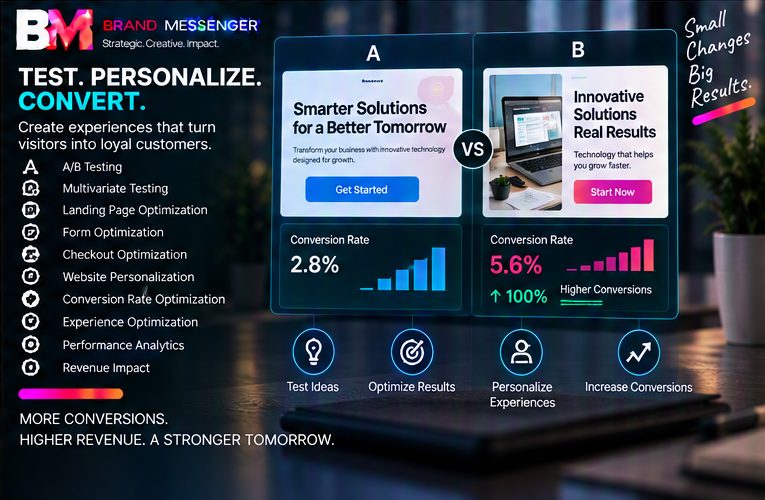
Our Conversion & Experience Optimization Services
Brand Messenger provides comprehensive Conversion & Experience Optimization capabilities, including:
Conversion Rate Optimization
Landing Page Optimization
A/B Testing
Multivariate Testing
Form Optimization
Checkout Optimization
Website Personalization
User Behavior Analysis
Heatmaps
Experience Optimization
Funnel Optimization
Conversion Journey Analysis
User Flow Analysis
Drop-Off Analysis
Call-to-Action Optimization
Content & Message Testing
Mobile Experience Optimization
Page Experience Analysis
Behavioral Segmentation
Customer Journey Optimization
Lead Conversion Optimization
E-Commerce Conversion Optimization
Experiment Management
Personalization Testing
Conversion Analytics
AI-Assisted Optimization
Conversion Performance Dashboards
Conversion Rate Optimization
Increase the Value of Existing Traffic
Conversion Rate Optimization or CRO is the structured process of improving digital experiences so a greater proportion of relevant visitors complete meaningful business actions.
Depending on the organization, a conversion may include:
Making a Purchase
Submitting a Lead Form
Requesting a Quote
Booking a Demo
Registering an Account
Starting a Trial
Scheduling an Appointment
Downloading Content
Joining a Mailing List
Registering for an Event
Contacting Sales
Completing an Application
Renewing a Subscription
Upgrading a Service
Brand Messenger approaches CRO as more than changing button colors or headlines.
We connect:
Behavioral Data + Customer Journey + Experience Analysis + Experimentation + Conversion Analytics
to identify where meaningful improvements may be possible.
Conversion Strategy
Define What Conversion Means Before Optimizing It
Not every website has the same objective, and not every customer journey should be optimized toward an immediate sale.
Brand Messenger can establish conversion strategies around:
Primary Conversions
Secondary Conversions
Micro-Conversions
Customer Journey Stages
Funnel Objectives
Lead Generation
E-Commerce
Customer Acquisition
Customer Activation
Customer Retention
Revenue Outcomes
For example:
Visit → Product View → Add to Cart → Checkout → Purchase
or:
Visit → Content Engagement → Lead Form → MQL → Sales → Customer
Each stage can be measured and optimized independently while remaining connected to the wider business objective.
Conversion Funnel Optimization
Improve Every Stage not Just the Final Conversion
A conversion funnel can lose customers at multiple points.
Brand Messenger can analyze funnels such as:
Visitor → Landing Page → Engagement → Form → Lead → Qualified Lead
or:
Product View → Cart → Checkout → Payment → Purchase
or:
Free Trial → Product Engagement → Subscription → Renewal
Funnel Optimization can identify:
High Drop-Off Stages
Low-Engagement Steps
Weak Conversion Points
Journey Friction
Form Abandonment
Checkout Abandonment
Content Gaps
Navigation Problems
Unclear Calls to Action
Mobile Experience Issues
The objective is to understand exactly where customers stop progressing and what can be improved.
Landing Page Optimization
Turn Campaign Traffic into Meaningful Action
Landing pages are often the connection between marketing investment and customer action.
Brand Messenger can optimize landing pages used for:
Paid Advertising
Lead Generation
Product Campaigns
Service Campaigns
Promotional Offers
Events
Webinars
Content Downloads
Demo Requests
Quote Requests
Product Launches
Account-Based Marketing
Email Campaigns
Social Campaigns
Landing Page Optimization can examine:
Value Proposition
Headlines
Supporting Copy
Calls to Action
Page Structure
Visual Hierarchy
Forms
Trust Elements
Content Length
Product Information
Mobile Experience
Page Flow
Conversion Paths
The goal is to create greater alignment between customer intent, campaign message, landing-page experience, and conversion objective.
Message-to-Landing-Page Alignment
Continue the Customer Experience After the Click
A customer should not click an advertisement promising one thing and arrive at a page presenting something unrelated.
Brand Messenger can help maintain continuity across:
Ad Message → Landing Page Message → Offer → CTA → Conversion
This can improve the relevance of the post-click experience and reduce unnecessary customer confusion.
A/B Testing
Test Ideas Against Real Customer Behavior
Marketing decisions should not always depend on assumptions.
A/B Testing allows organizations to compare different versions of a digital experience.
For example:
Version A → Existing Headline
versus
Version B → Alternative Headline
Testing can be applied to:
Headlines
Calls to Action
Landing Page Layouts
Images
Offers
Forms
Product Messages
Pricing Presentation
Navigation
Content
Email Elements
Campaign Experiences
Checkout Elements
Performance can then be evaluated against defined conversion or engagement objectives.
Structured Experimentation
Build a Repeatable Optimization Process
Brand Messenger can help organizations establish an experimentation framework:
Observe → Identify Problem → Develop Hypothesis → Create Variation → Test → Measure → Learn → Implement
A hypothesis might be:
"Reducing unnecessary fields in this lead form may improve completion."
The experiment can then test whether actual customer behavior supports the hypothesis.
This creates a more disciplined optimization process than making uncontrolled website changes.
Multivariate Testing
Understand How Multiple Experience Elements Work Together
A/B testing typically compares a limited number of versions.
Multivariate Testing can examine combinations of multiple elements where sufficient traffic and appropriate testing conditions exist.
Elements might include:
Headline
Hero Image
CTA
Offer
Page Layout
Product Message
Supporting Content
For example:
Headline A + Image A + CTA A
can be compared with other combinations to identify stronger experience configurations.
Multivariate testing is particularly useful where organizations have sufficient traffic to support more complex experimentation.
Experiment Management
Turn Individual Tests into an Optimization Program
Organizations running many experiments need a structured way to manage them.
Brand Messenger can establish Experiment Management around:
Experiment Name
Business Objective
Hypothesis
Target Audience
Experience
Variations
Conversion Metric
Start & End Dates
Experiment Status
Results
Findings
Recommended Action
Implementation Status
This creates a reusable institutional record of what was tested, what was learned, and what should happen next.
Form Optimization
Reduce Friction Between Customer Interest and Lead Capture
Forms are one of the most important conversion points for many organizations.
An interested visitor can quickly abandon an experience when a form is too long, confusing, poorly structured, or requests information that does not appear necessary.
Brand Messenger can analyze:
Number of Fields
Required Fields
Field Sequence
Form Layout
Labels
Instructions
Calls to Action
Error Messages
Mobile Usability
Multi-Step Forms
Progressive Data Collection
Form Completion
Form Abandonment
The objective is to balance the organization's need for useful customer information with the customer's need for a simple experience.
Lead Form Optimization
Improve the Journey from Visitor to Qualified Lead
Form optimization can also connect with Brand Messenger's Lead Management & Revenue Marketing capabilities.
The process can become:
Visitor → Form → Lead Capture → CRM → Lead Score → Qualification → MQL → Sales
Instead of optimizing only for the number of submissions, organizations can also evaluate lead quality and downstream conversion.
A form generating fewer but stronger qualified opportunities may sometimes create greater business value than one producing a large number of low-quality submissions.
Checkout Optimization
Reduce Friction at the Most Valuable Point in the Journey
Customers who reach checkout have already demonstrated meaningful purchase intent.
Checkout abandonment can therefore represent a significant lost opportunity.
Brand Messenger can analyze checkout experiences around:
Checkout Steps
Cart Experience
Account Requirements
Guest Checkout
Form Complexity
Shipping Information
Delivery Information
Payment Flow
Error Handling
Mobile Checkout
Order Review
Confirmation
Trust & Clarity
Abandonment Points
The objective is to make the purchase journey clearer and easier while maintaining required business and transactional controls.
Cart & Checkout Journey Analysis
Understand Where Purchase Intent Is Lost
The e-commerce journey can be analyzed as:
Product View → Add to Cart → Cart → Checkout → Payment → Purchase
Brand Messenger can measure conversion between stages and identify where customers leave.
This can support:
Cart Optimization
Checkout Optimization
Abandonment Analysis
Remarketing
Re-Engagement
Product Recommendations
Customer Journey Optimization
This connects conversion technology with the wider MarTech and AdTech ecosystem.
Website Personalization
Create More Relevant Experiences for Different Visitors
Different customers arrive with different needs, interests, histories, and lifecycle stages.
Brand Messenger can connect websites with CRM, CDP, first-party data, behavioral analytics, and AI-assisted personalization to create more relevant experiences where appropriate.
Personalization can include:
Headlines
Hero Content
Product Recommendations
Service Recommendations
Offers
Calls to Action
Content
Landing Pages
Customer Resources
Promotions
Navigation Priorities
Customer Journey Experiences
The model becomes:
Customer Context → Relevant Experience → Customer Response → Updated Intelligence
Audience-Based Personalization
Create Different Experiences for Different Customer Segments
Website experiences can be adapted for segments such as:
New Visitors
Returning Visitors
Existing Customers
High-Value Customers
Prospects
Qualified Leads
Product-Interest Segments
Geographic Segments
Account-Based Audiences
Inactive Customers
For example:
New Visitor → Brand & Product Introduction
Returning Prospect → Relevant Product Content
Existing Customer → Customer Resources
High-Intent Prospect → Demo or Sales CTA
This creates greater relevance without requiring entirely separate websites.
Behavioral Personalization
Let Customer Actions Influence the Experience
Brand Messenger can use appropriate behavioral signals to help determine experience changes.
Signals can include:
Pages Viewed
Products Viewed
Previous Visits
Content Engagement
Campaign Source
Search Activity
Customer Journey Stage
Previous Conversions
Product Interest
The experience can then adapt according to current customer context.
User Behavior Analysis
Understand What Visitors Do Between Arrival and Conversion
Traditional analytics may show that a visitor arrived and later left.
User Behavior Analysis helps investigate what happened between those points.
Brand Messenger can analyze:
Page Views
Navigation Paths
Click Behavior
Scroll Behavior
Interaction Patterns
Repeat Visits
Product Views
Content Engagement
Form Interaction
Funnel Progression
Exit Behavior
Conversion Paths
This helps reveal areas where users engage, hesitate, become confused, or abandon the journey.
User Flow Analysis
See How Customers Actually Navigate Digital Experiences
The path imagined by the marketing team may not be the path customers actually follow.
Brand Messenger can analyze flows such as:
Homepage → Service → Case Study → Contact
or:
Advertising → Landing Page → Product → Pricing → Demo
or:
Search → Article → Product → Form → Lead
User Flow Analysis can identify:
Common Paths
Unexpected Paths
Dead Ends
High-Exit Pages
Conversion Routes
Navigation Problems
Journey Loops
High-Performing Paths
This provides a stronger foundation for experience optimization.
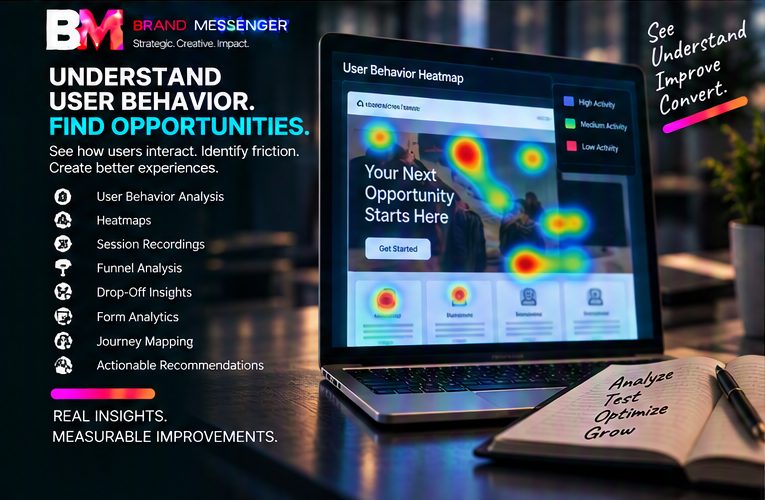
Heatmaps
Visualize Where Users Focus and Interact
Heatmaps can provide visual insight into how users interact with digital pages.
Depending on the analytics technology used, heatmap analysis can include:
Click Heatmaps
Scroll Heatmaps
Interaction Maps
Attention Patterns
Element Engagement
Page Depth
CTA Interaction
Navigation Interaction
Heatmaps can help answer questions such as:
Are visitors seeing the primary CTA?
How far down the page are users scrolling?
Which elements attract interaction?
Are customers interacting with non-clickable elements?
Which sections appear to receive limited engagement?
Heatmap findings can then become hypotheses for structured testing.
Session & Interaction Analysis
Understand Experience Problems in Greater Context
Where appropriate analytics technology is implemented and configured in line with applicable privacy requirements, interaction analysis can help identify recurring experience problems.
This can help teams investigate:
Repeated Navigation Difficulty
Form Friction
Confusing Interface Elements
Checkout Problems
Mobile Experience Issues
Unexpected Customer Behavior
The purpose is to identify patterns not simply observe isolated interactions.
Drop-Off Analysis
Find Where Customers Stop Moving Forward
Every customer journey contains potential drop-off points.
Brand Messenger can analyze transitions such as:
Landing Page → CTA
CTA → Form
Form Start → Form Completion
Product → Cart
Cart → Checkout
Checkout → Purchase
Trial → Paid Subscription
Lead → MQL
Drop-Off Analysis helps identify which stages require deeper investigation.
The process becomes:
Journey → Drop-Off → Behavioral Analysis → Hypothesis → Test → Optimization
Call-to-Action Optimization
Make the Next Step Clear
Calls to action help customers understand what to do next.
Brand Messenger can test and optimize:
CTA Wording
CTA Position
CTA Hierarchy
CTA Visibility
Supporting Message
Number of CTAs
Mobile CTA Experience
Primary vs. Secondary Actions
Examples may include:
Request a Demo
Request a Quote
Start Your Trial
Contact Sales
Learn More
Buy Now
The strongest CTA depends on the customer's intent and journey stage.
Mobile Conversion Optimization
Optimize for Customers Who Experience the Brand on Smaller Screens
Mobile visitors may experience entirely different usability and conversion challenges.
Brand Messenger can analyze:
Mobile Navigation
Page Layout
Form Experience
CTA Visibility
Content Hierarchy
Checkout
Page Interaction
Touch Targets
Mobile Customer Journeys
Mobile optimization should be considered throughout the complete conversion process rather than treated as a simple resized desktop experience.
Experience Optimization
Improve the Entire Experience not Just Individual Pages
Conversion is influenced by the complete customer experience.
Brand Messenger can examine:
Website Experience
Landing Pages
Navigation
Content
Search
Product Discovery
Forms
Customer Portals
Mobile Experiences
Checkout
Customer Journeys
Campaign Experiences
Experience Optimization connects customer behavior, customer intelligence, experimentation, personalization, and conversion analytics to create continuous improvement.
Customer Journey Experience Optimization
Optimize Across Touchpoints
Customers often interact with multiple experiences before converting.
For example:
Advertising → Landing Page → Website → Email → Product Page → Form → Sales
Optimizing only the landing page may overlook friction elsewhere.
Brand Messenger can connect Conversion & Experience Optimization with Customer Journey Orchestration to identify opportunities throughout the wider journey.
This allows optimization to consider both individual experiences and how those experiences work together.
Customer Intelligence & Conversion Optimization
Brand Messenger's Customer Intelligence & Behavioral Analytics capabilities can provide the analytical foundation for optimization.
The connection can operate as:
Customer Behavior → Analytics → Insight → Optimization Hypothesis → Experiment → Result
Behavioral intelligence can reveal:
High-Engagement Segments
Conversion Patterns
Customer Intent
Journey Drop-Off
Content Interest
Channel Behavior
Customer Friction
Conversion Paths
This helps prioritize optimization opportunities based on customer behavior rather than assumptions.
AI-Assisted Conversion Intelligence
Use AI to Discover Patterns and Optimization Opportunities
Brand Messenger can connect Conversion & Experience Optimization with its AI Marketing & Personalization capabilities.
AI-assisted analysis can support:
Conversion Pattern Analysis
Behavioral Segmentation
Purchase Intent Prediction
Drop-Off Risk
Customer Propensity
Experience Personalization
Next-Best Action
Product Recommendations
Content Recommendations
Experiment Analysis
Conversion Forecasting
Optimization Opportunity Identification
The objective is to use AI as an additional intelligence layer within a controlled optimization process.
Predictive Experience Optimization
Anticipate What Different Customers May Need
Where appropriate data is available, predictive intelligence can help identify customers with different probabilities of taking certain actions.
For example:
High Purchase Intent → Product-Focused Experience
Low Engagement → Simplified Journey
Returning Customer → Relevant Customer Content
High-Value Customer → Personalized Experience
Likely-to-Churn Customer → Retention Experience
This creates a bridge between predictive intelligence and experience personalization.
Conversion & Marketing Automation
Marketing Automation can respond when customers complete---or fail to complete---important conversion actions.
For example:
Form Completed → Lead Nurturing
Cart Abandoned → Recovery Journey
Demo Requested → Sales Notification
Trial Started → Onboarding Journey
Customer Inactive → Re-Engagement Journey
This allows conversion events to trigger appropriate downstream customer experiences.
Conversion & CRM
CRM integration can help organizations measure what happens after a digital conversion.
A lead-form submission is not necessarily the final business outcome.
The wider process can become:
Website Conversion → Lead → CRM → MQL → SQL → Opportunity → Customer → Revenue
This allows Brand Messenger to connect front-end conversion optimization with downstream lead quality and revenue performance.
Conversion & Customer Data Platform
A Customer Data Platform can provide customer context behind personalization and optimization.
Brand Messenger can connect:
First-Party Data → CDP → Unified Customer Profile → Segment → Personalized Experience → Conversion
Customer responses can then return to the data environment:
Experience → Behavior → Updated Profile → New Intelligence → Next Experience
This creates a continuous optimization loop.
Conversion & Content Marketing Technology
Content strongly influences conversion.
Brand Messenger can connect Content Marketing Technology with conversion intelligence to understand:
Which Content Generates Leads
Which Content Supports Conversion
Which Product Information Creates Engagement
Which Messages Perform Better
Which Content Creates Drop-Off
Which Customer Segments Prefer Which Content
Content can then be tested, personalized, and optimized according to performance.
Conversion & Campaign Management Technology
Campaign performance does not end when a customer clicks.
Brand Messenger can connect campaign technology with post-click optimization:
Campaign → Landing Page → Customer Behavior → Conversion → Revenue
This helps campaign teams understand whether weak performance originates from:
Audience
Creative
Campaign Message
Landing Page
Offer
Form
Customer Journey
Checkout
Follow-Up
This creates a more complete campaign optimization framework.
Conversion & Lead Management
Brand Messenger's Lead Management & Revenue Marketing capabilities allow conversion performance to be evaluated beyond raw form submissions.
The full journey can be measured as:
Visitor → Conversion → Lead → MQL → SQL → Opportunity → Revenue
This is important because the highest-converting experience is not always the experience producing the highest-quality customers.
Optimization can therefore consider:
Conversion Volume + Lead Quality + Pipeline + Revenue
Connecting MarTech Conversion with AdTech
Improve the Experience After Paid Media Generates the Click
Brand Messenger's AdTech capabilities can bring customers to digital experiences through:
Search Advertising
Social Advertising
Display
Programmatic
Video
Native
Retargeting
Other Paid Media
Conversion & Experience Optimization helps improve what happens after those customers arrive.
The relationship becomes:
AdTech → Audience → Advertisement → Landing Page → Experience → Conversion → Revenue → Attribution → Optimization
This creates a stronger connection between media investment and post-click performance.
Experimentation & AdTech Optimization
Advertising and landing-page testing can also operate together.
For example:
Ad Creative A → Landing Page A
versus:
Ad Creative B → Landing Page B
Performance can then be evaluated across:
Click-Through
Engagement
Conversion
Lead Quality
Customer Acquisition
Revenue
ROAS where measurable
This helps optimize the complete advertising-to-conversion experience rather than optimizing advertising and landing pages independently.
Conversion Analytics
Measure What Happens at Every Stage
Brand Messenger can build analytics around:
Traffic
Visitors • Sessions • Sources • Campaigns
Engagement
Page Views • Scroll • Clicks • Interaction • Content
Funnel
Entry • Progression • Drop-Off • Completion
Leads
Forms • Lead Conversion • MQL • SQL
Commerce
Product Views • Cart • Checkout • Purchase
Experience
User Flows • Heatmaps • Behavioral Patterns • Friction
Testing
Experiments • Variants • Conversion Performance • Findings
Revenue
Opportunities • Customers • Revenue • Attribution
This provides a complete view from visitor behavior to business outcomes.
Conversion & Experience Dashboards
Turn Optimization Data into Actionable Intelligence
Brand Messenger can develop dashboards for marketing, digital, e-commerce, customer experience, product, and executive teams.
Conversion Performance
Visitors • Conversions • Conversion Rate • Trend
Funnel Intelligence
Entry • Progression • Drop-Off • Completion
Landing Pages
Traffic • Engagement • CTA • Forms • Conversion
User Behavior
Clicks • Scroll • Navigation • Interaction • Exit
Experiments
Active Tests • Variants • Performance • Results
Personalization
Segments • Experiences • Engagement • Conversion
Lead & Revenue
Leads • MQLs • SQLs • Opportunities • Revenue
Executive Experience Intelligence
Traffic • Conversion • Customer Acquisition • Revenue • Optimization Opportunities
This connects digital experience metrics with wider marketing and business performance.
Continuous Experience Optimization
Build an Ongoing Improvement Cycle
Conversion optimization should not be treated as a one-time website project.
Customer behavior changes.
Campaigns change.
Products change.
Markets change.
Devices change.
Customer expectations change.
Brand Messenger can establish an ongoing optimization cycle:
Measure → Observe → Analyze → Prioritize → Hypothesize → Test → Learn → Implement → Measure Again
This creates a culture of continuous improvement across digital marketing and customer experience.
Conversion & Experience Optimization Across Brand Messenger MarTech
Conversion & Experience Optimization can operate as the experimentation and performance improvement layer across the Brand Messenger MarTech ecosystem.
It can connect with:
Marketing Automation
CRM & Customer Management Technology
Customer Data Platform & First-Party Data
Omnichannel Marketing Technology
Customer Journey Orchestration
AI Marketing & Personalization
Customer Intelligence & Behavioral Analytics
Campaign Management Technology
Content Marketing Technology
Lead Management & Revenue Marketing
Marketing Analytics
Marketing Dashboards & Business Intelligence
MarTech Integration & Data Infrastructure
Brand Messenger AdTech
Together:
Customer Data → Experience → Behavior → Intelligence → Experiment → Personalization → Conversion → Revenue → Learning → Optimization
Conversion Optimization Across the Customer Lifecycle
Discover
Optimize Campaign Landing Experiences
Engage
Improve Content, Navigation & Calls to Action
Capture
Optimize Forms & Lead Experiences
Consider
Personalize Product and Service Experiences
Convert
Improve Purchase, Registration and Sales Journeys
Onboard
Optimize Customer Activation Experiences
Grow
Personalize Recommendations, Cross-Sell and Upsell
Retain
Improve Customer Experiences and Renewal Journeys
Re-Engage
Test Win-Back Experiences and Offers
Optimization therefore becomes a continuous capability across the customer lifecycle rather than a single website activity.
Industries We Serve
Brand Messenger Conversion & Experience Optimization can support:
Retail & E-Commerce
B2B & Enterprise
Technology & SaaS
Financial Services
Telecommunications
Automotive
Real Estate
Travel & Tourism
Hospitality
Healthcare
Education
Entertainment & Media
Professional Services
Events & Exhibitions
Subscription Businesses
Franchise & Multi-Location Businesses
Membership Organizations
Non-Profit Organizations
Government & Public Sector
Startups & Scale-Ups
Benefits of Conversion & Experience Optimization
Brand Messenger helps organizations:
Increase the value of existing website traffic
Improve landing-page performance
Identify customer journey friction
Reduce unnecessary funnel drop-off
Improve lead-form experiences
Improve checkout journeys
Understand user behavior
Visualize interaction through heatmaps
Establish structured A/B testing
Conduct multivariate testing where appropriate
Build a systematic experimentation program
Personalize website experiences
Improve customer journey experiences
Connect behavioral intelligence with optimization
Use AI-assisted conversion intelligence
Improve mobile conversion experiences
Connect conversion data with CRM
Measure downstream lead quality
Connect conversion with pipeline and revenue
Improve campaign post-click performance
Connect MarTech with AdTech
Create continuous experience improvement
Turn customer behavior into measurable optimization decisions
Why Choose Brand Messenger?
Brand Messenger combines MarTech, Conversion Rate Optimization, customer behavior analytics, experimentation, website personalization, Customer Journey Orchestration, AI Marketing, CDP, CRM, Marketing Automation, Campaign Management, Content Technology, Lead Management, revenue analytics, and AdTech within one connected Conversion & Experience Optimization framework.
We do not approach conversion optimization as a collection of random website changes.
We build a structured improvement cycle:
Understand → Measure → Identify → Hypothesize → Test → Learn → Personalize → Optimize → Measure Again
Our Conversion & Experience Optimization capabilities span Conversion Rate Optimization, Landing Page Optimization, A/B Testing, Multivariate Testing, Form Optimization, Checkout Optimization, Website Personalization, User Behavior Analysis, Heatmaps, Experience Optimization, funnel analysis, experimentation, behavioral intelligence, and conversion analytics.
Because these capabilities operate within the wider Brand Messenger MarTech and AdTech ecosystem, organizations can connect customer acquisition with digital experiences, behavioral analytics, customer data, personalization, lead management, CRM, pipeline, revenue, and attribution.
The result is not simply a higher conversion rate.
It is a continuous experience optimization ecosystem designed to understand how customers behave, identify where friction exists, test better experiences, personalize customer interactions, improve conversion quality, and turn more marketing opportunities into measurable business outcomes.
Understand Every Interaction. Remove Every Barrier. Test What Matters. Optimize Every Experience. Convert More Opportunity into Growth.