





Predictive Analytics
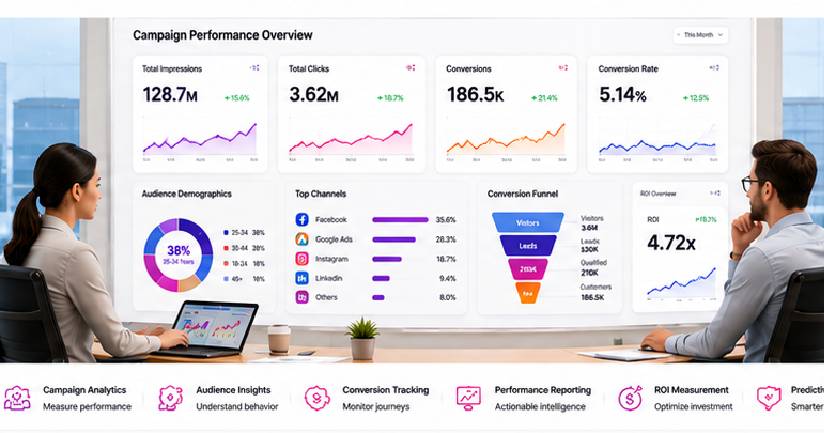
Turn Historical Data into Forward-Looking Intelligence. Anticipate Customer Behavior. Forecast Demand, Conversions and Revenue. Make Better Marketing Decisions with AI.
Traditional marketing analytics primarily explains what has already happened.
It can tell an organization how many customers converted, which campaigns generated engagement, where customers dropped out of the funnel, how revenue changed and which audiences performed differently.
Predictive Analytics goes further.
It uses historical data, current signals, statistical methods, machine learning and AI-assisted analysis to estimate what may happen next.
At Brand Messenger, our Predictive Analytics service connects marketing, advertising, CRM, CDP, commerce, customer journey, behavioral, campaign and business data to create forward-looking intelligence for marketing and enterprise decision-making.
Our four core capabilities are:
Predictive Conversion
Purchase Intent
Customer Forecasting
Revenue Forecasting
Our wider capabilities can extend across conversion propensity, lead propensity, purchase probability, churn-risk prediction, repeat-purchase forecasting, customer lifetime value prediction, demand forecasting, campaign forecasting, audience forecasting, funnel forecasting, pipeline forecasting, product-demand intelligence, customer growth forecasting, scenario modeling, predictive segmentation, next-best-action intelligence, anomaly detection, AI-assisted forecasting and executive predictive dashboards.
Our approach connects:
Historical Data → Current Signals → Customer Behavior → AI & Predictive Models → Probability / Forecast → Business Interpretation → Marketing Decision → Outcome → Learning
The objective is not to claim certainty about the future.
It is:
Use the Evidence Available Today to Make Better-Informed Decisions About What May Happen Tomorrow.
What Is Predictive Analytics?
Predictive Analytics uses historical and current information to estimate future outcomes, behaviors or trends.
For example, descriptive analytics may tell an organization:
2,500 customers purchased last month.
Predictive Analytics may ask:
How many customers may purchase next month?
or:
Which current prospects show patterns historically associated with conversion?
or:
What revenue range might current trends support next quarter?
The architecture becomes:
Historical Data + Current Data → Predictive Model → Estimated Future Outcome
Descriptive, Diagnostic, Predictive & Prescriptive Analytics
These analytical disciplines should remain distinct within Brand Messenger.
Descriptive Analytics
What happened?
Examples:
Revenue was $2 million.
Conversion was 4%.
Customer retention declined.
Diagnostic Analytics
What factors may help explain what happened?
Examples:
Which segments changed?
Which channels changed?
Where did funnel performance decline?
Predictive Analytics
What may happen next?
Examples:
What conversion volume might we expect?
Which customers may be more likely to purchase?
How might revenue develop?
Prescriptive / Decision Intelligence
What actions should be considered?
Examples:
Which audience should receive additional attention?
Should budgets be reconsidered?
Which retention strategy should be tested?
The progression becomes:
What Happened → Why Might It Have Happened → What May Happen Next → What Should We Consider Doing?
Predictive Analytics primarily focuses on the third question.
Prediction Is Not Certainty
This principle is fundamental to Brand Messenger's approach.
A predictive model might estimate:
Customer A — Higher Purchase Propensity
That does not mean:
Customer A Will Purchase.
Similarly:
Forecast Revenue = $5 million
does not mean:
Revenue Will Be Exactly $5 Million.
Predictions are estimates based on available data, assumptions and patterns.
Predictive Intelligence Supports Decisions. It Does Not Guarantee Outcomes.
Brand Messenger Predictive Analytics Services
Our capabilities can include:
Predictive Analytics Strategy
Predictive Marketing Analytics
AI-Powered Predictive Intelligence
Predictive Conversion
Conversion Propensity Modeling
Lead Conversion Prediction
Purchase Intent Intelligence
Purchase Propensity
Customer Forecasting
Customer Growth Forecasting
Revenue Forecasting
Sales Forecasting Integration
Demand Forecasting
Campaign Performance Forecasting
Marketing Performance Forecasting
Funnel Forecasting
Pipeline Forecasting
Customer Acquisition Forecasting
Retention Forecasting
Churn-Risk Prediction
Repeat-Purchase Prediction
Customer Lifetime Value Prediction
Product Demand Forecasting
Audience Forecasting
Predictive Audience Segmentation
Predictive Lead Scoring
Next-Purchase Intelligence
Next-Best-Action Intelligence
Customer Journey Prediction
Journey Progression Prediction
Time-to-Conversion Estimation
Budget Scenario Forecasting
Marketing ROI Forecasting
ROAS Forecasting where appropriate
Scenario Planning
Sensitivity Analysis
Trend Forecasting
Seasonality Analysis
Anomaly Detection
Forecast Monitoring
Model Performance Monitoring
CRM Integration
CDP Integration
First-Party Data Integration
Commerce Integration
Marketing Automation Integration
AdTech Integration
AI Marketing Intelligence Integration
Predictive Dashboards
Executive Forecast Reporting
Continuous Model Learning & Optimization
Predictive Conversion
Estimate Which Prospects and Marketing Interactions Are More Likely to Progress Toward Conversion
Predictive Conversion uses historical conversion information and current behavioral or customer signals to estimate conversion propensity.
The model becomes:
Historical Prospects + Behavior + Campaign Data + Customer Data + Conversion Outcomes → Predictive Model → Conversion Propensity Estimate → Marketing / Sales Intelligence
This can help organizations prioritize and understand opportunities more effectively.
Conversion Propensity
A conversion propensity model estimates the probability or relative likelihood that a prospect will complete a defined action.
The conversion could be:
Purchase
Lead Submission
Demo Request
Registration
Subscription
Booking
Application
Renewal
The model should always define exactly what “conversion” means.
Predictive Conversion Signals
Depending on the organization and appropriate data availability, signals may include:
Customer Information
Lifecycle Stage Customer Status Previous Purchases Account Information
Digital Behavior
Website Visits Product Views Content Engagement App Activity Return Visits
Marketing Engagement
Campaign Interaction Email Engagement Content Interaction
Funnel Behavior
Lead Stage MQL Status SQL Status Opportunity Activity
Commerce
Cart Activity Product Interest Purchase History
The specific variables should be selected according to business relevance, data quality, privacy requirements and model performance.
Predictive Lead Conversion
For lead-generation businesses, the architecture can become:
Lead → Behavioral + CRM Signals → Predictive Model → Conversion Propensity → Marketing / Sales Priority
This can connect with Brand Messenger's Lead Management & Revenue Marketing capabilities.
Predictive MQL & SQL Intelligence
Brand Messenger can use appropriate historical patterns to support estimation around:
Lead → MQL
and
MQL → SQL
progression.
This can complement conventional rules-based lead scoring.
Predictive Opportunity Conversion
For B2B organizations:
Opportunity Data + Engagement + CRM History + Pipeline Information → Predictive Model → Opportunity Progression Estimate
This can support pipeline intelligence.
It should not replace sales judgment.
Predictive Conversion + Marketing Funnel Optimization
Brand Messenger can connect Predictive Analytics with its Marketing Funnel Optimization service.
The architecture becomes:
TOFU → MOFU → BOFU
↓
Funnel Behavior
↓
Predictive Conversion
↓
Likely Progression Patterns
↓
Funnel Optimization
This can help organizations understand where future conversion opportunities may be developing.
Funnel Stage Prediction
Historical funnel behavior may help estimate whether prospects are more or less likely to progress from:
Visitor → Lead
Lead → MQL
MQL → SQL
SQL → Opportunity
Opportunity → Customer
Each prediction should be validated against actual future outcomes.
Purchase Intent
Identify Signals Associated with Increasing Customer Interest and Buying Consideration
Purchase Intent Analytics attempts to estimate whether customer or prospect behavior is becoming more consistent with purchase consideration.
Potential signals may include:
Repeated Product Views
Product Comparison
Pricing Page Activity
Cart Activity
Return Visits
Product Search
Demo Requests
Content Consumption
Relevant Campaign Engagement
Previous Purchase Behavior
The architecture becomes:
Customer Behavior → Intent Signals → AI / Statistical Analysis → Purchase Propensity Estimate
Purchase Intent Is Not Proof of Intent
This distinction is essential.
A customer visiting a pricing page five times may be considering a purchase.
They may also be:
Researching
Comparing
Checking information
Working for a competitor
Conducting academic research
Therefore:
Behavior Creates Signals. Signals Support Estimates. Estimates Do Not Reveal a Person's Mind.
Brand Messenger treats purchase intent as probabilistic intelligence.
Purchase Intent Scoring
Organizations can create an intent framework such as:
Low Observed Purchase Propensity
Developing Purchase Propensity
Higher Observed Purchase Propensity
The scoring model should be based on measurable evidence and validated against actual outcomes.
Behavioral Purchase Intent
Behavioral patterns can include:
Product Page → Comparison → Pricing → Return Visit → Cart
These sequences may historically correlate with conversion.
Predictive Analytics can identify such patterns across larger datasets.
B2B Purchase Intent
For B2B organizations, potential signals can include:
Repeated Solution Content Engagement
Case Study Interaction
Webinar Attendance
Pricing / Solution Pages
Demo Requests
Multiple Contacts from an Account
Sales Engagement
Brand Messenger can connect these signals with account-level intelligence where appropriate.
Account-Level Intent Intelligence
B2B purchasing often involves several stakeholders.
Therefore:
Individual Engagement
does not always equal:
Account Purchase Intent: Brand Messenger can distinguish contact-level and account-level behavior where appropriate data supports that analysis.
Purchase Intent + Audience Segmentation
Brand Messenger can connect intent estimates with Audience Segmentation.
Potential segments might include:
General Audience → Engaged Audience → Developing Intent → Higher Propensity
These segments can support different marketing experiences.
Purchase Intent + Personalization
Appropriate intent signals can help determine what information may be useful next.
For example:
Early-Stage Visitor
Educational Content
Returning Product Researcher
Product Comparison
High-Engagement Prospect
Demo / Consultation Opportunity
The objective should be to support the customer's decision not create manipulative pressure.
Purchase Intent + Marketing Automation
Marketing automation can respond to appropriate signals.
The architecture becomes:
Behavior → Intent Estimate → Business Rule → Customer Journey → Measurement
For example:
Repeated Product Interest → Relevant Product Information
rather than automatically sending aggressive sales messages.
Purchase Intent + Conversational AI
An AI customer assistant can use appropriate current-session context to help a customer explore:
Product Information
Pricing
Features
Comparisons
Support
The system should assist rather than pretend to know the customer's private intentions.
Customer Forecasting
Estimate How Customer Activity, Acquisition, Retention and Growth May Develop
Customer Forecasting looks beyond individual predictions to understand how the broader customer base may change over time.
Potential forecasts can include:
New Customers
Active Customers
Repeat Customers
Retained Customers
Churned Customers
Reactivated Customers
Subscribers
Renewals
Customer Growth
The architecture becomes:
Historical Customer Data + Current Trends + Business Context → Forecast Model → Future Customer Estimate
Customer Acquisition Forecasting
Brand Messenger can estimate future customer acquisition based on appropriate:
Historical Acquisition
Current Campaign Performance
Marketing Investment
Seasonality
Funnel Conversion
Pipeline
The model can become:
Traffic / Demand → Leads → Conversion → Estimated Customers
Customer Retention Forecasting
Historical retention patterns can support estimates of:
Active Customers
Renewals
Repeat Customers
Churn
This connects Predictive Analytics with Customer Lifetime Value Optimization.
Churn Prediction
Identify Customer Relationships Showing Patterns Historically Associated with Churn
Potential signals can include:
Declining Usage
Declining Purchase Frequency
Reduced Engagement
Longer Purchase Intervals
Subscription Changes
Service Activity
The model becomes:
Customer History + Current Signals → Churn-Risk Model → Risk Estimate
A churn-risk score is not proof that a customer intends to leave.
Repeat Purchase Forecasting
For appropriate products and services, Brand Messenger can estimate when repeat purchasing may occur.
The model becomes:
Purchase History → Typical Purchase Interval → Customer Behavior → Repeat-Purchase Estimate
This can support replenishment and retention strategies.
Customer Lifetime Value Prediction
Brand Messenger can connect Predictive Analytics with Customer Lifetime Value Optimization.
The architecture becomes:
Historical Transactions + Frequency + Retention + Customer Behavior → Predictive CLV Model → Estimated Future Customer Value
Predicted CLV should remain clearly distinguished from historical CLV.
High-Value Customer Prediction
Predictive models can identify customers whose current behavior resembles historical patterns associated with stronger long-term value.
This can help identify:
Emerging High-Value Customer Relationships: before they have accumulated the highest historical spend.
The result remains a probability or estimate—not a guarantee of future customer value.
Customer Growth Forecasting
Enterprise organizations can forecast:
Current Customer Base
Expected Acquisition
−
Expected Churn
=
Forecast Customer Base
More sophisticated models can incorporate:
Market Growth
Seasonality
Marketing Investment
Product Changes
Retention Programs
Revenue Forecasting
Connect Marketing, Customer, Funnel and Commercial Data to Forward-Looking Revenue Intelligence
Revenue Forecasting estimates future revenue based on available historical and current information.
The architecture can become:
Marketing Demand → Leads → Pipeline → Customers → Purchase / Contract Value → Retention / Repeat Revenue → Revenue Forecast
This creates an important bridge between marketing intelligence and enterprise planning.
Marketing-Driven Revenue Forecasting
Brand Messenger can analyze relationships between:
Marketing Investment
Traffic
Leads
Conversion
Pipeline
Customer Acquisition
Customer Value
Revenue
This can support estimates of potential marketing-related revenue outcomes.
It should not automatically attribute all future revenue to marketing.
Revenue Forecast by Funnel
A B2B model may become:
Leads
×
Lead-to-Opportunity Conversion
×
Opportunity-to-Customer Conversion
×
Average Customer Value
=
Revenue Estimate
Actual enterprise forecasting may require significantly more variables.
Pipeline Revenue Forecasting
For sales-led organizations:
Opportunity → Stage → Value → Historical Progression → Forecast
can support pipeline-based revenue estimates.
Sales judgment and commercial context should remain part of the process.
E-Commerce Revenue Forecasting
E-commerce forecasts may consider:
Website Traffic
Conversion Rate
Average Order Value
Repeat Purchase
Seasonality
Promotions
Product Availability
The architecture becomes:
Traffic × Conversion × Order Value + Repeat Customer Revenue → Revenue Forecast
subject to the model's assumptions.
Subscription Revenue Forecasting
Subscription businesses may consider:
New Subscriptions
Recurring Revenue
Renewals
Churn
Upgrades
Downgrades
The model becomes:
Existing Recurring Revenue + New Customers + Expansion − Churn / Contraction → Forecast Revenue
Customer Revenue Forecasting
Revenue forecasts can also be built from customer economics:
Customer Base × Purchase Frequency × Average Customer Value
with appropriate adjustments for:
Retention
Churn
Acquisition
Seasonality
This connects customer forecasting directly with revenue forecasting.
Product Revenue Forecasting
Brand Messenger can forecast revenue by:
Product
Product Category
Service
Subscription Plan
Market
where sufficient historical information exists.
Geographic Revenue Forecasting
Multi-market organizations can analyze forecasts across:
Country
Region
City
Store
Branch
Territory
Local differences in seasonality, pricing, marketing investment and market conditions should be considered.
Demand Forecasting
Estimate Future Demand to Support Marketing and Business Planning
Demand Forecasting can help organizations anticipate changes in:
Customer Interest
Product Demand
Lead Volume
Orders
Registrations
Subscriptions
Event Demand
The model becomes:
Historical Demand + Current Signals + Seasonality + Business Factors → Demand Forecast
Demand Forecasting + Marketing
Marketing teams can use demand forecasts to consider:
Campaign Timing
Budget Planning
Inventory Coordination
Promotional Strategy
Market Priorities
Content Planning
Forecasts should inform planning rather than dictate it automatically.
Seasonal Forecasting
Many businesses experience seasonal patterns.
Examples may include:
Holidays
Travel Seasons
Retail Periods
Enrollment Cycles
Annual Renewals
Event Seasons
Predictive models can incorporate historical seasonality where relevant.
Campaign Performance Forecasting
Brand Messenger can estimate potential campaign outcomes using:
Historical Campaign Performance
Current Performance
Budget
Audience
Conversion Rates
Campaign Duration
Potential forecast outputs can include:
Spend
Traffic
Leads
Conversions
Forecasts become less reliable when campaign conditions change substantially from the historical data.
Marketing Budget Forecasting
Predictive Analytics can connect with Brand Messenger's Budget & Bid Optimization service.
The architecture becomes:
Historical Spend + Current Performance + Budget Scenario → Forecast → Planning
Potential questions include:
What may happen if investment remains constant?
What may happen under moderate scaling?
What may happen if budget shifts between channels?
Scenario Planning
Explore Multiple Possible Futures Instead of Relying on One Forecast
A single forecast can create false precision.
Brand Messenger can create scenarios such as:
Scenario A — Maintain: Current marketing investment continues.
Scenario B — Moderate Growth
Investment increases within defined limits.
Scenario C — Accelerated Growth
More aggressive scaling is considered.
Each scenario can estimate potential:
Traffic
Leads
Customers
Revenue
Acquisition Cost
This provides management with a range of possible outcomes.
Forecast Ranges
Instead of reporting:
Revenue Next Quarter = $5,000,000
a more mature forecast may communicate:
Central Estimate
alongside an appropriate:
Forecast Range / Confidence Interval: where the modeling methodology supports it.
This better communicates uncertainty.
Sensitivity Analysis
Sensitivity analysis asks:
Which assumptions have the greatest effect on the forecast?
For example:
If revenue depends heavily on:
Conversion Rate: then small conversion changes may materially affect the forecast.
If it depends heavily on:
Customer Retention: then retention becomes a critical planning variable.
What-If Analysis
Brand Messenger can model questions such as:
What if conversion improves?
What if acquisition cost increases?
What if customer retention improves?
What if media investment changes?
What if average order value changes?
This supports strategic planning.
Predictive Audience Intelligence
Move from Static Audience Descriptions to Forward-Looking Audience Intelligence
Traditional segmentation may identify:
What customers have done.
Predictive segmentation can estimate:
What customers may be more likely to do next.
Potential predictive segments can include:
Higher Conversion Propensity
Higher Repeat-Purchase Propensity
Churn-Risk
Emerging High-Value Customers
Product-Interest Propensity
These remain model-based estimates.
Predictive Segmentation
Brand Messenger can connect:
Audience Segmentation
Predictive Analytics
to create:
Historical Behavior → Segment → Predictive Model → Future Propensity
This provides a more dynamic audience intelligence layer.
Predictive Customer Journey Analytics
Historical journeys can reveal patterns associated with future progression.
For example:
Ad → Website → Product → Pricing → Return Visit
may historically have a different conversion rate from:
Ad → Website → Exit
Predictive Journey Analytics can estimate how different journey patterns relate to potential outcomes.
Next-Step Prediction
The model can estimate:
What touchpoint or journey stage may occur next?
For example:
Content Engagement → Product Research
or
Product Research → Demo
These estimates can support Journey Orchestration.
Predictive Drop-Off
Historical funnel and journey information may identify patterns associated with abandonment.
The architecture becomes:
Journey Behavior → Predictive Model → Drop-Off Risk Estimate → Experience Strategy
This can help teams identify where proactive improvements may be useful.
Predictive Funnel Analytics
Brand Messenger can connect:
TOFU → MOFU → BOFU → Pipeline
with predictive intelligence.
Potential forecasts include:
Future TOFU Demand
Expected Lead Volume
MQL Volume
SQL Volume
Opportunity Volume
Customer Conversion
This connects marketing planning with revenue forecasting.
Predictive Pipeline Intelligence
For enterprise B2B organizations:
CRM + Opportunity History + Pipeline Stage + Engagement → Predictive Pipeline Intelligence
Potential outputs can include:
Opportunity Progression Estimates
Pipeline Conversion Estimates
Revenue Forecasts
Pipeline Risk Indicators
These should complement not replace sales management judgment.
Predictive CLV
Predictive CLV estimates future customer economic value.
The architecture becomes:
Customer History + Purchase Frequency + Retention + Behavior → Model → Estimated Future Value
This can support:
Customer Segmentation
Retention Strategy
Acquisition Economics
Advertising Strategy
Predictive Retention Intelligence
Historical patterns can help estimate which customer groups may have higher or lower retention probability.
This can support Brand Messenger's Loyalty, Retention & Customer Growth Technology.
The objective should be to strengthen customer relationships—not penalize customers because a model predicts lower future value.
Next-Best-Action Intelligence
Turn Predictions into Decision Support
Predictive Analytics can inform what action may be worth considering next.
The architecture becomes:
Customer Context → Prediction → Business Rules → Recommended Action → Human / Automated Decision → Customer Experience
Potential recommendations can include:
Educational Content
Product Information
Retention Communication
Customer Service
Renewal Reminder
Relevant Offer
The final action should reflect business rules, customer preferences and appropriate human oversight.
Next-Best-Offer Intelligence
Where appropriate, customer behavior and product relationships can support recommendations for relevant offers.
The objective should be:
Increase Relevance not Simply Increase Pressure to Purchase.
Predictive Personalization
Brand Messenger can connect predictive signals with AI Marketing & Personalization.
The architecture becomes:
Customer Data → Prediction → Customer Context → Personalized Experience → Measurement
Examples can include:
Content Recommendations
Product Recommendations
Journey Personalization
Retention Experiences
Predictive Marketing Automation
Marketing Automation can respond to predictive signals.
For example:
Higher Churn Risk → Retention Workflow
Repeat-Purchase Propensity → Replenishment Journey
Developing Product Interest → Relevant Product Information
Automation should include appropriate thresholds and governance.
Predictive Advertising Intelligence
Brand Messenger can connect predictive analytics with AdTech where appropriate.
Potential applications can include:
Predictive Audience Segmentation
Conversion-Value Signals
Customer Value Intelligence
Campaign Planning
Activation depends on platform capabilities, privacy requirements and data permissions.
Predictive Analytics + First-Party Data
Strong predictive systems increasingly depend on reliable first-party information.
The architecture becomes:
CRM Data
CDP Data
Commerce
Customer Journey
Marketing Engagement
↓
First-Party Customer Intelligence
↓
Predictive Analytics
First-party data can provide a stronger direct foundation for predictive models.
Predictive Analytics + CRM
CRM can provide:
Leads
Customer Status
Opportunities
Sales Outcomes
Customer Relationships
This can support models around:
Lead Conversion
Pipeline Progression
Customer Retention
Revenue
Predictive Analytics + CDP
A Customer Data Platform can connect information from:
Website + App + CRM + Commerce + Marketing → Unified Customer Data → Predictive Models → Customer Intelligence
The quality of identity resolution and underlying data directly affects predictive quality.
Predictive Analytics + Customer Journey Analytics
Customer Journey Analytics explains:
What paths customers have taken.
Predictive Analytics estimates:
What may happen next.
Together:
Past Journey → Current Journey → Predictive Intelligence → Potential Next Outcome
Predictive Analytics + Marketing Funnel Optimization
Marketing Funnel Optimization measures progression through:
TOFU → MOFU → BOFU → Pipeline
Predictive Analytics adds:
Expected Future Progression
This can support planning around:
Lead Volume
Qualification
Pipeline
Conversion
Revenue
Predictive Analytics + Customer Lifetime Value
CLV Optimization measures and improves long-term customer economics.
Predictive Analytics can estimate:
Potential Future Customer Value
The relationship becomes:
Historical CLV → Predictive CLV → Customer Value Strategy
Predictive Analytics + Marketing Dashboard & KPI Reporting
Brand Messenger can bring predictive intelligence into executive dashboards.
A management dashboard might show:
Actual: What has happened.
Target
What the organization planned.
Forecast
What current evidence suggests may happen.
The executive view becomes:
Actual ↔ Target ↔ Forecast: This creates a much stronger decision environment than historical reporting alone.
Predictive Executive Dashboard
A Brand Messenger Predictive Analytics dashboard can include:
Conversion
Actual Conversion Predicted Conversion Trend
Customer
Current Customers Forecast Acquisition Forecast Retention Churn Risk
Revenue
Actual Revenue Target Revenue Forecast Revenue
Funnel
Current Funnel Expected Progression Pipeline Forecast
Customer Value
Historical CLV Predicted CLV
Marketing
Current Spend Forecast Performance Scenario Analysis
Forecast vs. Actual Reporting
Predictions should be evaluated after the future becomes known.
Brand Messenger can track:
Forecast → Actual Outcome → Forecast Error → Model Review
This is essential.
A predictive model should not simply make forecasts indefinitely without measuring whether those forecasts were useful.
Forecast Accuracy Monitoring
Depending on the model, Brand Messenger can monitor appropriate forecast-error measures and performance over time.
The important question is:
How Well Did the Prediction Perform Against Reality?
This creates accountability for predictive systems.
Model Drift
Customer behavior and markets change.
A model trained on older patterns may gradually become less reliable.
Brand Messenger can monitor for:
Performance Decline
Behavioral Changes
Data Changes
Market Changes
This is often referred to as model drift.
Models may require recalibration or retraining.
Data Quality for Predictive Analytics
AI Cannot Reliably Predict from Unreliable Data
Potential data issues include:
Missing Conversions
Duplicate Customers
Inconsistent CRM Stages
Incorrect Revenue
Incomplete Purchase History
Tracking Changes
Poor Identity Resolution
The principle is:
Better Prediction Begins with Better Data.
Historical Data Requirements
Predictive models generally need sufficient relevant historical information.
A business with limited history may need to begin with:
Descriptive Analytics
Rule-Based Intelligence
Simple Forecasting
before advanced machine-learning models become appropriate.
Brand Messenger should choose the level of predictive sophistication supported by the data.
Data Relevance
More data does not automatically produce better predictions.
The question should be:
Does this information meaningfully and appropriately help predict the defined outcome?
Unnecessary variables can increase complexity, privacy risk and model instability.
Correlation vs. Prediction vs. Causation
These concepts should remain distinct.
Correlation
Two variables move together.
Prediction
One set of variables helps estimate an outcome.
Causation
Changing one factor actually causes another outcome to change.
A model can be highly predictive without proving causation.
This distinction is particularly important when deciding what marketing action to take.
Predictive Analytics Does Not Replace Experimentation
Suppose a model predicts:
Customers receiving Experience A have higher conversion probability.
That does not necessarily prove Experience A causes the improvement.
Brand Messenger can combine Predictive Analytics with:
A/B Testing
Controlled Experiments
Incrementality Analysis
to evaluate causal effects where appropriate.
Responsible AI & Predictive Analytics
Predict Carefully. Govern the Models. Keep Human Judgment in the Decision Loop.
Predictive models can influence:
Marketing
Customer Experience
Sales Prioritization
Retention
Advertising
Brand Messenger can structure responsible predictive systems around:
Defined Objectives
Data Quality
Appropriate Data
Model Validation
Human Oversight
Performance Monitoring
Bias Assessment where relevant
Security
Governance
Explainability appropriate to the use case
Sensitive Predictive Decisions
Additional caution is required where predictions affect sensitive or regulated areas such as:
Employment
Housing
Credit
Financial Services
Healthcare
Education
Public Services
Marketing predictive models should not be used to circumvent anti-discrimination, eligibility or regulatory requirements.
Protected & Sensitive Characteristics
Predictive models should not casually use sensitive information such as:
Race or Ethnicity
Religion
Political Beliefs
Health Information
Biometrics
Other Protected Characteristics
simply because data may technically be available.
Data selection should reflect necessity, proportionality and applicable requirements.
Face Signatures + Predictive Analytics
For appropriate physical environments, Face Signatures by Messenger2050 Technologies can provide a supporting physical-space behavioral intelligence layer.
Potential aggregated signals may include:
Visitor Traffic
Return-Visit Trends
Audience Flow
Zone Activity
Event Activity
Location Patterns
These signals can contribute to appropriate aggregate forecasts such as:
Visitor Demand
Location Activity
Event Traffic
Retail Traffic Trends
Individual biometric identity is not necessary for many predictive marketing objectives.
Where aggregated information answers the business question, it should generally be preferred.
Retail Predictive Analytics
Brand Messenger can combine:
Commerce + CRM + Loyalty + Digital Behavior + Appropriate Store Intelligence
to support estimates around:
Customer Demand
Repeat Purchase
Product Demand
Customer Retention
Revenue
This connects Predictive Analytics with Smart Retail Experiences.
Event Predictive Analytics
Brand Messenger's Smart Event Technology can contribute data for forecasts around:
Registrations
Attendance
Session Demand
Visitor Flow
Lead Generation
Forecasts can support planning while remaining subject to uncertainty.
B2B Predictive Analytics
Enterprise B2B applications can include:
Lead Conversion Prediction
Account Engagement
Opportunity Progression
Pipeline Forecasting
Revenue Forecasting
Renewal Risk
Account Value
This connects marketing, sales and revenue operations.
E-Commerce Predictive Analytics
Potential applications include:
Purchase Propensity
Product Demand
Cart Conversion
Repeat Purchase
Customer Value
Churn / Inactivity
Revenue Forecasting
This creates a forward-looking commerce intelligence layer.
SaaS & Subscription Predictive Analytics
Potential applications include:
Trial Conversion
Subscription Conversion
Churn Risk
Renewal Probability
Upgrade Propensity
Customer Lifetime Value
Recurring Revenue Forecasting
These models can connect product, CRM, billing and marketing information where appropriate.
Predictive Analytics Maturity Model
Organizations can develop predictive capabilities progressively.
Level 01 — Historical Reporting
What Happened?
Dashboards • KPIs • Historical Trends
Level 02 — Trend Analysis
What Direction Are We Moving?
Growth • Decline • Seasonality
Level 03 — Statistical Forecasting
What May Happen?
Customer • Conversion • Demand • Revenue Forecasts
Level 04 — Customer-Level Prediction
Who / What May Be More Likely to Convert, Purchase, Churn or Return?
Propensity • Intent • Churn • CLV
Level 05 — AI-Assisted Predictive Marketing
Prediction + Segmentation + Journey + Personalization + Automation
Level 06 — Enterprise Predictive Intelligence
CRM + CDP + First-Party Data + Marketing + Advertising + Customer + Revenue + AI + Executive BI
The goal is not to use the most complicated AI model.
It is to use the most appropriate model that produces reliable, useful and governable intelligence.
Complete Brand Messenger Predictive Analytics Process
A comprehensive engagement can follow:
Business Objective → Prediction Question → Outcome Definition → Data Source Assessment → First-Party Data Review → CRM / CDP / Commerce Integration → Historical Data Preparation → Data Quality Assessment → Feature / Signal Selection → Privacy & Governance Review → Model Selection → Model Development → Validation → Predictive Conversion → Purchase Intent Intelligence → Customer Forecasting → Revenue Forecasting → Scenario Modeling → Business Interpretation → Dashboard Integration → Marketing / Sales / Customer Activation Where Appropriate → Actual Outcome Measurement → Forecast Accuracy Evaluation → Model Monitoring → Continuous Improvement
The lifecycle becomes:
Collect → Understand → Model → Predict → Interpret → Decide → Measure → Validate → Learn → Improve
Across the Brand Messenger Predictive Intelligence Ecosystem
Predictive Analytics connects with Brand Messenger's wider capabilities:
First-Party Data Strategy
Build the Data Foundation → CRM + CDP
Connect Customer Information → Audience Segmentation
Understand Different Customer Groups → Customer Journey Analytics
Understand Historical Paths → Marketing Funnel Optimization
Measure TOFU → MOFU → BOFU → Pipeline
↓
Customer Lifetime Value Optimization
Understand Long-Term Customer Economics → Predictive Analytics
Predictive Conversion • Purchase Intent • Customer Forecasting • Revenue Forecasting → AI Marketing Intelligence
Discover Patterns & Opportunities → Marketing Automation
Respond to Predictive Signals → Personalization
Deliver Relevant Experiences → AdTech + Budget & Bid Optimization
Use Appropriate Business Signals in Advertising Decisions → Marketing Dashboard & KPI Reporting
Compare Actual → Target → Forecast
↓
Executive Decision Intelligence
The complete intelligence cycle becomes:
Historical Data → Current Signals → Customer Behavior → AI → Prediction → Marketing Decision → Customer Outcome → Measurement → Learning
Industries & Business Models We Serve
Brand Messenger Predictive Analytics can support appropriate applications across:
Enterprise Organizations
B2B
E-Commerce
Retail
SaaS
Technology
Telecommunications
Financial Services
Hospitality
Travel
Automotive
Real Estate
Consumer Brands
Professional Services
Subscription Businesses
Membership Organizations
Media
Entertainment
Events
Education
Healthcare
Multi-Location Businesses
Lead Generation Businesses
Sales-Led Organizations
Marketing-Led Organizations
The appropriate predictive methodology depends on the available data, business model and intended decision.
Benefits of Predictive Analytics
Brand Messenger can help organizations:
Move beyond historical reporting
Estimate future conversion opportunities
Develop conversion propensity models
Identify purchase-intent signals
Forecast customer acquisition
Forecast customer retention
Estimate churn risk
Predict repeat-purchase patterns
Develop predictive CLV
Forecast demand
Forecast revenue
Forecast funnel progression
Support pipeline forecasting
Compare marketing scenarios
Understand seasonal patterns
Develop predictive audience segments
Support predictive lead scoring
Improve customer journey intelligence
Support next-best-action strategies
Connect predictions with marketing automation
Support personalization
Connect predictive signals with advertising intelligence
Integrate CRM, CDP and first-party data
Build predictive executive dashboards
Compare actual performance with forecasts
Monitor forecast accuracy
Identify model drift
Create a more forward-looking marketing decision environment
Why Choose Brand Messenger?
Brand Messenger combines Predictive Conversion, Purchase Intent, Customer Forecasting, Revenue Forecasting, First-Party Data, CRM, CDP, Audience Segmentation, Customer Journey Analytics, Marketing Funnel Optimization, Customer Lifetime Value, Marketing Automation, Personalization, AdTech, Budget & Bid Optimization, AI Marketing Intelligence and Executive KPI Reporting within one connected predictive intelligence ecosystem.
We do not approach Predictive Analytics as:
Give Data to AI → Predict the Future → Assume the Prediction Is Correct.
We approach it as:
Define the Business Question → Connect Reliable Data → Identify Relevant Signals → Build the Model → Validate the Prediction → Interpret the Result → Apply Human Judgment → Measure the Outcome → Improve the Model.
The distinction matters.
Predictive Conversion estimates how likely defined prospects or interactions may be to progress toward conversion.
Purchase Intent identifies behavioral patterns associated with increasing purchase consideration without pretending to know what a customer is thinking.
Customer Forecasting estimates how acquisition, retention, churn and customer growth may develop.
Revenue Forecasting connects customer, funnel, pipeline and commercial information with forward-looking financial estimates.
First-Party Data provides a stronger direct data foundation.
Customer Journey Analytics reveals the historical paths from which predictive patterns can be learned.
Marketing Funnel Optimization provides the TOFU, MOFU, BOFU and pipeline structure for forecasting progression.
CLV Optimization extends predictive intelligence into long-term customer economics.
AI Marketing Intelligence discovers patterns across complex datasets.
Marketing Automation and Personalization can respond to appropriate predictive signals.
And Marketing Dashboard & KPI Reporting gives executives a clear view across:
Actual → Target → Forecast
The result is not a promise to predict the future perfectly.
It is something more useful:
A Better-Informed View of What May Happen Next and the Intelligence to Prepare for It.
Predict Conversion. Understand Purchase Intent. Forecast Customers. Anticipate Revenue. Turn Data into Forward-Looking Marketing Intelligence.
Predictive Conversion. Purchase Intent. Customer Forecasting. Revenue Forecasting. One Connected AI-Powered Predictive Marketing Intelligence Ecosystem.