





Turn Marketing Data into Decisions. Connect Performance to Revenue. Give Leadership the Intelligence to Grow.
Modern organizations generate marketing data across almost every customer interaction.Advertising platforms produce impressions, clicks, spend, and conversion data. Websites generate visitor and behavioral information. CRM systems contain leads, customers, opportunities, and sales activity. Marketing automation platforms record engagement and customer journeys. Campaign systems measure responses. Customer Data Platforms connect customer information. Revenue systems reveal the eventual commercial outcome.
The challenge is no longer simply collecting data.
The challenge is connecting that data, understanding what it means, identifying what is driving performance, and transforming marketing information into intelligence that teams and executives can use to make better decisions.
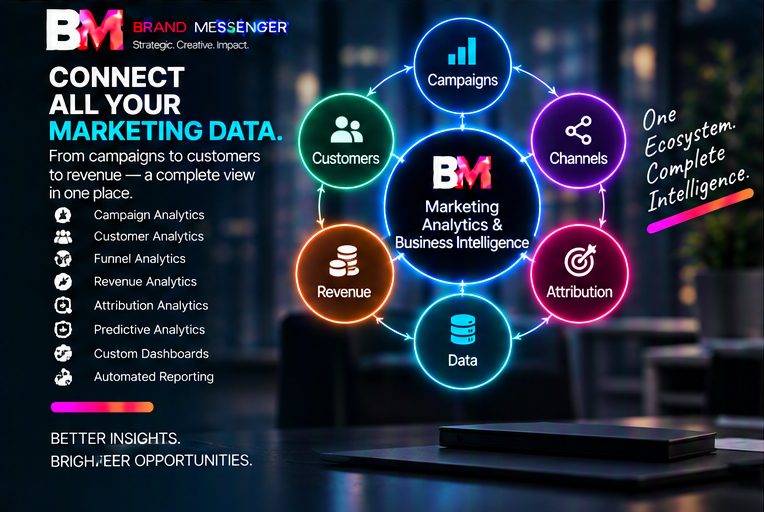
At Brand Messenger, our Marketing Analytics & Business Intelligence services help organizations bring marketing, customer, campaign, funnel, advertising, sales, and revenue data into a connected measurement and decision-intelligence environment.
From Marketing Dashboards, KPI Reporting, Campaign Analytics, Customer Analytics, and Funnel Analytics to Revenue Analytics, ROI Measurement, Attribution Analytics, Predictive Analytics, and Executive Marketing Intelligence, we help organizations understand performance from individual marketing activities through to business outcomes.
Our approach connects:
Data → Measurement → Analytics → Intelligence → Insight → Decision → Action → Performance → Learning
Measure What Matters. Understand What Drives Performance. Turn Marketing Data into Business Intelligence.
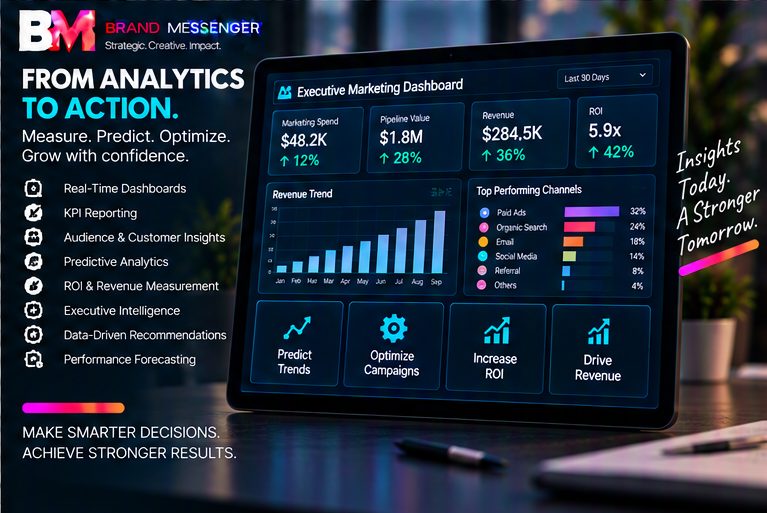
Our Marketing Analytics & Business Intelligence Services
Brand Messenger provides comprehensive Marketing Analytics & Business Intelligence capabilities, including:
Marketing Dashboards
KPI Reporting
Campaign Analytics
Customer Analytics
Funnel Analytics
Revenue Analytics
ROI Measurement
Attribution Analytics
Predictive Analytics
Executive Marketing Intelligence
Marketing Performance Analytics
Channel Analytics
Audience Analytics
Customer Journey Analytics
Conversion Analytics
Lead & Pipeline Analytics
Content Performance Analytics
Marketing Automation Analytics
Omnichannel Analytics
Customer Lifetime Value Analytics
Retention & Churn Analytics
Marketing Spend Analytics
Budget Performance Analytics
Marketing Forecasting
Performance Benchmarking
Marketing Data Visualization
Real-Time Performance Monitoring
Automated Marketing Reporting
AI-Assisted Marketing Intelligence
Cross-Channel Business Intelligence
Marketing Data Integration
Marketing Dashboards
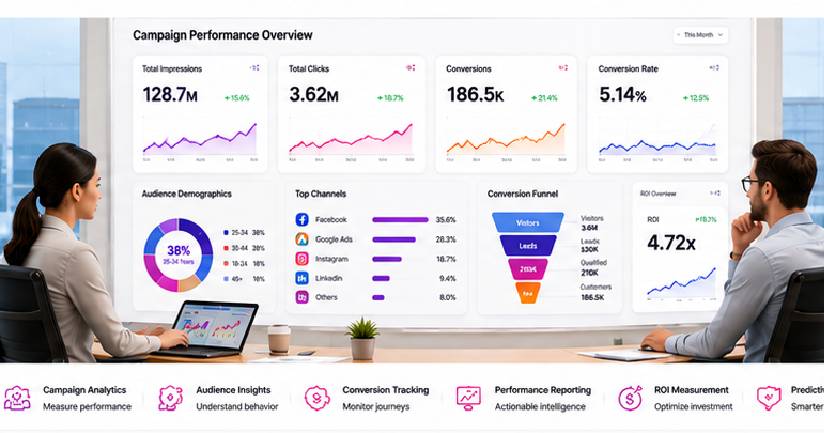
See Marketing Performance in One Connected View
Marketing teams often work across multiple systems, each providing its own reports and metrics.
Brand Messenger can develop connected Marketing Dashboards that bring relevant information together into more useful performance views.
Dashboards can provide visibility across:
Marketing Campaigns
Advertising
Website Performance
Customer Engagement
Lead Generation
Conversion
CRM
Customer Journeys
Marketing Automation
Content
Revenue
Customer Retention
Marketing Investment
ROI / ROAS where measurable
Rather than moving between multiple platforms to understand performance, teams can work toward a more centralized intelligence environment.
The objective is:
Multiple Data Sources → Connected Dashboard → Clearer Marketing Intelligence
Role-Based Marketing Dashboards
Give Every Team the Intelligence It Actually Needs
Not every stakeholder needs the same dashboard.
Brand Messenger can structure dashboards for different organizational roles.
Marketing Teams
Campaigns • Channels • Leads • Engagement • Conversion • Content
Performance Marketing Teams
Media Spend • CPA • ROAS • Conversion • Attribution • Optimization
CRM & Customer Teams
Customers • Segments • Engagement • Lifecycle • Retention • Churn
Sales & Revenue Teams
MQLs • SQLs • Opportunities • Pipeline • Revenue
Customer Experience Teams
Journeys • Behavior • Engagement • Drop-Off • Experience Performance
Management
Marketing Performance • Investment • Pipeline • Revenue • Trends
Executives
Business Outcomes • Growth • Marketing Contribution • Forecasts • Strategic Intelligence
This helps ensure that analytics supports decisions rather than simply displaying more data.
KPI Reporting
Define and Measure the Metrics That Matter
Organizations can track hundreds of marketing metrics.
That does not mean every metric should become a KPI.
Brand Messenger helps organizations establish KPI frameworks aligned with business, marketing, customer, campaign, and revenue objectives.
KPIs can cover areas such as:
Awareness
Reach • Impressions • Audience Growth • Brand Engagement
Engagement
Clicks • Content Engagement • Email Engagement • Website Activity
Acquisition
Leads • Cost per Lead • MQLs • SQLs • Customer Acquisition
Conversion
Conversion Rate • Funnel Progression • Purchase • Form Completion
Customer
Retention • Repeat Purchase • Customer Lifetime Value • Churn
Revenue
Pipeline • Revenue • Average Customer Value • Marketing Contribution
Investment
Marketing Spend • CPA • ROI • ROAS where applicable
The objective is to connect operational metrics with meaningful business outcomes.
KPI Framework & Measurement Architecture
Connect Business Objectives with Marketing Measurement
Brand Messenger can help organizations build measurement frameworks such as:
Business Objective → Marketing Objective → KPI → Metric → Data Source → Dashboard → Decision
For example:
Business Objective: Increase revenue\ Marketing Objective: Generate qualified demand\ KPI: Marketing-sourced pipeline\ Supporting Metrics: Leads, MQLs, SQLs, opportunity value, conversion rate
This creates a clearer relationship between what the organization wants to achieve and what marketing should measure.
Automated Marketing Reporting
Reduce Repetitive Reporting Work
Marketing teams often spend significant time collecting information manually from different platforms.
Brand Messenger can help automate appropriate reporting workflows by connecting relevant marketing systems and data sources.
Automated reporting can support:
Daily Reports
Weekly Reports
Monthly Reports
Campaign Reports
Performance Reports
Executive Reports
Client Reports
Channel Reports
Revenue Reports
KPI Updates
Automation can reduce repetitive data collection while allowing teams to spend more time interpreting results and taking action.
Campaign Analytics
Understand What Every Campaign Actually Achieves
Campaign Analytics provides visibility into how marketing initiatives perform across audiences, channels, creative, customer journeys, and business outcomes.
Brand Messenger can analyze:
Campaign Reach
Engagement
Traffic
Leads
Conversions
Customer Acquisition
Revenue
Media Spend
Cost per Result
Audience Performance
Channel Performance
Creative Performance
Funnel Progression
Customer Journey
Campaign ROI
Campaign ROAS where applicable
Campaign Analytics can move reporting beyond:
"How many people saw the campaign?"
toward:
"What happened because of the campaign?"
Cross-Campaign Analytics
Compare Performance Across Marketing Initiatives
Individual campaign reports provide only part of the picture.
Brand Messenger can compare campaigns according to:
Objective
Audience
Channel
Market
Product
Creative
Offer
Lead Quality
Conversion
Customer Acquisition
Revenue Contribution
Cost
ROI
This can help identify patterns across multiple campaigns and improve future campaign planning.
Channel Analytics
Understand How Different Marketing Channels Contribute
Brand Messenger can create channel-level analytics across appropriate environments such as:
Search
Social Media
Display
Programmatic
Video
SMS
Websites
Mobile
CRM
Customer Portals
Content
Events
Retail Media
Other Paid and Owned Channels
Rather than evaluating channels only according to isolated platform metrics, Brand Messenger can connect channel performance with the wider customer journey.
The model becomes:
Channel → Engagement → Customer Journey → Conversion → Revenue
Customer Analytics
Turn Customer Data into Customer Intelligence
Marketing performance cannot be fully understood without understanding customers.
Brand Messenger Customer Analytics can connect relevant information from:
CRM
Customer Data Platforms
First-Party Data
Customer Transactions
Marketing Automation
Customer Journeys
Campaigns
Websites
Customer Portals
Customer Service
Digital Engagement
Customer Analytics can examine:
Customer Acquisition
Customer Segments
Customer Behavior
Customer Engagement
Purchase Behavior
Customer Value
Repeat Purchase
Customer Retention
Customer Churn
Customer Lifetime Value
Customer Journey
Customer Experience
This creates a stronger connection between marketing activity and customer relationships.
Audience & Segment Analytics
Understand Which Audiences Create Greater Value
Different audience segments can perform very differently.
Brand Messenger can analyze segments according to:
Engagement
Conversion
Customer Acquisition
Product Interest
Purchase Behavior
Customer Value
Retention
Revenue
Campaign Response
Channel Preference
Customer Journey
This can help organizations distinguish between audiences that generate surface-level activity and audiences that create meaningful business outcomes.
Customer Lifetime Value Analytics
Measure Beyond the First Conversion
A customer relationship may create value over months or years.
Brand Messenger can analyze Customer Lifetime Value using relevant factors such as:
Purchase Frequency
Average Customer Value
Repeat Purchases
Subscription Revenue
Renewal
Retention
Customer Tenure
Cross-Sell
Upsell
Customer Engagement
This can help organizations compare:
Customer Acquisition Cost → Customer Lifetime Value
and better understand the economics of customer acquisition and retention.
Retention & Churn Analytics
Understand Who Stays, Who Leaves and What May Be Changing
Brand Messenger can analyze:
Retention Rates
Renewal Rates
Repeat Purchases
Customer Engagement
Customer Inactivity
Churn
Re-Engagement
Customer Tenure
Product Usage
Customer Value
At-Risk Segments
When connected with predictive analytics, historical patterns can also help identify signals associated with potential churn or disengagement.
This enables organizations to move from simply reporting churn toward developing stronger retention intelligence.
Funnel Analytics
See Where Customers Progress and Where Opportunities Are Lost
Marketing funnels contain multiple stages.
Brand Messenger can analyze funnels such as:
Visitor → Lead → MQL → SQL → Opportunity → Customer → Revenue
For e-commerce:
Visitor → Product View → Cart → Checkout → Purchase → Repeat Purchase
For subscriptions:
Visitor → Registration → Trial → Activation → Paid Customer → Renewal
Funnel Analytics can measure:
Stage Volume
Stage Conversion
Drop-Off
Conversion Time
Customer Progression
Funnel Velocity
Segment Performance
Channel Performance
Revenue Outcomes
This helps organizations identify exactly where customer progression becomes weaker.
Funnel Drop-Off Analysis
Find the Stages That Require Attention
Brand Messenger can identify drop-off between stages such as:
Visitor → Lead
Lead → MQL
MQL → SQL
SQL → Opportunity
Opportunity → Customer
or:
Cart → Checkout
Checkout → Purchase
Understanding where customers stop progressing can help prioritize optimization.
The process becomes:
Funnel → Drop-Off → Analysis → Insight → Action → Measurement
Conversion Analytics
Connect Digital Actions with Downstream Business Outcomes
Conversion Analytics can examine actions such as:
Form Submission
Quote Request
Demo Request
Registration
Download
Purchase
Subscription
Upgrade
Renewal
Sales Conversion
Brand Messenger can connect front-end conversions with CRM and revenue outcomes where appropriate.
For example:
Landing Page Conversion → Lead → MQL → SQL → Opportunity → Revenue
This helps distinguish between conversion quantity and conversion quality.
Lead & Pipeline Analytics
Connect Marketing Performance with Sales Progression
Brand Messenger's Lead Management & Revenue Marketing capabilities can connect marketing analytics with:
Leads
Lead Sources
Lead Scores
MQLs
SQLs
Opportunities
Pipeline Value
Pipeline Stages
Pipeline Velocity
Won Revenue
Lost Opportunities
This allows marketing teams to measure not only how many leads they generate, but what ultimately happens to those leads.
The measurement lifecycle becomes:
Campaign → Lead → MQL → SQL → Opportunity → Customer → Revenue
Revenue Analytics
Connect Marketing Activity with Commercial Outcomes
Revenue Analytics helps organizations understand how marketing activity relates to pipeline, customers, and revenue.
Brand Messenger can analyze:
Marketing-Sourced Revenue
Marketing-Influenced Revenue
Revenue by Campaign
Revenue by Channel
Revenue by Audience
Revenue by Customer Segment
Revenue by Product
Revenue by Market
Revenue by Customer Journey
Pipeline Contribution
Customer Acquisition
Customer Lifetime Value
This moves marketing intelligence closer to the financial outcomes that matter to business leadership.
Revenue Performance Intelligence
Understand More Than Total Revenue
Revenue can be analyzed from multiple perspectives.
Brand Messenger can help answer:
Which campaigns generate stronger revenue?
Which channels create higher-value customers?
Which customer segments generate greater lifetime value?
Which lead sources create stronger opportunities?
Which markets are growing?
Where is customer value declining?
This provides a more strategic understanding of marketing's relationship with business performance.
ROI Measurement
Understand the Return on Marketing Investment
Marketing investment should be evaluated against meaningful outcomes.
Brand Messenger can help structure ROI measurement around relevant costs and returns.
At a simplified level:
Marketing ROI = (Return Attributable to Marketing − Marketing Cost) ÷ Marketing Cost
Depending on the use case, measurement may consider:
Campaign Cost
Media Spend
Marketing Technology Cost
Creative Cost
Customer Acquisition Cost
Revenue
Gross Profit where available
Customer Lifetime Value
Pipeline Contribution
The appropriate methodology depends on available data and the organization's financial measurement framework.
ROAS Measurement
Measure Advertising Revenue Against Media Spend
For advertising-focused campaigns, Return on Ad Spend can provide a more specific performance measure.
ROAS = Revenue Attributed to Advertising ÷ Advertising Spend
Brand Messenger can connect ROAS with its wider AdTech capabilities to analyze performance across:
Campaign
Channel
Audience
Creative
Placement
Product
Market
ROAS should be considered alongside customer quality, profitability, lifetime value, and wider business objectives rather than treated as the only measure of advertising success.
Marketing Spend Analytics
Understand Where Marketing Investment Is Going
Brand Messenger can provide visibility into marketing investment across:
Advertising Channels
Campaigns
Markets
Products
Audiences
Customer Acquisition
Content
Events
Marketing Programs
Technology
Spend analytics can help compare:
Investment → Activity → Conversion → Revenue → Return
This creates a stronger foundation for budget planning and optimization.
Budget Performance Analytics
Allocate Investment According to Performance Intelligence
Brand Messenger can analyze budget performance across campaigns and channels to help identify:
High-Performing Investments
Underperforming Spend
Cost Trends
Customer Acquisition Cost
Cost per Lead
Cost per Conversion
Revenue Contribution
ROI / ROAS
Scaling Opportunities
When connected with predictive and AI-assisted analytics, this information can also support future budget scenarios and allocation decisions.
Attribution Analytics
Understand Which Marketing Touchpoints Contribute to Outcomes
Customers rarely convert after a single marketing interaction.
A customer journey might be:
Social Ad → Website → Article → Email → Product Page → Demo → Sales → Revenue
Another might be:
Search → Landing Page → Retargeting → WhatsApp → CRM → Purchase
Attribution Analytics helps organizations understand how different marketing touchpoints contribute to conversion and revenue.
Brand Messenger can support analysis across approaches such as:
First-Touch Attribution
Last-Touch Attribution
Multi-Touch Attribution
Position-Based Models
Time-Based Models
Data-Informed Attribution Approaches
Campaign Attribution
Revenue Attribution
The appropriate approach depends on available data, customer journey complexity, technology, and business requirements.
Multi-Touch Attribution
See the Customer Journey Behind the Conversion
Assigning all credit to the final interaction can hide the influence of earlier marketing activity.
Multi-Touch Attribution can help organizations understand the contribution of multiple touchpoints.
For example:
Paid Media → Content → Email → Webinar → Sales → Customer
Instead of asking:
"Which channel got the final click?"
organizations can begin asking:
"Which combination of interactions helped create the customer?"
Cross-Channel Measurement
Measure the Complete Marketing Ecosystem
Brand Messenger can connect data across paid, owned, customer, and sales channels.
The measurement environment can include:
Advertising + Website + Content + Email + SMS + WhatsApp + CRM + CDP + Mobile + Customer Portal + Sales + Revenue
This allows organizations to move from platform-specific reporting toward cross-channel marketing intelligence.
Customer Journey Analytics
Measure Marketing Through the Customer's Actual Experience
Marketing performance should not always be measured according to organizational channel boundaries.
Customers experience a journey.
Brand Messenger can analyze:
Journey Entry
Touchpoints
Channel Sequences
Engagement
Journey Progression
Drop-Off
Conversion Paths
Assisted Touchpoints
Journey Duration
Customer Outcomes
The model becomes:
Customer Journey → Interaction → Behavior → Conversion → Business Outcome
This connects analytics directly with Brand Messenger's Customer Journey Orchestration capabilities.
Content Performance Analytics
Understand Which Content Contributes to Customer Progression
Brand Messenger can connect its Content Marketing Technology with analytics to measure:
Content Reach
Engagement
Downloads
Leads
Product Interest
Journey Contribution
Conversion
Assisted Conversion
Revenue Contribution where measurable
This helps organizations identify content that supports customer acquisition, engagement, conversion, and retention.
Marketing Automation Analytics
Measure Automated Customer Engagement
Brand Messenger can analyze performance across automated marketing workflows such as:
Lead Nurturing
Customer Onboarding
Drip Campaigns
Trigger-Based Campaigns
Re-Engagement
Renewal
Loyalty
Customer Lifecycle Automation
Metrics can include:
Workflow Entries
Progression
Engagement
Drop-Off
Conversion
Journey Completion
Customer Outcomes
This helps organizations understand whether automation is creating meaningful customer and business results.
Omnichannel Marketing Analytics
Understand Performance Across Connected Customer Communication
Brand Messenger can connect analytics across:
Email → SMS → WhatsApp → Push → Mobile → Web → Social → CRM → Customer Portal
Omnichannel Analytics can help identify:
Channel Preferences
Customer Engagement
Channel Sequences
Cross-Channel Conversion
Journey Progression
Channel Contribution
Customer Response
This provides a stronger understanding of how communication channels work together.
Predictive Analytics
Move from What Happened to What May Happen Next
Traditional analytics focuses largely on historical performance.
Predictive Analytics uses relevant historical and current data to estimate future probabilities, patterns, or outcomes.
Brand Messenger can apply predictive analytics to areas such as:
Customer Conversion Propensity
Purchase Intent
Lead Conversion
Customer Lifetime Value
Churn Risk
Renewal Probability
Customer Retention
Product Affinity
Campaign Performance
Revenue Trends
Marketing Demand
Budget Performance
The objective is to help organizations move from:
What happened?
to:
What may happen next and what should we consider doing about it?
Marketing Forecasting
Use Historical Performance to Support Future Planning
Brand Messenger can use appropriate historical information to support forecasting around:
Leads
Conversions
Customer Acquisition
Campaign Performance
Marketing Demand
Pipeline
Revenue
Customer Retention
Marketing Spend
Channel Performance
Forecasts are estimates rather than guarantees, but they can provide useful planning intelligence when based on sufficient and relevant data.
AI-Assisted Marketing Intelligence
Discover Patterns Across Complex Marketing Data
Marketing environments can generate millions of individual data points.
Brand Messenger can use AI-assisted analytics to help identify:
Performance Patterns
Customer Segments
Conversion Trends
Campaign Opportunities
Customer Behavior
Churn Indicators
Revenue Patterns
Audience Performance
Channel Relationships
Performance Anomalies
Emerging Trends
Optimization Opportunities
AI becomes an additional intelligence layer that helps teams interpret complex marketing information more efficiently.
From Descriptive Analytics to Decision Intelligence
Build Different Levels of Marketing Intelligence
Brand Messenger can structure analytics across multiple levels.
Descriptive Analytics
What happened?
Campaign performance, traffic, conversions, revenue.
Diagnostic Analytics
Why did it happen?
Audience, channel, journey, creative, funnel, and behavioral analysis.
Predictive Analytics
What may happen next?
Conversion propensity, churn risk, revenue trends, customer value.
Prescriptive / Decision Support
What should we consider doing next?
Budget adjustments, audience priorities, customer journeys, retention actions, campaign optimization.
This progression transforms reporting into a more advanced decision-support capability.
Executive Marketing Intelligence
Give Leadership a Business View of Marketing
Executives do not need every campaign metric.
They need to understand how marketing contributes to business performance.
Brand Messenger can develop Executive Marketing Intelligence around:
Marketing Investment
Customer Acquisition
Marketing-Sourced Pipeline
Marketing-Influenced Pipeline
Revenue Contribution
Customer Growth
Customer Lifetime Value
Customer Retention
Market Performance
Product Performance
ROI
Strategic Trends
Forecasts
Performance Risks
Growth Opportunities
This provides senior leadership with a more concise and commercially relevant view of marketing.
Executive Marketing Dashboards
From Operational Metrics to Strategic Intelligence
An executive dashboard can organize information around:
Growth
Customers • Revenue • Pipeline • Market Trends
Marketing Contribution
Campaigns • Acquisition • Pipeline • Revenue
Customer
Customer Value • Retention • Churn • Growth
Investment
Marketing Spend • Customer Acquisition Cost • ROI • ROAS
Performance
Targets • Actuals • Trends • Variance
Forecast
Pipeline Forecast • Revenue Outlook • Customer Trends
Intelligence
Risks • Opportunities • Emerging Patterns • Recommended Areas for Review
The purpose is not to overwhelm leadership with data.
It is to provide decision-ready marketing intelligence.
Marketing Performance Benchmarking
Compare Performance Over Time
Brand Messenger can establish benchmarks using an organization's relevant historical information.
Performance can be compared:
Month over Month
Quarter over Quarter
Year over Year
Campaign vs. Campaign
Channel vs. Channel
Market vs. Market
Product vs. Product
Audience vs. Audience
Benchmarking can help teams distinguish between temporary fluctuations and meaningful performance trends.
Real-Time Marketing Performance Monitoring
Identify Important Changes Earlier
Where supported by integrated platforms and data availability, Brand Messenger can create near-real-time or regularly refreshed monitoring environments.
Monitoring can identify:
Campaign Performance Changes
Media Spend Changes
Conversion Drops
Traffic Changes
Lead Volume Changes
Revenue Changes
Funnel Problems
Customer Engagement Changes
Performance Anomalies
Alerts can help relevant teams investigate important changes without continuously monitoring every platform manually.
Marketing Data Visualization
Make Complex Information Easier to Understand
Business intelligence should make data clearer not more complicated.
Brand Messenger can structure visualizations such as:
KPI Cards
Trend Charts
Funnel Visualizations
Customer Journey Views
Campaign Comparisons
Channel Comparisons
Audience Segments
Geographic Performance
Revenue Trends
Attribution Views
Forecasts
The appropriate visualization depends on the decision the user needs to make.
Marketing Analytics & Customer Intelligence
Brand Messenger's Customer Intelligence & Behavioral Analytics capabilities can provide deeper customer context behind marketing performance.
The connection can operate as:
Customer Data → Customer Behavior → Analytics → Customer Intelligence → Marketing Decision
This can help explain:
Why Customers Engage
Which Segments Convert
Which Customers Have Greater Value
Where Customers Drop Off
Which Customers May Churn
Which Journeys Perform Better
Which Audiences Respond to Different Campaigns
This transforms customer information into a strategic component of marketing analytics.
Marketing Analytics & Campaign Management
Campaign Management Technology provides operational campaign data.
Marketing Analytics provides the performance intelligence.
Together:
Campaign Plan → Activation → Performance Data → Analytics → Insight → Optimization
Brand Messenger can connect campaign analytics with:
Campaign Objectives
Audiences
Channels
Creative
Spend
Leads
Conversions
Pipeline
Revenue
This creates a closed-loop campaign measurement environment.
Marketing Analytics & Lead Management
Brand Messenger can connect Marketing Analytics with Lead Management & Revenue Marketing to measure the complete demand funnel:
Campaign → Lead → MQL → SQL → Opportunity → Customer → Revenue
This can reveal whether marketing activities generate:
More Leads
Better Leads
Stronger Opportunities
Higher Pipeline Value
More Customers
Greater Revenue
This is particularly important for B2B, enterprise, professional services, technology, and other longer sales-cycle environments.
Marketing Analytics & Conversion Optimization
Conversion & Experience Optimization generates important behavioral and experimentation data.
Brand Messenger can connect:
Experience → Behavior → Conversion → Experiment → Result → Optimization
Analytics can help evaluate:
Landing Pages
Forms
Checkout
Funnels
Website Personalization
A/B Tests
Multivariate Tests
Customer Journeys
This creates a measurable foundation for continuous digital experience improvement.
Marketing Analytics & AI Marketing
Brand Messenger's AI Marketing & Personalization capabilities can use marketing analytics as an intelligence foundation.
The relationship can become:
Historical Data → Customer Intelligence → Predictive Model → Marketing Decision → Customer Action → New Data
This can support:
Predictive Audience Segmentation
Lead Scoring
Purchase Intent
Next-Best Action
Next-Best Offer
Churn Prediction
Customer Lifetime Value
Campaign Optimization
Analytics therefore becomes an important learning layer for AI-assisted marketing.
Marketing Analytics & CRM
CRM provides essential downstream information about leads, opportunities, customers, and sales.
Brand Messenger can connect:
Marketing Activity → CRM → Lead → Opportunity → Customer → Revenue
This allows marketing performance to be measured beyond clicks and form submissions.
It also helps create a stronger connection between marketing intelligence and sales intelligence.
Marketing Analytics & Customer Data Platform
Brand Messenger's Customer Data Platform & First-Party Data capabilities can provide a unified data foundation for analytics.
The architecture can operate as:
Customer Sources → CDP → Unified Customer Profile → Analytics → Customer Intelligence → Activation
Analytics can then feed insights back into:
Customer Segmentation
Personalization
Customer Journeys
Marketing Automation
Campaigns
Advertising
This creates a continuous data and intelligence cycle.
Connecting MarTech Analytics with AdTech
Connect Customer Marketing with Paid Media Performance
Brand Messenger's wider ecosystem spans both MarTech and AdTech.
This allows analytics to connect paid media with customer and revenue outcomes:
Advertising Spend → Impression → Click → Website → Lead / Purchase → CRM → Customer → Revenue → Attribution
AdTech information can include:
Media Spend
Impressions
Clicks
Audience
Creative
Conversions
ROAS
MarTech can add:
Customer Identity
CRM
Customer Journey
Lead Quality
Pipeline
Retention
Customer Lifetime Value
Revenue
Together, they provide a more complete view of marketing performance.
Marketing Data Integration
Connect the Systems Behind Marketing Intelligence
Analytics depends on reliable data connections.
Brand Messenger can connect appropriate data from:
CRM
CDP
Marketing Automation
Advertising Platforms
Websites
Mobile Applications
Campaign Platforms
Content Systems
E-Commerce Platforms
Customer Portals
Sales Systems
Revenue Systems
Business Intelligence Environments
The objective is to reduce isolated reporting and create a more connected marketing data architecture.
Marketing Intelligence Data Flow
A connected Brand Messenger analytics environment can operate as:
Customer Touchpoints
↓
Marketing & Advertising Platforms
↓
CRM / CDP / Automation
↓
Marketing Data Integration
↓
Analytics & Measurement
↓
Dashboards & Business Intelligence
↓
Predictive & AI-Assisted Intelligence
↓
Marketing / Executive Decision
↓
Campaign, Journey & Budget Optimization
This transforms fragmented marketing data into an ongoing intelligence system.
Marketing Analytics Across Brand Messenger MarTech
Marketing Analytics & Business Intelligence can operate as the measurement, intelligence, and decision-support layer across the Brand Messenger MarTech ecosystem.
It can connect with:
Marketing Automation
CRM & Customer Management Technology
Customer Data Platform & First-Party Data
Omnichannel Marketing Technology
Customer Journey Orchestration
AI Marketing & Personalization
Customer Intelligence & Behavioral Analytics
Campaign Management Technology
Content Marketing Technology
Lead Management & Revenue Marketing
Conversion & Experience Optimization
Marketing Data Infrastructure
Brand Messenger AdTech
Together:
Data → Customer → Campaign → Engagement → Conversion → Pipeline → Revenue → Analytics → Intelligence → Decision → Optimization
Marketing Intelligence Across the Complete Customer Lifecycle
Awareness
Reach • Impressions • Audience Growth • Brand Engagement
Acquisition
Traffic • Leads • Cost per Lead • Customer Acquisition
Engagement
Content • Campaign • Channel • Customer Behavior
Conversion
Conversion Rate • MQL • SQL • Purchase
Revenue
Pipeline • Customer Revenue • Marketing Contribution
Growth
Cross-Sell • Upsell • Customer Value
Retention
Repeat Purchase • Renewal • Customer Lifetime Value
Risk
Churn • Declining Engagement • At-Risk Customers
Optimization
Attribution • ROI • Predictive Analytics • Budget Intelligence
This allows Brand Messenger to measure marketing across the complete customer relationship rather than only the acquisition stage.
Industries We Serve
Brand Messenger Marketing Analytics & Business Intelligence can support:
Retail & E-Commerce
FMCG & Consumer Brands
B2B & Enterprise
Technology & SaaS
Financial Services
Telecommunications
Automotive
Real Estate
Travel & Tourism
Hospitality
Healthcare
Education
Entertainment & Media
Professional Services
Events & Exhibitions
Manufacturing & Industrial
Subscription Businesses
Franchise & Multi-Location Businesses
Membership Organizations
Non-Profit Organizations
Government & Public Sector
Startups & Scale-Ups
Benefits of Marketing Analytics & Business Intelligence
Brand Messenger helps organizations:
Bring marketing performance into connected dashboards
Establish meaningful KPI frameworks
Reduce repetitive manual reporting
Understand campaign performance
Compare marketing channels
Analyze customer behavior and value
Measure complete marketing funnels
Identify funnel drop-off
Connect leads with pipeline and revenue
Measure customer lifetime value
Analyze retention and churn
Understand marketing spend
Measure ROI and ROAS where appropriate
Improve attribution
Understand multi-touch customer journeys
Apply predictive analytics
Develop marketing forecasts
Identify emerging performance trends
Use AI-assisted marketing intelligence
Provide executives with decision-ready information
Connect MarTech and AdTech measurement
Integrate marketing data across platforms
Connect marketing performance with business outcomes
Build a continuous marketing intelligence environment
Why Choose Brand Messenger?
Brand Messenger combines MarTech, AdTech, marketing analytics, customer intelligence, CRM, CDP, Marketing Automation, Customer Journey Orchestration, Campaign Management, Content Marketing Technology, Lead Management, Conversion Optimization, attribution, predictive analytics, AI-assisted intelligence, revenue measurement, and Business Intelligence within one connected analytics framework.
We do not view Marketing Analytics as simply producing reports showing clicks, impressions, traffic, and conversions.
We build an intelligence progression:
What Happened? → Why Did It Happen? → What Is Driving Performance? → What May Happen Next? → What Should We Consider Doing Next?
Our capabilities span Marketing Dashboards, KPI Reporting, Campaign Analytics, Customer Analytics, Funnel Analytics, Revenue Analytics, ROI Measurement, Attribution Analytics, Predictive Analytics, and Executive Marketing Intelligence, supported by cross-channel measurement, customer journey analytics, marketing data integration, and AI-assisted intelligence.
Because Marketing Analytics & Business Intelligence operates across the wider Brand Messenger MarTech and AdTech ecosystem, organizations can connect media investment, campaigns, customer engagement, customer journeys, leads, CRM, opportunities, conversions, retention, revenue, and business outcomes within a more complete measurement environment.
The result is not simply more dashboards.
It is a connected Marketing Intelligence environment designed to transform fragmented marketing data into meaningful measurement, predictive insight, executive intelligence, and better business decisions.
Measure What Matters. Understand What Drives Growth. Predict What Comes Next. Turn Marketing Data into Business Intelligence.