




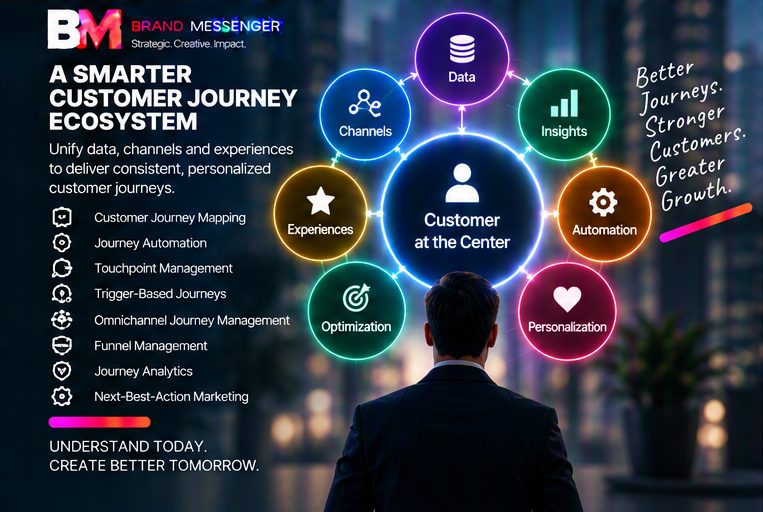
Understand Every Journey. Connect Every Touchpoint. Turn Customer Intent into Meaningful Action.
Customers rarely follow a simple path from first contact to conversion. They discover a brand, visit a website, interact with content, respond to campaigns, compare products, leave, return through another channel, speak with sales, make a purchase, and continue interacting long after conversion.
The challenge is not simply communicating with customers at individual touchpoints. It is understanding how those touchpoints connect as one continuous customer journey.
At Brand Messenger, our Customer Journey Orchestration services help organizations map, automate, coordinate, analyze, and continuously improve customer journeys across marketing, sales, digital experiences, and customer engagement channels.
From Customer Journey Mapping and Journey Automation to Touchpoint Management, Omnichannel Journey Management, Trigger-Based Journeys, Funnel Management, Journey Analytics, Drop-Off Analysis, Conversion Path Analysis, and Next-Best-Action Marketing, we help organizations create customer journeys that respond intelligently to customer behavior.
Our approach connects:
Customer → Touchpoint → Behavior → Data → Decision → Next Action → Experience → Conversion → Relationship
See the Journey. Understand the Customer. Orchestrate What Happens Next.
Our Customer Journey Orchestration Services
Brand Messenger provides comprehensive Customer Journey Orchestration capabilities, including:
Customer Journey Mapping
Journey Automation
Touchpoint Management
Omnichannel Journey Management
Trigger-Based Journeys
Funnel Management
Journey Analytics
Drop-Off Analysis
Conversion Path Analysis
Next-Best-Action Marketing
Customer Lifecycle Journey Design
Behavioral Journey Orchestration
Journey Segmentation
Personalized Customer Journeys
Real-Time Journey Triggers
Cross-Channel Journey Coordination
Lead Journey Management
Customer Onboarding Journeys
Retention & Loyalty Journeys
Re-Engagement Journeys
Journey Performance Optimization
AI-Assisted Journey Intelligence
Journey Dashboards & Reporting
Customer Journey Mapping
Visualize the Complete Customer Experience
Customer Journey Mapping helps organizations understand how customers move through different stages, channels, interactions, and decisions. Brand Messenger can map journeys such as: Awareness → Discovery → Consideration → Engagement → Lead → Evaluation → Conversion → Onboarding → Retention → Loyalty → Advocacy Journey Mapping can identify:
Customer Stages
Customer Goals
Customer Needs
Marketing Touchpoints
Digital Touchpoints
Sales Interactions
Communication Channels
Customer Actions
Decision Points
Conversion Points
Friction Points
Drop-Off Points
Opportunities for Engagement
Opportunities for Personalization
Next Actions
The objective is to understand the customer experience as a connected journey rather than a collection of independent interactions.
Journey Automation
Turn Customer Journeys into Intelligent Automated Workflows
Once a journey has been mapped, Brand Messenger can help translate it into automated marketing workflows. For example: New Lead → Welcome → Product Education → Engagement → Lead Qualification → Sales Follow-Up → Conversion → Customer Onboarding Automation can determine:
Who enters a journey
When the journey begins
Which communication is delivered
Which channel is used
How long the system waits
Which conditions are evaluated
What happens after engagement
What happens after non-response
When another journey begins
When sales should be notified
When the journey should end
This allows organizations to manage larger numbers of customer journeys without manually coordinating every interaction.
Touchpoint Management
Connect Every Interaction Around the Customer
A customer journey may include dozens of touchpoints. Brand Messenger helps organizations identify and coordinate relevant interactions across:
Advertising
Search
Social Media
Websites
Landing Pages
Forms
SMS
Mobile Apps
Push Notifications
CRM
Sales Teams
Customer Portals
Events
Customer Service
E-Commerce
Loyalty Programs
Each touchpoint can contribute information to the wider customer journey and influence what happens next.
The objective is to create continuity between interactions rather than allowing every channel or department to operate independently.
Omnichannel Journey Management
One Customer Journey Across Multiple Channels
Customers move between channels continuously. A journey might begin with advertising, continue through a website, move into email, transition to WhatsApp, involve a sales conversation, and eventually continue through a customer portal or mobile application. Brand Messenger can orchestrate: Advertising → Website → Email → SMS → WhatsApp → CRM → Sales → Mobile → Customer Portal Instead of treating these as separate campaigns, Omnichannel Journey Management connects them around the same customer relationship. This can create a more consistent experience while helping organizations understand how different channels contribute to customer progression.
Trigger-Based Journeys
Let Customer Behavior Determine What Happens Next
Customer journeys become more responsive when actions can trigger the next appropriate step. Triggers can include:Website Visit
Form Submission
Account Registration
Content Download
Product View
Pricing Page Visit
Demo Request
Cart Abandonment
Purchase
Event Registration
Email Engagement
Customer Inactivity
Subscription Expiry
Renewal Date
CRM Status Change
Customer Milestone
For example: Product Viewed → Interest Identified → Personalized Follow-Up → Customer Returns → Conversion Or: Customer Inactive → Re-Engagement Journey → Customer Responds → Active Customer Segment This allows journeys to respond to actual customer activity rather than relying only on fixed campaign schedules.
Behavioral Journey Orchestration
Build Journeys Around What Customers Actually Do
Two customers entering the same campaign may behave very differently. One may engage immediately. Another may require more education. Another may show strong purchase intent. Another may stop interacting completely. Brand Messenger can use appropriate behavioral information to create different journey paths. Behavioral signals can include:
Website Activity
Content Engagement
Email Engagement
Product Interest
Campaign Response
Purchase Activity
App Engagement
Form Submissions
Customer Service Interactions
Inactivity
Repeat Visits
Previous Conversions
This enables journeys to evolve according to customer behavior.
Funnel Management
Understand How Customers Move Toward Conversion
Customer Journey Orchestration can connect directly with marketing and sales funnels. A typical funnel can include: Reach → Awareness → Engagement → Lead → Qualified Lead → Opportunity → Conversion → Customer Brand Messenger helps organizations monitor how customers move between funnel stages. Funnel Management can support:
Marketing Funnels
Lead Generation Funnels
Sales Funnels
E-Commerce Funnels
Subscription Funnels
Event Registration Funnels
Customer Onboarding Funnels
Renewal Funnels
Each stage can be connected with specific customer journeys, triggers, automation, communication, and measurement.
Funnel Stage Automation
Automatically Respond as Customers Progress
Customer progression can automatically initiate different actions. For example:
Visitor → Lead
Start lead nurturing.
Lead → Qualified Lead
Update CRM and notify sales.
Opportunity → Customer
Stop acquisition communication and begin onboarding.
Customer → Repeat Customer
Begin retention or loyalty journey.
This creates a direct connection between funnel management and customer journey automation.
Journey Segmentation
Different Customers Need Different Journeys
Customer Journey Orchestration should not assume every customer requires the same experience. Brand Messenger can create journeys for segments such as:
New Prospects
Qualified Leads
New Customers
Existing Customers
Repeat Customers
High-Value Customers
Loyalty Customers
Subscription Customers
Renewal Customers
At-Risk Customers
Inactive Customers
Lapsed Customers
Re-Engaged Customers
Journeys can also differ according to product interest, customer value, location, behavior, account type, or other appropriate attributes.
Personalized Customer Journeys
Make the Journey Relevant to the Individual
Personalization can extend beyond changing a customer's name in a message. Brand Messenger can use appropriate customer information to personalize:
Content
Offers
Product Recommendations
Messages
Communication Channels
Customer Journey Paths
Follow-Up
Website Experiences
Onboarding
Retention Programs
Loyalty Experiences
Personalization can consider customer profile, lifecycle stage, previous engagement, product interest, purchase history, and other relevant information.
Conversion Path Analysis
Understand Which Journeys Actually Lead to Results
Customers may take very different paths before converting. One customer might follow: Google Search → Website → Email → Demo → Sale Another might follow: Social Campaign → Landing Page → WhatsApp → CRM → Sales → Conversion Another might follow: Event → Email Nurturing → Website Return → Proposal → Customer Brand Messenger helps organizations analyze these paths to understand:
Common Conversion Routes
High-Performing Touchpoints
Channel Combinations
Customer Decision Patterns
Journey Length
Number of Interactions
Assisted Touchpoints
Conversion Points
Journey Friction
This provides greater visibility into how customers actually reach business outcomes.
Drop-Off Analysis
Understand Where Customers Leave and Why It Matters
Knowing how many customers converted is important. Understanding where everyone else disappeared can be even more valuable. Brand Messenger can analyze journey and funnel drop-off at stages such as: Landing Page → Form Lead → Qualified Lead Product View → Cart Cart → Checkout Trial → Subscription Proposal → Sale Customer → Renewal Drop-Off Analysis can help identify:
High-Abandonment Stages
Journey Friction
Weak Touchpoints Communication Gaps Delayed Follow-Up Channel Problems Funnel Bottlenecks Customer Experience Issues Re-Engagement Opportunities These insights can then inform journey optimization.
Traditional campaign analytics often focus on individual messages or channels.
Customer Journey Analytics looks at how interactions work together.
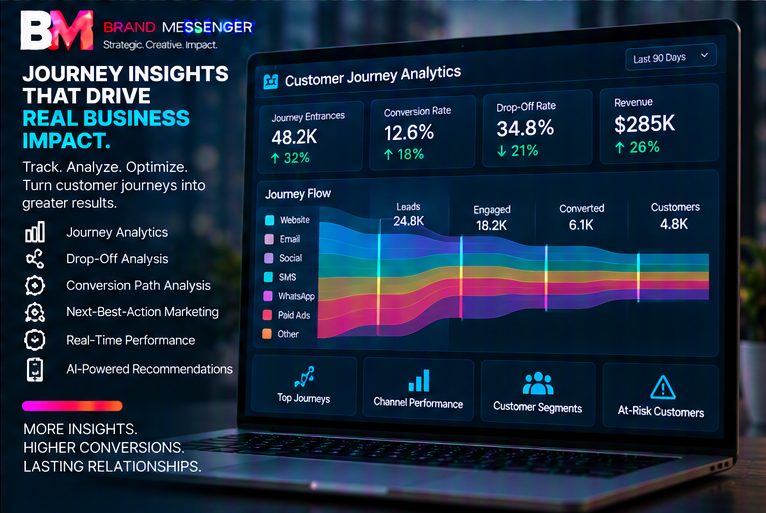
Brand Messenger can analyze:
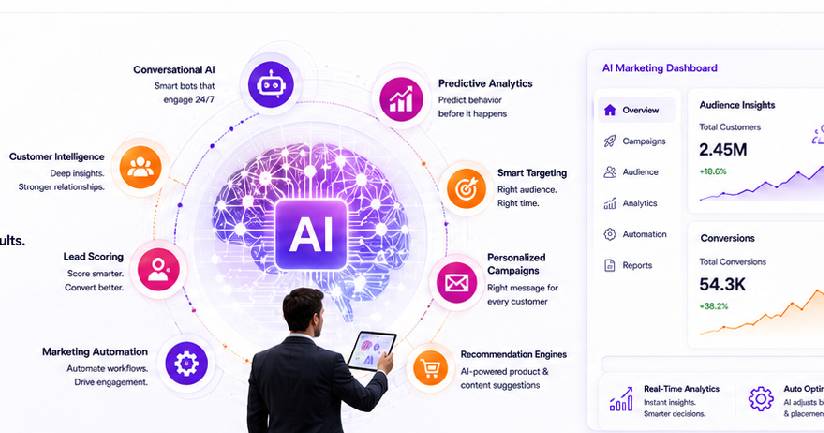
Journey Entries Journey Progression Journey Completion Customer Engagement Touchpoint Performance Funnel Movement Conversion Rates Journey Duration Drop-Off Rates Re-Engagement Customer Retention Channel Contribution Customer Lifecycle Progression Revenue Contribution This creates a more complete understanding of customer behavior. Journey Overview Active Journeys • Customers in Journey • Completion • Conversion • Drop-Off Funnel Performance Visitors • Leads • Qualified Leads • Opportunities • Customers Touchpoint Performance Web • Email • SMS • WhatsApp • Mobile • Social • CRM • Sales Conversion Intelligence Conversion Paths • Journey Length • Conversion Rate • Assisted Touchpoints Customer Lifecycle Prospects • Leads • Customers • Repeat Customers • Loyal Customers • At-Risk Customers Executive Journey Intelligence Customer Growth • Conversion • Retention • Revenue • Journey Performance • Key Opportunities This helps teams understand both operational journey performance and wider business outcomes.
One of the most important objectives of Customer Journey Orchestration is answering a simple question:
What should happen next for this customer?
Depending on customer context, the next action might be:
Send Educational Content Recommend a Product Present an Offer Send a Reminder Trigger an Email Send an SMS Start a WhatsApp Interaction Personalize a Website Experience Notify Sales Begin Onboarding Offer an Upgrade Start a Renewal Journey Begin Re-Engagement Take No Marketing Action Next-Best-Action strategies can combine customer data, business rules, journey stage, behavior, engagement history, and AI-assisted intelligence where appropriate.
AI-assisted analysis can help organizations identify patterns across complex customer journeys.
Brand Messenger can incorporate intelligence around:
Customer Intent Journey Patterns Conversion Propensity Engagement Prediction Churn Indicators Customer Lifetime Value Journey Drop-Off Risk Channel Preference Product Affinity Next-Best Action Next-Best Offer Customer Segmentation Journey Performance Forecasting AI can help support decision-making while business rules and human oversight remain part of the wider orchestration environment.
Customer Journey Orchestration can connect marketing directly with CRM and sales processes.
For example:
Advertising → Landing Page → Lead → Nurturing → Lead Score → Qualified Lead → CRM → Sales → Conversion
Brand Messenger can coordinate:
Lead Capture Lead Nurturing Lead Qualification Lead Scoring CRM Updates Sales Notifications Sales Handover Follow-Up Opportunity Progression Conversion This helps reduce the gap between marketing activity and sales execution.
The customer journey does not end at purchase.
Brand Messenger can create automated onboarding journeys such as:
Purchase → Welcome → Setup → Education → Product Adoption → Check-In → Engagement
Onboarding journeys can include:
Welcome Communication Account Setup Product Education Training Feature Discovery Customer Support Usage Reminders Helpful Content Customer Check-Ins Feedback A structured onboarding journey can help establish a stronger relationship immediately after conversion.
Existing customers require different journeys from prospects.
Brand Messenger can orchestrate retention and loyalty journeys around:
Customer Engagement Repeat Purchases Cross-Selling Upselling Renewal Loyalty Programs Customer Milestones VIP Customers Customer Appreciation Product Recommendations Feedback Advocacy These journeys can respond to customer behavior, value, lifecycle stage, and engagement history.
Customers can become inactive at different stages of the relationship.
Brand Messenger can identify appropriate inactivity conditions and initiate re-engagement journeys.
For example:
Inactivity Detected → Re-Engagement Message → Personalized Content → Offer → Customer Returns → Active Journey
Different journeys can be created for:
Dormant Leads Inactive Customers Lapsed Buyers Expired Subscribers Inactive App Users Previous Event Attendees Abandoned Prospects The objective is to create structured opportunities to restore customer engagement.
Journey orchestration should not remain static.
Brand Messenger can use journey analytics, funnel data, customer behavior, and conversion information to identify opportunities for improvement.
Optimization can include:
Removing Unnecessary Steps Improving Weak Touchpoints Adjusting Journey Timing Changing Communication Channels Improving Personalization Reducing Drop-Off Improving Lead Handover Refining Triggers Improving Customer Segmentation Testing Journey Variations Improving Conversion Paths Strengthening Retention Journeys The process becomes:
Map → Orchestrate → Measure → Analyze → Optimize → Learn → Improve
Customer Journey Orchestration becomes significantly more powerful when connected with Brand Messenger's Customer Data Platform & First-Party Data capabilities.
The architecture can operate as:
Customer Touchpoints → First-Party Data → CDP → Unified Customer Profile → Segment → Journey → Next Action
Customer interactions can then return information to the customer profile:
Journey Response → Customer Data → Updated Profile → New Decision → Next Journey
This creates a continuous intelligence loop.
CRM provides important context about customer relationships, leads, opportunities, accounts, and lifecycle stages.
Brand Messenger can connect:
CRM Status → Journey Trigger → Customer Communication → Customer Response → CRM Update
For example:
Lead Qualified → Sales Journey
Customer Converted → Onboarding Journey
Renewal Approaching → Renewal Journey
Customer Inactive → Re-Engagement Journey
This connects CRM operations directly with customer experience.
Marketing Automation provides the workflow engine that can execute many customer journeys.
Customer Journey Orchestration determines the wider experience:
Who → Why → Where → When → What Happens Next
Marketing Automation helps execute:
Trigger → Rule → Action → Wait → Condition → Next Action
Together they create more sophisticated and scalable customer engagement.
orchestrated journeys can operate.
Journeys can coordinate:
Email → SMS → WhatsApp → Push → Mobile App → Web → Social Messaging → CRM → Customer Portal
The objective is not to use every channel.
The objective is to select and coordinate the most appropriate channels around the customer's journey.
Customer journeys can begin before a customer enters the organization's owned MarTech environment.
Brand Messenger can connect AdTech and MarTech journeys:
Advertising → Audience Engagement → Website → Lead → CRM → Automation → Customer Journey → Conversion
Customer intelligence can also support appropriate advertising activation:
Customer Segment → AdTech Audience → Advertising → Engagement → Customer Journey
This creates greater continuity between paid acquisition and owned customer relationships.
Customer Journey Orchestration acts as the decision and experience coordination layer across the Brand Messenger MarTech ecosystem.
It can connect with: Marketing Automation CRM & Customer Management Technology Customer Data Platform & First-Party Data Omnichannel Marketing Technology Personalization Technology Lead Management Customer Experience Technology Content & Digital Experience Technology Marketing Analytics AI Marketing Intelligence Marketing Dashboards & Business Intelligence MarTech Integration & Data Infrastructure Brand Messenger AdTech Together:
Data → Customer → Segment → Journey → Trigger → Decision → Channel → Experience → Conversion → Measurement → Optimization
Brand Messenger can orchestrate customer experiences across: Acquisition Nurturing Conversion
Qualified → Opportunity → Decision → Customer
Onboarding Engagement Growth Retention Re-Engagement Advocacy Loyal Customer → Review → Referral → Advocacy
This allows customer journey technology to support the entire customer relationship not simply the acquisition funnel. Brand Messenger Customer Journey Orchestration can support: Retail & E-Commerce B2B & Enterprise Technology & SaaS Financial Services Telecommunications Automotive Real Estate Travel & Tourism Hospitality Healthcare Education Entertainment & Media Professional Services Events & Exhibitions Subscription Businesses Franchise & Multi-Location Businesses Membership Organizations Non-Profit Organizations Government & Public Sector Startups & Scale-Ups Brand Messenger helps organizations: Understand complete customer journeys Map customer interactions and touchpoints Automate complex customer journeys Coordinate experiences across multiple channels Respond to customer behavior Connect marketing, sales, and customer engagement Improve funnel visibility Identify customer drop-off points Analyze conversion paths Personalize customer journeys Improve lead nurturing Strengthen customer onboarding Improve retention and loyalty Re-engage inactive customers Connect CRM with customer journeys Activate CDP customer intelligence Coordinate omnichannel communication Apply AI-assisted journey intelligence Identify next-best actions Improve journey measurement Continuously optimize customer experiences Connect MarTech and AdTech around the customer
Brand Messenger combines MarTech, customer journey strategy, customer data, CDP, CRM, Marketing Automation, omnichannel communication, personalization, funnel management, analytics, AI-assisted intelligence, and AdTech integration within one connected Customer Journey Orchestration framework.Journey Analytics
Measure the Complete Journey not Just Individual Campaigns
Customer Journey Performance Dashboards
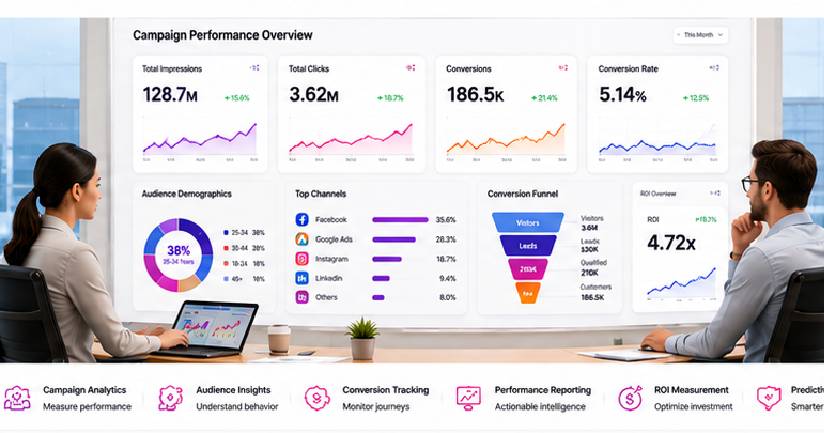
Brand Messenger can develop dashboards showing customer journey performance across different stages.
Next-Best-Action Marketing
Determine the Most Relevant Next Step
AI-Assisted Journey Intelligence
Use Customer Data to Make Journeys Smarter
Lead Journey Management
Connect Marketing Engagement with Sales Opportunities
Customer Onboarding Journeys
Continue the Experience After Conversion
Retention & Loyalty Journeys
Turn Customer Relationships into Long-Term Value
Re-Engagement Journeys
Reconnect When Customer Engagement Declines
Customer Journey Optimization
Continuously Improve How Customers Move Forward
Customer Data & Journey Orchestration
Put Customer Intelligence Behind Every Journey
CRM & Customer Journey Orchestration
Marketing Automation & Journey Orchestration
Omnichannel Marketing & Journey Orchestration
Brand Messenger's Omnichannel Marketing Technology provides the communication channels through which
Connecting Customer Journeys with AdTech
Customer Journey Orchestration Across Brand Messenger MarTech
Customer Journeys Across the Complete Lifecycle
Industries We Serve
Benefits of Customer Journey Orchestration
Why Choose Brand Messenger?
We do not view a customer journey as a static diagram showing a few stages.
We approach Customer Journey Orchestration as an active technology layer that continuously connects:
Customer Data → Customer Context → Behavior → Journey Stage → Decision → Next-Best Action → Channel → Experience → Response
Our Customer Journey Orchestration capabilities cover Customer Journey Mapping, Journey Automation, Touchpoint Management, Omnichannel Journey Management, Trigger-Based Journeys, Funnel Management, Journey Analytics, Drop-Off Analysis, Conversion Path Analysis, Next-Best-Action Marketing, lifecycle journeys, personalization, and journey optimization.
Because Customer Journey Orchestration operates across the wider Brand Messenger MarTech ecosystem, it can connect Customer Data Platforms, CRM, Marketing Automation, Omnichannel Marketing, personalization, analytics, AI intelligence, and AdTech into a continuous customer experience.
The result is not simply a mapped customer journey.
It is a connected, measurable, responsive customer journey ecosystem designed to understand where customers are, recognize what they are doing, determine what should happen next, and continuously improve the path toward stronger customer relationships and business growth.
Map Every Journey. Connect Every Touchpoint. Orchestrate Every Next Step. Grow Every Relationship.
Explore more : Link to Face Signatures