






Demand Generation Marketing
Create Market Demand. Engage the Right Buyers. Accelerate Qualified Opportunities. Build a Predictable B2B Pipeline.
B2B growth does not begin when a prospect fills out a form or asks for a sales meeting.
It begins much earlier when potential customers recognize a business challenge, discover a possible solution, develop interest, engage with relevant content, compare alternatives, and gradually become ready for a commercial conversation.
Demand Generation Marketing is Brand Messenger's dedicated B2B growth discipline for creating and developing that demand across the entire buyer journey.
At Brand Messenger, we connect brand awareness, thought leadership, content, paid media, account targeting, B2B events, lead generation, CRM, marketing automation, lead scoring, sales alignment, attribution, and revenue intelligence into one coordinated demand-generation system.
Our core capabilities include:
Pipeline Generation
Marketing Qualified Leads (MQLs)
Sales Qualified Leads (SQLs)
Multi-Touch Campaigns
Lead Acceleration
The objective is not simply to generate more leads.
It is to create a systematic path from market awareness to qualified pipeline and measurable business growth.
Create the Demand. Develop the Buyer. Accelerate the Opportunity. Build the Pipeline.
Our Demand Generation Marketing Services
Brand Messenger provides capabilities across:
B2B Demand Generation Strategy
Market Development
Demand Creation
Demand Capture
Pipeline Generation
Pipeline Acceleration
Ideal Customer Profile Development
Target Account Strategy
Audience Segmentation
Buying Committee Targeting
Decision-Maker Targeting
Account-Based Demand Generation
Marketing Qualified Lead Development
Sales Qualified Lead Development
Lead Qualification
Lead Scoring
Lead Nurturing
Lead Acceleration
Opportunity Acceleration
Multi-Touch Campaigns
Multi-Channel Demand Generation
Content-Led Demand Generation
Thought Leadership Campaigns
Paid Demand Generation
Search Demand Capture
Social Demand Generation
LinkedIn Campaigns
Display Advertising
Programmatic Advertising
Native Advertising
Retargeting
Webinar Marketing
B2B Event Demand Generation
Executive Event Marketing
Email Marketing
Marketing Automation
Personalized Campaigns
Landing Pages
Conversion Optimization
CRM Integration
Sales Handoff
Pipeline Marketing
Revenue Marketing
Campaign Attribution
Pipeline Attribution
Demand Generation Analytics
Executive Revenue Dashboards
AI-Assisted Demand Intelligence
B2B Demand Generation Strategy
Build Demand Before Asking for the Sale
Demand Generation begins by understanding:
Who the target market is
Which companies matter
Which business problems they face
Who influences the purchase
What information buyers need
Which channels reach them
What creates engagement
What makes a prospect sales-ready
Brand Messenger can develop the strategy around:
Business Objective → Market → ICP → Buyer → Business Need → Message → Content → Channel → Engagement → Qualification → Pipeline
This creates a structured marketing system rather than a collection of disconnected campaigns.
Demand Creation
Reach Buyers Before They Are Actively Searching
Many potential customers may have a business problem without actively searching for a solution.
Demand Creation helps introduce:
The Problem
The Opportunity
The Category
The Solution
The Brand
Brand Messenger can use:
Thought Leadership
Industry Content
Research
Social Media
Video
Native Advertising
Display Advertising
Programmatic Advertising
Events
Executive Forums
PR
The objective is to move audiences from:
Unaware → Aware → Interested
Demand Creation therefore develops future market opportunity.
Demand Capture
Convert Existing Market Interest into Commercial Opportunity
Some buyers already understand their problem and are actively evaluating solutions.
Demand Capture focuses on converting this existing interest through:
Search Marketing
High-Intent Content
Landing Pages
Demo Requests
Consultation Requests
Product Pages
Contact Forms
Retargeting
Comparison Content
The journey becomes:
Existing Need → Search / Research → Brand Discovery → Engagement → Lead → Sales Opportunity
Strong B2B marketing requires both:
Demand Creation + Demand Capture
Pipeline Generation
Build Marketing Around Commercial Opportunity
Pipeline Generation connects marketing activity directly with the development of potential sales opportunities.
Brand Messenger can structure pipeline programs around:
Target Accounts
Qualified Prospects
MQLs
SQLs
Meetings
Opportunities
Pipeline Value
The journey becomes:
Market → Engagement → Lead → MQL → SQL → Opportunity → Pipeline
The focus shifts from:
How many leads did marketing generate?
to:
How much qualified business opportunity did marketing help create?
Pipeline Generation Strategy
Brand Messenger can develop pipeline-generation programs according to:
Revenue Goals
Average Opportunity Value
Target Industries
Target Accounts
Sales Cycle
Conversion Rates
Geographic Markets
Product Priorities
This allows marketing activity to work backward from commercial objectives.
For example:
Revenue Goal → Required Pipeline → Required Opportunities → Required SQLs → Required MQLs → Required Demand
This creates stronger alignment between marketing investment and business growth.
Pipeline Marketing
Market Across the Entire Opportunity Journey
Marketing should not necessarily stop when a lead reaches sales.
Brand Messenger can continue supporting opportunities through:
Case Studies
Executive Content
Product Information
Customer Evidence
Events
Webinars
Retargeting
Personalized Content
This allows marketing to contribute throughout the sales pipeline.
The model becomes:
Lead Generation → Lead Development → Opportunity Support → Pipeline Acceleration
Marketing Qualified Leads - MQLs
Identify Prospects Showing Meaningful Marketing Engagement
A Marketing Qualified Lead (MQL) is generally a prospect that meets the organization's agreed marketing qualification criteria and demonstrates sufficient fit and/or engagement to move into a higher-priority stage.
Brand Messenger can help define MQL criteria using appropriate indicators such as:
Company Fit
Industry • Company Size • Geography • Account Tier
Contact Fit
Role • Seniority • Buying Influence
Engagement
Content • Website • Webinar • Event • Campaign
Intent
Demo Request • Consultation • Pricing Interest • High-Value Actions
The conceptual model becomes:
Fit + Engagement + Intent → Marketing Qualification
MQL definitions should be agreed between Marketing and Sales rather than created by Marketing in isolation.
MQL Development
Develop Interest Before Passing Leads to Sales
Not every lead is immediately ready for a sales conversation.
Brand Messenger can develop leads through:
Educational Content
Email Nurturing
Webinars
Retargeting
Case Studies
Product Content
Executive Events
Industry Reports
The journey becomes:
Lead → Education → Engagement → Qualification → MQL
This helps reduce premature sales handoffs.
MQL Scoring
Brand Messenger can establish scoring frameworks based on available indicators.
For example:
Account Fit + Contact Fit + Behavioral Engagement + Intent Signals
A high-value target account showing strong engagement may deserve greater priority than a low-fit contact completing a single form.
Lead scoring should support commercial judgment rather than replace it.
Sales Qualified Leads - SQLs
Move Sales-Ready Prospects into Commercial Engagement
A Sales Qualified Lead (SQL) represents a prospect that meets the organization's agreed criteria for active sales engagement.
Qualification may consider:
Business Need
Company Fit
Relevant Stakeholder
Solution Interest
Timing
Commercial Potential
Appropriate Sales Readiness
The progression becomes:
Lead → MQL → Sales Qualification → SQL → Opportunity
Brand Messenger can help establish clear transitions between these stages.
MQL-to-SQL Development
Build the Bridge Between Marketing and Sales
A common B2B challenge is generating large numbers of MQLs that sales teams do not consider valuable.
Brand Messenger can help align both teams around:
Qualification Criteria
Lead Scoring
Account Fit
Intent
Handoff Rules
Sales Feedback
Lead Recycling
The objective is not simply to increase MQL volume.
It is to improve:
MQL Quality → SQL Conversion → Opportunity Creation
Lead Qualification
Brand Messenger can help define qualification around:
Company
Industry
Role
Business Requirement
Product Fit
Engagement
Timing
Commercial Potential
Different organizations may use different qualification methodologies depending on their sales model.
The important principle is consistency:
What exactly makes a lead qualified?
Marketing and Sales should be able to answer that question in the same way.
Multi-Touch Campaigns
Develop Demand Across Multiple Interactions
Complex B2B purchases rarely happen after a single advertisement, email, or website visit.
A buyer journey may look like:
LinkedIn Post → Industry Article → Display Ad → Website Visit → Research Download → Email → Webinar → Retargeting → Executive Briefing → Sales Meeting
Brand Messenger develops Multi-Touch Campaigns that coordinate these interactions into a connected buyer journey.
Multi-Channel Demand Generation
Reach Buyers Wherever Their Research Happens
Brand Messenger can coordinate demand-generation campaigns across:
Search
Social Media
Display
Programmatic
Native Advertising
Website
Content
Webinars
Conferences
Executive Events
Direct Outreach
Each channel can serve a different purpose.
Search
Capture Existing Demand
Reach Professional Audiences
Display & Programmatic
Build Awareness and Reinforcement
Native Advertising
Distribute Thought Leadership
Content
Educate Buyers
Develop Relationships
Events
Create Deeper Engagement
Sales Outreach
Move Qualified Demand into Conversation
The combined journey creates greater continuity.
Multi-Touch Buyer Journeys
Different buyers may follow different paths.
Buyer Journey A
Search → Website → Demo → Sales
Buyer Journey B
LinkedIn → Report → Email → Webinar → Sales
Buyer Journey C
Programmatic Ad → Content → Retargeting → Executive Event → Opportunity
Demand Generation should support multiple paths rather than assume every prospect follows the same funnel.
Buying Committee Demand Generation
Market to the Account, Not Only One Individual
Complex B2B purchases can involve multiple stakeholders.
These may include:
Economic Buyer
Executive Sponsor
Technical Evaluator
Department Leader
User
Procurement
Finance
Brand Messenger can develop different messages for each stakeholder.
For example:
CEO → Business Growth
CFO → Financial Impact
CTO → Technology
Operations → Efficiency
Procurement → Commercial Requirements
The objective is to create demand across the buying committee.
Account-Based Demand Generation
Concentrate Demand Creation Around High-Value Accounts
Brand Messenger can combine Demand Generation with Account-Based Marketing for strategic companies.
The process becomes:
Target Account → Buying Committee → Personalized Content → Paid Media → Executive Outreach → Engagement → Meeting → Opportunity
Account-based demand programs can be particularly effective for:
Enterprise Sales
High-Value Contracts
Complex Solutions
Long Buying Cycles
Target Account Demand Programs
Accounts can be organized into tiers.
Tier 1
Highly personalized campaigns.
Tier 2
Industry and account-cluster campaigns.
Tier 3
Broader scalable demand generation.
This allows investment to reflect account value and strategic importance.
Content-Led Demand Generation
Educate the Market Before Asking for the Meeting
Content is one of the most important components of B2B Demand Generation.
Brand Messenger can develop:
Industry Reports
White Papers
Guides
Research
Case Studies
Webinars
Executive Insights
Articles
Video
Solution Guides
Comparison Content
The journey becomes:
Business Problem → Insight → Education → Brand Authority → Engagement → Demand
Thought Leadership Demand Generation
Become Part of the Buyer's Thinking Before Becoming Part of the Buying Process
Thought Leadership can help organizations create demand around:
Industry Change
Emerging Technology
Market Challenges
Regulation
Innovation
Business Transformation
The objective is to become associated with useful expertise.
The model becomes:
Insight → Authority → Trust → Engagement → Commercial Interest
Research-Led Demand Generation
Original research can provide strong B2B campaign material.
Brand Messenger can build campaigns around:
Surveys
Industry Research
Benchmark Reports
Market Studies
Trend Reports
One research asset can support:
Report → PR → Native Advertising → Social Content → Webinar → Executive Event → Lead Generation
This turns a single research initiative into a multi-channel demand engine.
Webinar Demand Generation
Webinars can combine education and lead development.
Brand Messenger can manage:
Topic → Audience → Promotion → Registration → Attendance → Engagement → Follow-Up → Qualification
Webinars can support:
Awareness
Education
Lead Capture
MQL Development
Lead Acceleration
B2B Events & Demand Generation
Brand Messenger can connect Demand Generation with its dedicated B2B Events & Conferences Marketing capabilities.
This may include:
Executive Roundtables
Industry Conferences
Business Summits
Networking Events
Customer Forums
Executive Briefings
The journey can become:
Target Account → Event Invitation → Engagement → Business Conversation → SQL → Opportunity
Events can be particularly valuable for developing higher-value B2B opportunities.
Executive Roundtable Demand Generation
For strategic accounts:
Industry Issue → Executive Invitation → Peer Discussion → Relationship → Follow-Up
This creates a more consultative form of demand generation than conventional promotional campaigns.
Paid Demand Generation
Use Paid Media to Reach and Develop B2B Audiences
Brand Messenger can connect Demand Generation with:
Search Advertising
LinkedIn Advertising
Display Advertising
Programmatic Advertising
Native Advertising
Retargeting
Paid media can support:
Awareness
Content Distribution
Lead Capture
Webinar Registration
Event Promotion
Demo Generation
Lead Acceleration
Search Demand Capture
Be Present When Buyers Actively Look for Solutions
Search can capture prospects already expressing potential interest.
Brand Messenger can structure campaigns around:
Problem-Based Searches
Solution Searches
Product Categories
Business Requirements
High-Intent Keywords
The journey becomes:
Business Need → Search → Landing Page → Lead → Qualification
Search is particularly important for capturing demand that already exists.
LinkedIn Demand Generation
LinkedIn can support B2B Demand Generation through:
Industry Targeting
Company Targeting
Role Targeting
Seniority Targeting
Thought Leadership
Lead Generation Campaigns
Retargeting
Brand Messenger can connect LinkedIn activity with wider multi-touch campaigns and CRM.
Programmatic B2B Demand Generation
Programmatic Advertising can support:
Awareness
Account Reinforcement
Content Distribution
Retargeting
Multi-Touch Journeys
A prospect may experience:
Programmatic Exposure → Content → Website → Retargeting → Webinar → Lead
This connects Brand Messenger Demand Generation with the wider AdTech ecosystem.
Native Advertising for Demand Generation
Native Advertising can help distribute:
Thought Leadership
Research
Industry Content
Executive Insights
Sponsored Articles
The journey becomes:
Relevant Content Environment → Insight → Brand → Website → Lead
Native advertising can be particularly useful when education is required before direct conversion.
Retargeting for Demand Generation
Continue the Conversation with Interested Buyers
Prospects may visit a website or consume content without converting immediately.
Brand Messenger can develop retargeting around:
Solution Pages
Research Content
Webinar Visitors
Event Pages
Product Pages
Different engagement levels can receive different follow-up creative.
For example:
Research Visitor → Case Study
Case Study Visitor → Webinar
Webinar Attendee → Executive Briefing
This creates progressive demand development.
Email Demand Generation
Email can support the full buyer journey.
Awareness
Industry Insight
Education
Guide or Report
Consideration
Case Study
Evaluation
Solution Information
Conversion
Demo or Consultation
Email becomes more effective when communication reflects buyer stage rather than repeatedly sending the same sales message.
Marketing Automation
Scale Multi-Touch Demand Development
Brand Messenger can connect Demand Generation with Marketing Automation.
For example:
Content Download → CRM / Marketing Platform → Lead Score Updated → Relevant Nurture Journey → Additional Engagement → MQL → Sales Handoff
Automation can support:
Nurturing
Lead Scoring
Segmentation
Campaign Triggers
Follow-Up
Sales Alerts
Lead Recycling
Lead Nurturing
Develop Buyers That Are Interested but Not Yet Ready
A prospect may have genuine interest without being ready for sales.
Brand Messenger can nurture leads using:
Educational Content
Industry Insights
Case Studies
Webinars
Product Information
Events
Retargeting
The journey becomes:
Interest → Education → Engagement → Confidence → Sales Readiness
This prevents marketing from forcing every lead directly into a sales conversation.
Lead Acceleration
Move Qualified Buyers Forward Faster
Lead Acceleration focuses on prospects that have already demonstrated meaningful engagement but have not yet progressed.
Brand Messenger can identify opportunities for additional engagement through:
Personalized Content
Case Studies
Retargeting
Executive Outreach
Product Demonstrations
Webinars
Executive Briefings
Sales Follow-Up
The objective is to remove unnecessary delay between:
Interest → Qualification → Sales Conversation
Lead Acceleration Signals
Depending on available systems and data, potential signals may include:
Repeated Website Visits
High-Value Page Visits
Multiple Content Downloads
Webinar Attendance
Event Participation
Pricing Interest
Demo Interest
Engagement from Multiple People at One Account
These signals can help determine where additional marketing or sales attention may be appropriate.
They should be interpreted within the wider account context.
Opportunity Acceleration
Continue Marketing After Sales Engagement Begins
Once a prospect becomes an opportunity, marketing can continue supporting the buying process.
Brand Messenger can provide:
Case Studies
Customer Evidence
ROI Content
Executive Content
Technical Materials
Product Videos
Comparison Content
Executive Events
This can help address questions from different members of the buying committee.
The journey becomes:
Opportunity → Education → Confidence → Decision
Lead Recycling
Not every MQL or SQL converts immediately.
Some prospects may be:
Too Early
Not Ready
Delayed
Missing Budget
Waiting for Internal Approval
Instead of discarding these leads, Brand Messenger can return suitable prospects to nurturing.
The process becomes:
Sales → Not Ready → Marketing Nurture → New Engagement → Requalification
This protects previously generated demand.
B2B Lead Generation & Demand Generation
Brand Messenger maintains both as distinct but connected services.
B2B Lead Generation
Focuses on identifying prospects, decision-makers, outreach, qualification, appointments, and pipeline development.
Demand Generation
Creates and develops broader market demand through content, media, campaigns, events, nurturing, and multi-touch engagement.
Together:
Demand Creation → Prospect Engagement → Lead Generation → Qualification → Pipeline
Demand Generation creates the environment.
B2B Lead Generation converts identifiable interest into potential commercial opportunity.
Demand Generation & Account-Based Marketing
Demand Generation can operate broadly across a market.
ABM concentrates resources around selected accounts.
A connected strategy can become:
Market Demand → Engaged Companies → High-Value Accounts → ABM → Opportunity
This allows organizations to use broad demand generation for discovery while applying deeper personalization to priority accounts.
Demand Generation & B2B Events
Events can operate at multiple stages:
Awareness
Industry Conference
Engagement
Webinar
Consideration
Executive Roundtable
Evaluation
Executive Briefing
Opportunity
Private Business Meeting
This allows Brand Messenger to integrate event marketing into the buyer journey.
Demand Generation & Sales Enablement
Give Sales the Content Needed to Convert Demand
Brand Messenger can support sales teams with:
Case Studies
Industry Content
Product Materials
Executive Presentations
ROI Materials
Customer Stories
Competitive Positioning
Follow-Up Content
Marketing creates demand.
Sales Enablement helps commercial teams convert that demand into effective business conversations.
Marketing & Sales Alignment
Build One Connected Revenue Journey
Demand Generation works best when Marketing and Sales agree on:
Target Market
ICP
Target Accounts
MQL Definition
SQL Definition
Lead Scoring
Handoff Criteria
Sales Follow-Up
Pipeline Stages
Attribution
Revenue Reporting
The operating model becomes:
Marketing Creates & Develops Demand → Sales Converts Qualified Demand → Customer Success Develops the Relationship
CRM Integration
Connect Demand with the Commercial Pipeline
Brand Messenger can connect demand-generation activity with CRM.
The flow becomes:
Campaign → Lead → Account → Engagement → MQL → SQL → Opportunity → Pipeline → Customer
CRM can capture:
Lead Source
Campaign
Account
Contact
Qualification
Sales Activity
Opportunity
Pipeline
Revenue
This creates visibility beyond campaign-level metrics.
CDP & Demand Generation
Where appropriate, Customer Data Platform capabilities can help organize signals from:
Website
CRM
Campaigns
Content
Events
Customer Systems
The architecture can become:
Data Sources → CDP → Unified Audience → Segmentation → Campaign Activation → Engagement → Updated Intelligence
This can support more coordinated demand-generation journeys.
Demand Generation & Brand Messenger AdTech
Brand Messenger Demand Generation can connect with AdTech capabilities including:
Programmatic Advertising
Audience Targeting
Ad Serving
Paid Media
Dynamic Creative
Retargeting
Bid Optimization
Advertising Measurement
Advertising Data & Identity
AdTech Integration
The advertising journey can become:
Target Audience → Paid Media → Engagement → Lead → CRM → Qualification
Demand Generation & Brand Messenger MarTech
Demand Generation can connect with:
CRM & Customer Management
Customer Data Platform
Marketing Automation
Omnichannel Marketing
Customer Journey Orchestration
AI Marketing & Personalization
Customer Intelligence
Campaign Management
Content Marketing Technology
Lead Management & Revenue Marketing
Marketing Analytics & Business Intelligence
Together:
Audience → Engagement → Data → Lead → Nurturing → Qualification → Sales → Revenue
Customer Success & Demand Generation
Demand Generation primarily develops new market opportunity, but existing customers can also create additional demand through:
Advocacy
Referrals
Case Studies
Expansion
Customer Events
The wider lifecycle becomes:
Demand → Customer → Success → Advocacy → New Demand
Successful customers can therefore contribute to future acquisition.
Demand Generation Funnel
A traditional funnel can be represented as:
Target Market → Awareness → Engagement → Lead → MQL → SQL → Opportunity → Pipeline → Customer
But B2B buyers do not always progress in a perfectly linear sequence.
Brand Messenger therefore combines funnel measurement with multi-touch journey analysis.
Demand Generation Flywheel
Demand can also be viewed as a continuing cycle:
Create Demand → Capture Demand → Develop Demand → Convert Demand → Customer Success → Advocacy → Create New Demand
This recognizes that customers, referrals, content, events, and advocacy can contribute to future growth.
Pipeline Velocity
Understand How Opportunities Move
Brand Messenger can analyze available indicators such as:
Number of Qualified Opportunities
Opportunity Value
Conversion Rates
Sales Cycle Length
The purpose is to understand not only how much pipeline exists, but how efficiently qualified opportunities progress.
Demand Generation Measurement
Measure What Happens Beyond the Click
Brand Messenger can monitor performance across:
Market
Reach • Awareness • Target Accounts
Engagement
Website • Content • Events • Campaigns
Leads
Leads • MQLs • SQLs
Meetings
Appointments • Demos • Consultations
Opportunities
Created • Influenced
Pipeline
Pipeline Value • Pipeline Progression
Revenue
Customers • Revenue where attributable
This creates a more commercially meaningful measurement framework.
MQL-to-SQL Conversion
One important indicator is:
MQLs → SQLs
A high volume of MQLs with very few SQLs can indicate issues with:
Targeting
Qualification
Lead Scoring
Campaign Quality
Marketing/Sales Alignment
Brand Messenger can analyze this transition to improve lead quality.
SQL-to-Opportunity Conversion
The next critical transition is:
SQL → Opportunity
This helps determine whether qualified leads are developing into real commercial conversations.
Marketing and sales feedback can be used to refine targeting and qualification.
Pipeline Contribution
Brand Messenger can evaluate:
Marketing-Sourced Pipeline
Marketing-Influenced Pipeline
Campaign-Sourced Opportunities
Campaign-Influenced Opportunities
Definitions should be agreed internally so reporting remains consistent and does not overstate marketing contribution.
Cost per Qualified Lead
Demand Generation can evaluate:
Cost per Lead
Cost per MQL
Cost per SQL
Cost per Meeting
Cost per Opportunity
This is more informative than optimizing exclusively for the cheapest possible raw lead.
Cost per Opportunity
A campaign that generates fewer leads may still outperform one producing large lead volumes if it creates more genuine opportunities.
Brand Messenger can therefore evaluate:
Marketing Investment → Qualified Opportunities
This helps move optimization toward business quality.
Pipeline ROI
Where appropriate revenue and attribution data are available, Brand Messenger can evaluate:
Marketing Investment → Pipeline → Revenue
This helps organizations understand the commercial contribution of demand-generation activity.
Pipeline is potential value and should not automatically be treated as realized revenue.
Multi-Touch Attribution
Understand the Journey Behind the Opportunity
A B2B customer may interact with:
Paid Media
Search
Content
Webinar
Event
Sales
before becoming an opportunity.
Brand Messenger can use appropriate attribution frameworks to analyze the contribution of multiple touchpoints.
The objective is not to pretend one interaction caused the entire sale.
It is to better understand how marketing channels contribute across the journey.
Account Engagement Analytics
For account-based demand programs, Brand Messenger can analyze available signals across an account rather than only individual leads.
For example:
Contact A → Webinar
Contact B → Website
Contact C → Report
Together, these interactions may indicate broader account engagement.
This creates:
Person-Level Engagement + Account-Level Intelligence
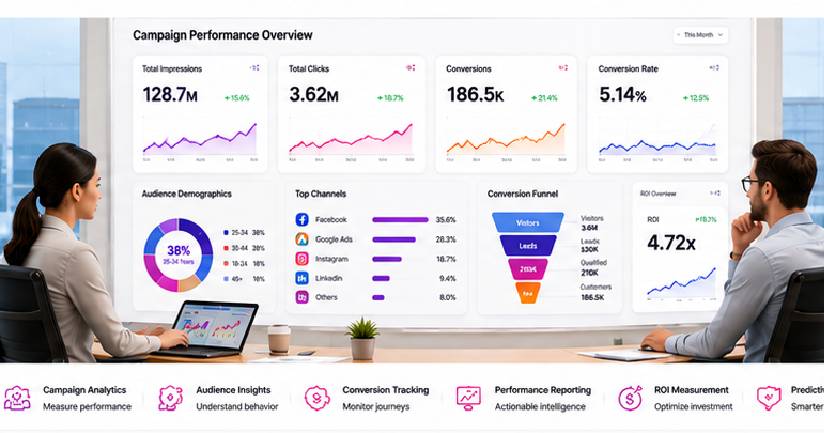
Demand Generation Dashboards
Brand Messenger can create dashboards covering:
Market
Target Audience • Accounts • Reach
Campaigns
Channels • Content • Spend • Engagement
Leads
Leads • MQLs • SQLs
Accounts
Engaged Accounts • Priority Accounts
Meetings
Booked • Completed
Opportunities
Created • Influenced
Pipeline
Value • Stage • Velocity
Revenue
Won Business where measurable
This provides Marketing, Sales, Business Development, and leadership with a connected view of demand performance.
Executive Demand & Pipeline Intelligence
Leadership may need a concise view of:
Marketing Investment
Demand Generated
MQLs
SQLs
Opportunities
Pipeline
Pipeline Velocity
Revenue
The objective is to answer:
Is Marketing Creating Qualified Business Demand and Contributing to Growth?
AI-Assisted Demand Generation
Use Intelligence to Improve Prioritization and Optimization
Brand Messenger can use AI-assisted analysis to support:
Audience Segmentation
Account Prioritization
Lead Scoring
Content Recommendations
Campaign Optimization
Engagement Analysis
Lead Acceleration
Pipeline Pattern Analysis
Where sufficient appropriate data exists, predictive models may help identify patterns associated with:
Higher Conversion Potential
Stronger Account Engagement
Sales Readiness
Opportunity Progression
AI should support marketing and sales judgment rather than guarantee future outcomes.
Predictive Lead Prioritization
Traditional lead scoring may rely on fixed rules.
AI-assisted analysis can potentially add behavioral patterns and historical conversion information where sufficient data exists.
The objective is to help answer:
Which prospects may deserve attention next?
Sales and marketing teams remain responsible for qualification and commercial decisions.
Next-Best-Action for Demand Generation
Different prospect behaviors can trigger different appropriate actions.
For example:
New Visitor → Educational Content
Engaged Lead → Case Study
Webinar Attendee → Follow-Up Content
High-Intent Prospect → Sales Outreach
Strategic Account → Executive Briefing
Not Ready → Nurture
This helps create more relevant buyer journeys.
Demand Generation Operations
Build the Operational System Behind the Campaigns
Brand Messenger can support Demand Generation Operations across:
Campaign Planning
Audience Management
CRM
Marketing Automation
Lead Scoring
Lead Routing
Sales Handoff
Data Management
Attribution
Reporting
The objective is to make demand generation repeatable rather than dependent on isolated campaigns.
Campaign Planning & Governance
Enterprise demand-generation programs may require:
Campaign Ownership
Audience Definitions
Approval Workflows
Budget Controls
Lead Definitions
Data Standards
Sales SLAs
Reporting Standards
Brand Messenger can help establish a consistent operational framework.
Lead Routing
Qualified leads can be routed according to:
Geography
Industry
Product
Account
Territory
Opportunity Type
The journey becomes:
Qualified Demand → Correct Sales Team → Faster Follow-Up
Sales Feedback Loop
Sales feedback can improve future demand generation.
For example:
Marketing Generates Lead → Sales Qualifies → Outcome Returned to CRM → Marketing Learns
Feedback may reveal:
Stronger Industries
Better Job Roles
Poor-Fit Leads
High-Value Campaigns
Better Content
This creates continuous optimization.
Complete Demand Generation Workflow
Brand Messenger can structure the complete process as:
Business Growth Objective → Market & ICP → Target Accounts & Buyers → Demand Creation → Content & Media → Multi-Touch Engagement → Demand Capture → Lead → Lead Nurturing → MQL → Lead Acceleration → SQL → Sales Handoff → Opportunity → Pipeline → Revenue → Customer Success → Advocacy → New Demand
This transforms marketing into a connected B2B growth system.
Demand Generation Marketing vs. B2B Lead Generation
Brand Messenger keeps both services because they perform different but complementary roles.
Demand Generation Marketing
Builds awareness, creates interest, educates the market, engages buying groups, develops demand, and creates qualified pipeline.
B2B Lead Generation
Focuses more specifically on:
Prospect Identification
Decision-Maker Targeting
Executive Outreach
Appointment Setting
Sales Pipeline Development
Demand Generation can create the market interest.
B2B Lead Generation can identify and develop specific business opportunities.
Together:
Create Demand → Identify Opportunity → Qualify → Convert → Grow
Demand Generation vs. Performance Marketing
Performance Marketing
Typically optimizes campaigns around measurable actions and efficiency.
Demand Generation
Covers a wider B2B buying journey that may include:
Awareness
Education
Thought Leadership
Multiple Stakeholders
Long Sales Cycles
MQLs
SQLs
Pipeline
Performance Marketing can therefore operate as one component within a broader Demand Generation strategy.
Demand Generation vs. Brand Marketing
Brand Marketing
Builds awareness, positioning, reputation, and preference.
Demand Generation
Develops market interest into engagement and commercial opportunity.
The strongest B2B growth programs can connect both:
Brand Awareness → Market Trust → Demand → Pipeline
Brand and demand should reinforce one another rather than operate as completely disconnected activities.
Across the Brand Messenger B2B Growth Ecosystem
Demand Generation Marketing connects naturally with Brand Messenger's broader B2B services:
Brand Strategy
Build Recognition and Positioning → B2B Marketing
Reach Business Audiences → Demand Generation Marketing
Create and Develop Market Demand → B2B Lead Generation
Identify and Qualify Business Prospects → Account-Based Marketing
Develop Strategic Accounts → B2B Events & Conferences Marketing
Create High-Value Business Engagement → Sales Enablement
Support Commercial Conversations → Customer Success Marketing
Onboard, Retain, Expand and Develop Customers → Customer Advocacy
Create References, Referrals and New Demand
The complete growth journey becomes:
Market → Demand → Lead → MQL → SQL → Opportunity → Pipeline → Customer → Expansion → Advocacy → New Demand
Industries We Serve
Brand Messenger Demand Generation Marketing can support:
Technology & SaaS
AI & Automation
Cybersecurity
Enterprise Software
Telecommunications
Financial Services
Banking
Insurance
Professional Services
Consulting
Legal Services
Healthcare
Pharmaceutical
Industrial & Manufacturing
Engineering
Energy
Infrastructure
Construction
Architecture
Real Estate
Logistics & Supply Chain
Automotive
Education
Media & Advertising
B2B Services
Government Technology
B2B Startups & Scale-Ups
Enterprise Platforms
Benefits of Demand Generation Marketing
Brand Messenger helps organizations:
Create market awareness before buyers are ready to purchase
Capture existing market demand
Build qualified B2B pipeline
Improve MQL development
Improve MQL-to-SQL conversion
Develop multi-touch buyer journeys
Reach multiple buying committee members
Build account-based demand programs
Connect content with commercial outcomes
Integrate paid media with lead development
Build webinar and event demand-generation programs
Nurture longer B2B buying cycles
Accelerate engaged leads
Recycle prospects that are not yet ready
Support opportunities after sales engagement begins
Connect Marketing and Sales
Integrate campaigns with CRM
Automate lead development
Improve lead routing
Measure pipeline contribution
Analyze multi-touch journeys
Improve campaign attribution
Connect marketing investment with revenue where measurable
Build a repeatable B2B growth engine
Why Choose Brand Messenger?
Brand Messenger combines Demand Generation, Pipeline Generation, MQL Development, SQL Development, Multi-Touch Campaigns, Lead Acceleration, B2B Lead Generation, Account-Based Marketing, B2B Events, Content Marketing, Media Planning & Buying, AdTech, MarTech, CRM, Marketing Automation, Sales Enablement, Revenue Marketing, and Business Intelligence within one connected B2B demand framework.
We do not approach Demand Generation as simply:
Run Campaign → Capture Leads → Send Them to Sales
We approach it as:
Market → ICP → Target Account → Buyer → Demand Creation → Multi-Touch Engagement → Demand Capture → Lead → MQL → Acceleration → SQL → Opportunity → Pipeline → Revenue → Customer Growth
Our Demand Generation Marketing capabilities span Pipeline Generation, MQLs, SQLs, Multi-Touch Campaigns, Lead Acceleration, Account-Based Demand, Content-Led Demand, Paid Media, Events, Marketing Automation, Lead Scoring, CRM Integration, Sales Alignment, Attribution, and Pipeline Intelligence.
Because Demand Generation operates inside the wider Brand Messenger B2B Marketing, Advertising, Media, Content, Events, AdTech, MarTech, CRM, Lead Management, Customer Success, and Business Intelligence ecosystem, organizations can connect every stage—from the first moment a market becomes aware of a problem to the point where a qualified opportunity enters the sales pipeline and ultimately develops into a customer relationship.
The result is not simply more campaign activity or a larger database of leads.
It is a connected B2B demand engine designed to create market interest, identify and develop qualified buyers, coordinate multiple touchpoints, accelerate commercial conversations, generate pipeline, and connect marketing activity with sustainable business growth.
Create the Demand. Engage the Buying Committee. Develop the Lead. Accelerate the Opportunity. Build the Pipeline. Drive B2B Growth.