






Connect Your Marketing Technology. Unify Your Operations. Build a MarTech Ecosystem That Works as One.
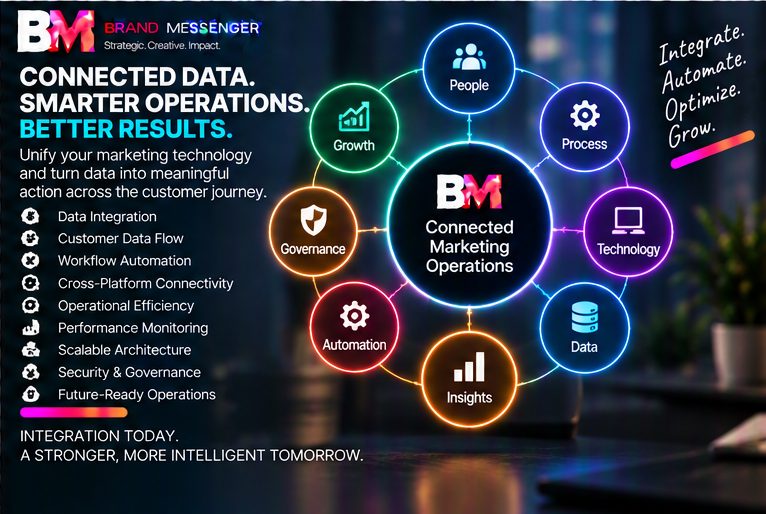
Modern marketing organizations depend on an increasingly complex technology environment.CRM platforms manage customer relationships. Customer Data Platforms unify customer information. Marketing automation systems execute campaigns and journeys. Websites, applications, advertising platforms, analytics systems, content platforms, social technologies, customer portals, commerce systems, and business intelligence tools all generate and consume marketing data.
The challenge is not simply having these technologies.
The real challenge is making them connect, exchange data, support consistent workflows, operate efficiently, and provide marketing teams with reliable information and operational control.
At Brand Messenger, our MarTech Integration & Marketing Operations services help organizations design, connect, manage, and optimize their marketing technology ecosystem.
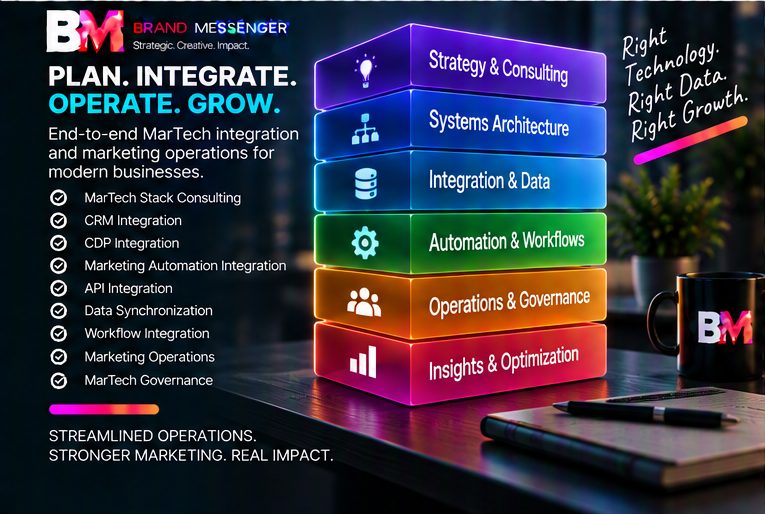
From MarTech Stack Consulting and Marketing Systems Architecture to CRM Integration, CDP Integration, Marketing Automation Integration, APIs, Data Synchronization, Workflow Integration, Marketing Operations, and MarTech Governance, we create the technology and operational foundation that connects the wider marketing ecosystem.
Our approach connects:
Strategy → Technology → Integration → Data → Workflow → Operations → Governance → Intelligence → Optimization
Connect Every Platform. Unify Every Workflow. Make Marketing Technology Work Together.
Our MarTech Integration & Marketing Operations Services
Brand Messenger provides comprehensive capabilities across:
MarTech Stack Consulting
Marketing Systems Architecture
CRM Integration
CDP Integration
Marketing Automation Integration
API Integration
Data Synchronization
Workflow Integration
Marketing Operations
MarTech Governance
MarTech Stack Assessment
Technology Requirements Analysis
Platform Selection Support
Marketing Technology Roadmaps
System Integration Planning
Customer Data Flow Design
Marketing Data Architecture
Application Integration
API & Webhook Integration
Cross-Platform Data Exchange
Customer Identity Data Integration
Campaign Data Integration
Lead Data Integration
Marketing-to-Sales Integration
Marketing Workflow Automation
Integration Monitoring
Data Quality Management
Marketing Process Design
Campaign Operations
Lead Management Operations
Marketing Performance Operations
MarTech Documentation
User & Access Governance
Technology Lifecycle Management
Marketing Operations Dashboards
AI & Automation Readiness
MarTech Performance Optimization
MarTech Stack Consulting
Build the Right Technology Ecosystem Around Your Marketing Strategy
A MarTech stack should not be a random collection of software.
Every platform should have a defined role within the organization's marketing and customer ecosystem.
Brand Messenger helps organizations assess and structure technology across areas such as:
CRM
Customer Data Platforms
Marketing Automation
Email Marketing
SMS
Customer Journey Orchestration
Campaign Management
Content Management
Digital Asset Management
Social Media Technology
Loyalty Platforms
Lead Management
Personalization
Analytics
Business Intelligence
Advertising Technology
Integration Technology
Our objective is to answer four fundamental questions:
What technology do you need?
What should each platform do?
How should the platforms connect?
How should data and workflows move between them?
MarTech Stack Assessment
Understand What You Already Have Before Adding More Technology
Many organizations accumulate marketing technologies over time.
This can create:
Duplicate Platforms
Overlapping Features
Disconnected Customer Data
Manual Data Transfers
Unused Technology
Inconsistent Workflows
Reporting Gaps
Integration Problems
Technology Silos
Unnecessary Complexity
Brand Messenger can assess the existing MarTech environment across:
Platforms → Capabilities → Integrations → Data → Workflows → Users → Performance
The assessment helps identify where technology should be integrated, consolidated, optimized, replaced, or better utilized.
MarTech Capability Mapping
Understand What Every Platform Is Responsible For
Brand Messenger can map technologies against marketing capabilities.
For example:
CRM
Customers • Leads • Accounts • Opportunities • Sales
CDP
Customer Data • Identity • Unified Profiles • Segmentation
Marketing Automation
Triggers • Nurturing • Lifecycle Automation • Campaigns
Journey Orchestration
Touchpoints • Journey Logic • Next Actions
Content Technology
Content • Assets • Distribution • Personalization
Loyalty Technology
Rewards • Membership • Retention • Customer Growth
Analytics & BI
Measurement • Dashboards • Intelligence • Reporting
AdTech
Advertising • Audience Activation • Media • Attribution
This helps prevent unnecessary platform overlap and creates clearer ownership across the technology stack.
Marketing Technology Roadmap
Build MarTech in the Right Sequence
Organizations do not necessarily need to implement every technology at once.
Brand Messenger can develop phased MarTech roadmaps based on:
Current Technology
Business Priorities
Marketing Requirements
Customer Journeys
Data Availability
Integration Dependencies
Operational Readiness
Growth Requirements
Budget
Technical Resources
A roadmap may progress through:
Foundation → Integration → Automation → Customer Intelligence → Personalization → Advanced Analytics → AI
This creates a more manageable path toward marketing technology maturity.
Marketing Systems Architecture
Design How the Entire Marketing Technology Environment Works Together
Marketing Systems Architecture defines how technologies, data, customer identities, workflows, and business processes connect.
Brand Messenger can design architecture covering:
Customer Touchpoints
CRM
CDP
Marketing Automation
Websites
Mobile Applications
Customer Portals
Content Platforms
Campaign Platforms
Social Technologies
Loyalty Systems
Advertising Platforms
Analytics
Business Intelligence
Integration Services
APIs
Data Environments
A simplified architecture can operate as:
Customer Touchpoints
↓
Web / Mobile / Social / Commerce / Events / Customer Service
↓
CRM + CDP
↓
Marketing Automation + Journey Orchestration
↓
Campaigns + Content + Loyalty + Personalization
↓
AdTech + Audience Activation
↓
Analytics + Business Intelligence
This creates a connected rather than fragmented marketing environment.
Customer-Centric MarTech Architecture
Design Technology Around the Customer Relationship
Technology architecture should not be designed only around individual departments.
Brand Messenger can organize MarTech around the customer lifecycle:
Discover → Engage → Identify → Convert → Onboard → Retain → Grow → Advocate
Different technologies support different stages, but customer information should move appropriately across the ecosystem.
The objective is to create:
One Customer Relationship → Multiple Connected Technologies
rather than:
Multiple Platforms → Multiple Disconnected Customer Views
CRM Integration
Connect Customer Relationships with the Wider Marketing Ecosystem
CRM is often one of the most important systems within the MarTech environment.
Brand Messenger can integrate CRM with:
Websites
Lead Forms
Marketing Automation
CDP
Campaign Platforms
SMS
Customer Portals
Sales Systems
Loyalty Platforms
Analytics
Advertising Platforms where appropriate
The flow can operate as:
Marketing Interaction → Lead / Customer → CRM → Marketing Journey → Sales → Customer → Revenue
CRM Integration can support:
Lead Capture
Contact Synchronization
Account Data
Customer Status
Lead Source
Campaign Association
Lead Qualification
Sales Handoff
Opportunity Information
Customer Lifecycle Updates
Revenue Feedback
This helps connect marketing activity with downstream customer and business outcomes.
CDP Integration
Connect Customer Data Across the Marketing Ecosystem
Customer Data Platforms can provide an important customer-data layer between multiple marketing systems.
Brand Messenger can connect CDPs with:
CRM
Websites
Mobile Applications
E-Commerce
Marketing Automation
Customer Portals
Loyalty Platforms
Campaign Systems
Analytics
Customer Service
Advertising Platforms
The architecture can operate as:
Customer Sources → CDP → Unified Customer Profile → Segmentation → Activation → Measurement
CDP Integration can support:
Customer Data Collection
Identity Resolution
Unified Profiles
Customer Segmentation
Audience Activation
Personalization
Journey Orchestration
Analytics
This helps transform fragmented customer information into more usable marketing intelligence.
CRM + CDP Integration
Connect Customer Management with Customer Intelligence
CRM and CDP technologies can perform complementary roles.
A connected architecture can operate as:
CRM → Customer & Sales Relationship
CDP → Unified Customer Data & Behavioral Intelligence
Together:
CRM + CDP → Customer Profile → Segmentation → Marketing Activation → Customer Response → Updated Intelligence
This creates a stronger foundation for personalization, automation, analytics, and customer growth.
Marketing Automation Integration
Connect Automation with the Systems That Provide Customer Context
Marketing automation becomes significantly more useful when it can receive data from and send information to other systems.
Brand Messenger can integrate Marketing Automation with:
CRM
CDP
Websites
Forms
E-Commerce
Customer Portals
Mobile Applications
Content Platforms
Loyalty Systems
Analytics
Sales Systems
This can enable workflows such as:
Form Submission → CRM → Marketing Automation → Lead Nurturing
Purchase → Customer Profile → Onboarding Automation
Customer Inactivity → Retention Journey
Renewal Date → Renewal Automation
Lead Qualification → Sales Handoff
Automation therefore becomes part of the customer lifecycle rather than an isolated messaging tool.
API Integration
Create Technology Connections Between Marketing Systems
APIs allow supported systems to exchange information and trigger actions.
Brand Messenger can design and implement API-based integrations for appropriate marketing environments.
API Integration can support:
Customer Data Exchange
Contact Synchronization
Lead Transfer
Campaign Data
Customer Status Updates
Product Information
Customer Activity
Conversion Data
Loyalty Information
Marketing Events
Analytics Data
The architecture can operate as:
Platform A ↔ API / Integration Layer ↔ Platform B
This helps reduce manual data transfer and enables more responsive marketing workflows.
Webhook Integration
Trigger Marketing Actions When Important Events Happen
Where supported, webhooks can allow one system to notify another when an event occurs.
For example:
Form Submitted → Create CRM Lead
Purchase Completed → Start Onboarding
Subscription Expiring → Start Renewal Journey
Customer Status Changed → Update Audience
Lead Qualified → Notify Sales
Reward Earned → Send Customer Communication
This enables more event-driven marketing operations.
Data Synchronization
Keep Marketing Information Consistent Across Platforms
Disconnected systems can create different versions of the same customer.
Brand Messenger can design synchronization processes for:
Customer Records
Contacts
Leads
Accounts
Customer Segments
Customer Status
Campaign Information
Marketing Preferences
Product Data
Transaction Data
Loyalty Information
Conversion Data
Synchronization can be:
Real-Time where supported and appropriate
Event-Driven
Scheduled
Batch-Based
One-Way
Bi-Directional
The appropriate method depends on the systems, business requirements, data volume, and operational needs.
Customer Data Flow Management
Understand Where Data Comes From, Where It Goes and Why
Brand Messenger can map customer data flows across the MarTech environment.
For example:
Website → CDP → CRM → Marketing Automation → Campaign → Customer Response → Analytics
or:
E-Commerce → CRM → Loyalty → Marketing Automation → Customer Journey
or:
CRM → CDP → Audience Segment → AdTech → Conversion → CRM
Data-flow mapping can define:
Source
Destination
Data Type
Trigger
Frequency
Transformation
Ownership
Business Purpose
This creates greater visibility into the marketing data ecosystem.
Marketing Data Quality
Better Marketing Technology Requires Better Data
Integration alone does not solve poor-quality data.
Brand Messenger can help establish processes around:
Duplicate Records
Missing Information
Invalid Data
Inconsistent Fields
Formatting
Customer Matching
Data Standardization
Customer Status
Source Identification
Segmentation Readiness
The objective is to improve the reliability of the data being used for automation, personalization, analytics, and customer engagement.
Workflow Integration
Connect Technology with the Way Marketing Teams Actually Work
Systems should not simply exchange data.
They should support coordinated business processes.
Brand Messenger can integrate workflows across:
Marketing
Creative
Sales
Customer Service
CRM
Campaign Management
Content
Customer Experience
Analytics
Management
For example:
Campaign Brief → Content Creation → Approval → Campaign Setup → Launch → Monitoring → Reporting
or:
Lead Capture → Qualification → Nurturing → MQL → Sales Handoff → Opportunity
or:
Customer Issue → CRM Update → Retention Journey → Follow-Up
Workflow Integration helps technology support the actual operational lifecycle.
Cross-Department Workflow Integration
Connect Marketing with the Wider Organization
Marketing does not operate independently.
Brand Messenger can help create technology workflows connecting:
Marketing + Sales
Leads • MQLs • SQLs • Opportunities • Revenue
Marketing + Creative
Briefs • Assets • Approval • Campaign Delivery
Marketing + Customer Service
Customer Issues • Feedback • Retention • Experience
Marketing + E-Commerce
Products • Promotions • Purchases • Customer Data
Marketing + Management
KPIs • Performance • Budgets • Business Intelligence
This creates greater operational continuity between departments.
Marketing-to-Sales Integration
Create a Connected Revenue Process
One of the most important MarTech integrations is between marketing and sales.
Brand Messenger can create processes such as:
Campaign → Lead → Lead Score → MQL → Sales Handoff → SQL → Opportunity → Customer → Revenue
Integration can support:
Lead Transfer
Lead Ownership
Qualification Status
Sales Notifications
Follow-Up
Opportunity Updates
Revenue Feedback
Closed-Loop Reporting
This allows marketing to understand what happens after a lead is handed to sales.
Marketing Operations
Build the Operational Engine Behind Modern Marketing
Marketing Operations---or Marketing Ops---is the operational discipline that helps marketing teams manage technology, processes, data, workflows, campaigns, measurement, and governance.
Brand Messenger Marketing Operations can support:
Marketing Process Management
Campaign Operations
Marketing Technology Administration
Workflow Management
Data Management
Lead Management Operations
Reporting Operations
Performance Monitoring
Marketing Documentation
Cross-Team Coordination
Technology Optimization
Operational Governance
Marketing Operations helps transform marketing strategy into repeatable execution.
Campaign Operations
Create Repeatable Campaign Execution Processes
Brand Messenger can establish campaign operating workflows such as:
Campaign Request → Planning → Audience → Content → Approval → Technology Setup → QA → Launch → Monitor → Measure → Optimize
Campaign Operations can include:
Campaign Intake
Campaign Briefs
Campaign Setup
Audience Preparation
Asset Coordination
Approval
Scheduling
Tracking
Quality Assurance
Launch
Monitoring
Reporting
This creates greater consistency across campaign execution.
Lead Management Operations
Standardize the Journey from Lead Capture to Sales
Brand Messenger can establish operational processes covering:
Lead Capture
Lead Source
Lead Enrichment
Lead Scoring
Lead Qualification
MQL Management
Lead Routing
Sales Handoff
Lead Status
Recycling
Nurturing
Conversion Reporting
The operating flow can become:
Lead → Qualification → Nurturing → MQL → Sales → Opportunity → Revenue
This connects MarTech operations directly with revenue marketing.
Marketing Process Design
Turn Repetitive Marketing Activities into Structured Workflows
Brand Messenger can map and improve recurring marketing processes.
Examples include:
Campaign Creation
Content Approval
Lead Processing
Customer Segmentation
Audience Activation
Customer Onboarding
Renewal Campaigns
Reporting
Budget Review
Marketing Requests
Asset Management
Each process can define:
Trigger → Owner → Action → Approval → System → Output → Measurement
This reduces ambiguity and makes operations easier to scale.
Marketing Operations Automation
Reduce Repetitive Manual Work
Brand Messenger can identify appropriate opportunities to automate operational activities.
Automation can support:
Lead Routing
Data Synchronization
Campaign Notifications
Approval Notifications
Audience Updates
Customer Status Changes
Reporting
Task Creation
Sales Notifications
Renewal Triggers
Workflow Escalations
The objective is not to automate everything.
It is to automate repetitive and rules-based work so teams can focus more on strategy, creativity, customer experience, and optimization.
MarTech Governance
Create Structure Around Technology, Data and Operations
As MarTech environments grow, organizations need clearer governance.
Brand Messenger can help establish governance around:
Technology Ownership
Platform Responsibilities
User Roles
Access Management
Integration Ownership
Data Ownership
Workflow Standards
Naming Conventions
Campaign Standards
Documentation
Technology Changes
Platform Reviews
Vendor Management
Data Usage
Operational Controls
Governance helps ensure the MarTech environment remains manageable as it expands.
Platform Ownership & Responsibility
Define Who Owns What
A common operational problem is unclear technology ownership.
Brand Messenger can help define responsibilities such as:
CRM Owner
Customer & Lead Management
CDP Owner
Customer Data & Identity
Marketing Automation Owner
Automation & Lifecycle Campaigns
Campaign Operations Owner
Campaign Execution
Analytics Owner
Measurement & Reporting
Integration Owner
Data & System Connectivity
Clear ownership can reduce operational gaps and conflicting platform changes.
User, Role & Access Governance
Marketing technologies may contain customer information, campaign data, business information, and administrative capabilities.
Brand Messenger can help organizations structure:
User Roles
Platform Permissions
Administrative Access
Team Access
Agency Access
External Partner Access
Access Reviews
User Onboarding
User Offboarding
Access structures should reflect organizational responsibilities and the security capabilities available within each platform.
MarTech Documentation
Build an Operational Knowledge Base for the Technology Stack
Complex MarTech environments should not depend entirely on individual team members remembering how everything works.
Brand Messenger can help document:
Technology Inventory
System Architecture
Integrations
APIs
Data Flows
Customer Fields
Campaign Processes
Automation Workflows
Platform Owners
User Roles
Naming Standards
Operational Procedures
Troubleshooting Information
Documentation helps improve continuity, onboarding, governance, and future development.
Integration Monitoring & Operational Reliability
Know When Important Connections Stop Working
An integration can exist technically but still fail operationally.
Potential issues can include:
API Failures
Authentication Problems
Missing Records
Delayed Synchronization
Duplicate Data
Workflow Errors
Broken Triggers
Unexpected Data Changes
Brand Messenger can help establish monitoring and operational review processes for important marketing integrations.
The lifecycle becomes:
Integrate → Monitor → Detect → Investigate → Resolve → Improve
MarTech Quality Assurance
Test Before Marketing Technology Reaches Customers
Technology errors can affect campaigns, customer journeys, personalization, reporting, and customer experience.
Brand Messenger can establish QA processes for:
Campaign Setup
Automation
Integrations
Customer Segments
Data Mapping
Forms
CRM Workflows
Personalization
Tracking
Reporting
A typical process can be:
Build → Test → Validate → Approve → Launch → Monitor
This adds operational discipline to marketing technology deployment.
MarTech Performance Optimization
Continuously Improve the Technology Environment
A MarTech stack should evolve as business and marketing requirements change.
Brand Messenger can periodically review:
Platform Utilization
Integration Performance
Workflow Efficiency
Data Quality
Automation Performance
Technology Overlap
User Adoption
Reporting
Operational Bottlenecks
New Requirements
This helps organizations avoid maintaining a technology stack that no longer reflects how the business operates.
Technology Lifecycle Management
Manage MarTech from Selection Through Optimization
Brand Messenger can support the technology lifecycle:
Requirements → Evaluation → Selection → Architecture → Integration → Implementation → Adoption → Governance → Optimization → Replacement / Expansion
This creates a more disciplined approach to MarTech investment.
AI & Automation Readiness
Build the Data and Integration Foundation for Intelligent Marketing
AI Marketing requires more than adding an AI tool.
Effective AI-assisted marketing depends on:
Connected Customer Data
Reliable Data
Defined Customer Identity
Integrated Platforms
Structured Workflows
Historical Performance Data
Measurement
Appropriate Governance
Brand Messenger can assess whether the MarTech environment is prepared for capabilities such as:
Predictive Marketing
AI Audience Segmentation
AI Lead Scoring
Recommendation Engines
Next-Best Action
Next-Best Offer
Churn Prediction
Campaign Optimization
Marketing Forecasting
The progression becomes:
Connect → Organize → Measure → Automate → Analyze → Predict → Personalize
MarTech Integration & Customer Journey Orchestration
Customer journeys require multiple systems to work together.
For example:
Website → CDP → CRM → Marketing Automation → Email → Customer Portal → Sales
Brand Messenger can integrate these environments so customer actions can influence what happens next.
This supports journeys such as:
Lead Nurturing
Customer Onboarding
Product Education
Repeat Purchase
Renewal
Retention
Win-Back
Cross-Sell
Upsell
Integration therefore becomes the technical foundation beneath journey orchestration.
MarTech Integration & Customer Data
Brand Messenger's Customer Data Platform & First-Party Data capabilities can connect directly with the integration layer.
The data lifecycle can operate as:
Collect → Integrate → Resolve → Unify → Segment → Activate → Measure → Update
This allows customer data to move appropriately between marketing systems while supporting a more consistent customer profile.
MarTech Integration & Marketing Automation
Marketing Automation can act only on the data and events available to it.
Integration can provide signals such as:
New Lead
Customer Purchase
Customer Status
Product Interest
Membership
Renewal Date
Customer Inactivity
Loyalty Activity
Sales Status
These signals can trigger relevant automated journeys.
The relationship becomes:
Integrated Data → Trigger → Automation → Customer Action → Updated Data
MarTech Integration & Marketing Analytics
Marketing Analytics depends on data from multiple systems.
Brand Messenger can connect:
Advertising + Website + CRM + CDP + Marketing Automation + Campaigns + Customer Journeys + Sales + Revenue
into analytics and Business Intelligence environments.
This helps create a measurement lifecycle such as:
Marketing Activity → Customer Interaction → Conversion → Pipeline → Revenue → Analytics
Integration therefore becomes essential to meaningful cross-channel reporting.
MarTech Integration & Loyalty Technology
Customer loyalty programs may require information from:
CRM
Transactions
Customer Profiles
Membership Systems
Marketing Automation
Customer Portals
Analytics
Brand Messenger can connect these systems so loyalty activity becomes part of the wider customer relationship.
For example:
Purchase → Customer Profile → Loyalty Points → Reward → Customer Communication → Redemption → Updated Profile
MarTech Integration & Social Technology
Social & Community Marketing Technology can connect with:
CRM
Customer Service
Campaign Management
Content Technology
Lead Management
Analytics
Customer Journeys
For example:
Social Enquiry → CRM Lead → Marketing Automation → Sales
or:
Social Engagement → Audience Intelligence → Campaign Segment
This helps social activity become part of the wider customer and marketing ecosystem.
Connecting MarTech with Brand Messenger AdTech
Connect Owned Customer Technology with Paid Advertising Technology
Brand Messenger's MarTech and AdTech ecosystems can operate as connected but distinct technology layers.
MarTech can manage:
CRM → CDP → Automation → Journeys → Customer Engagement → Loyalty → Analytics
AdTech can manage:
Audience Activation → Media Buying → Ad Serving → Paid Media → Retargeting → Bid Optimization → Advertising Measurement
Integration connects the two:
First-Party Data → CRM / CDP → Audience → AdTech → Advertising → Conversion → CRM → Customer Journey → Revenue
This creates a closed-loop relationship between customer marketing and paid advertising.
MarTech-to-AdTech Data Flow
A connected environment can operate as:
CRM / CDP
↓
Customer Segmentation
↓
Audience Eligibility & Activation
↓
Advertising Platforms
↓
Campaign Delivery
↓
Customer Interaction
↓
Conversion
↓
CRM / CDP Update
↓
Marketing Automation / Customer Journey
↓
Revenue & Attribution
This allows paid advertising to participate in a wider customer lifecycle rather than operate as an isolated media activity.
MarTech Operations & Business Intelligence
Marketing Operations generates important operational intelligence.
Brand Messenger can develop dashboards around:
Technology
Platforms • Integrations • Utilization • Status
Campaign Operations
Campaigns • Workflow • Approvals • Launches
Lead Operations
Leads • Routing • MQLs • Handoffs
Data Operations
Records • Synchronization • Data Quality • Exceptions
Automation
Workflows • Triggers • Activity • Performance
Marketing Performance
Campaigns • Conversion • Pipeline • Revenue
Governance
Users • Access • Platforms • Documentation • Reviews
This gives marketing leadership visibility into both marketing performance and the operational environment supporting it.
MarTech Operations Command View
Create One Operational View Across the Marketing Ecosystem
For larger marketing environments, Brand Messenger can bring key operational information into a centralized management view.
This can include:
Technology Status
Campaign Activity
Data Synchronization
Automation Activity
Lead Flow
Customer Journeys
Marketing Performance
Integration Issues
Operational Alerts
The objective is to help teams understand not only what marketing is achieving, but whether the underlying technology environment is operating as expected.
MarTech Integration Architecture
A connected Brand Messenger MarTech environment can operate as:
Customer Touchpoints
↓
Web \| Mobile \| Social \| E-Commerce \| Events \| Customer Portals
↓
CRM + CDP + Customer Identity
↓
Marketing Automation + Journey Orchestration
↓
Campaign + Content + Social + Loyalty Technology
↓
AdTech & Audience Activation
↓
Marketing Data Integration
↓
Analytics + Business Intelligence + AI
↓
Marketing & Executive Decisions
This architecture connects customer experience, marketing operations, advertising, analytics, and business intelligence.
MarTech Integration & Marketing Operations Across Brand Messenger MarTech
MarTech Integration & Marketing Operations can operate as the technology architecture, connectivity, operational control, and governance layer across the entire Brand Messenger MarTech ecosystem.
It connects:
Marketing Automation
CRM & Customer Management Technology
Customer Data Platform & First-Party Data
Omnichannel Marketing Technology
Customer Journey Orchestration
AI Marketing & Personalization
Customer Intelligence & Behavioral Analytics
Campaign Management Technology
Content Marketing Technology
Lead Management & Revenue Marketing
Conversion & Experience Optimization
Marketing Analytics & Business Intelligence
Loyalty, Retention & Customer Growth Technology
Social & Community Marketing Technology
Brand Messenger AdTech
Together:
Technology → Integration → Customer Data → Workflow → Automation → Activation → Measurement → Governance → Optimization
A Connected MarTech Operating Model
Plan
Strategy • Requirements • Architecture • Roadmap
Connect
CRM • CDP • Automation • APIs • Platforms
Synchronize
Customers • Leads • Campaigns • Events • Conversions
Automate
Workflows • Journeys • Operations • Notifications
Operate
Campaigns • Leads • Data • Technology
Measure
Performance • Funnel • Pipeline • Revenue
Govern
Platforms • Access • Data • Processes • Documentation
Optimize
Technology • Integrations • Workflows • Operations
Innovate
AI • Predictive Intelligence • Personalization • Automation
This provides a complete operating framework for modern marketing technology.
Industries We Serve
Brand Messenger MarTech Integration & Marketing Operations can support:
B2B & Enterprise
Retail & E-Commerce
Technology & SaaS
Financial Services
Telecommunications
Automotive
Travel & Tourism
Hospitality
Healthcare
Education
Real Estate
Professional Services
Entertainment & Media
Events & Exhibitions
Manufacturing & Industrial
Consumer Brands & FMCG
Subscription Businesses
Membership Organizations
Franchise & Multi-Location Businesses
Non-Profit Organizations
Government & Public Sector
Startups & Scale-Ups
Benefits of MarTech Integration & Marketing Operations
Brand Messenger helps organizations:
Build a more connected MarTech ecosystem
Understand and rationalize existing technology
Develop structured MarTech roadmaps
Design scalable marketing systems architecture
Connect CRM with wider marketing technology
Integrate CDPs and customer data
Connect Marketing Automation with customer systems
Implement API and webhook integrations
Synchronize data across platforms
Reduce unnecessary manual data transfer
Improve customer data consistency
Connect marketing and sales workflows
Create repeatable campaign operations
Improve lead management operations
Automate operational marketing workflows
Establish clearer technology ownership
Build MarTech governance
Improve platform and access management
Document technology and data flows
Monitor important integrations
Improve MarTech quality assurance
Connect MarTech with AdTech
Create stronger analytics and BI foundations
Prepare the technology environment for AI-assisted marketing
Improve technology utilization
Scale marketing operations more effectively
Why Choose Brand Messenger?
Brand Messenger brings together MarTech strategy, systems architecture, integration, customer data, CRM, CDP, Marketing Automation, Customer Journey Orchestration, Campaign Management, Content Technology, Loyalty Technology, Social Technology, Marketing Analytics, AI Marketing, Marketing Operations, and AdTech within one connected technology framework.
We do not approach MarTech as a collection of isolated software subscriptions.
We approach it as an operating ecosystem:
Strategy → Architecture → Platforms → Integration → Data → Workflow → Operations → Intelligence → Governance → Optimization
Our MarTech Integration & Marketing Operations capabilities span MarTech Stack Consulting, Marketing Systems Architecture, CRM Integration, CDP Integration, Marketing Automation Integration, API Integration, Data Synchronization, Workflow Integration, Marketing Operations, and MarTech Governance.
Because this service operates across the entire Brand Messenger MarTech and AdTech ecosystem, it provides the foundation that allows customer data, marketing technology, campaigns, automation, customer journeys, advertising, analytics, and revenue intelligence to work together.
The result is not simply an integrated technology stack.
It is a connected marketing operating environment designed to reduce technology fragmentation, improve data flow, automate workflows, strengthen operational control, support governance, enable customer intelligence, and provide the technology foundation for scalable modern marketing.
Connect the Stack. Unify the Data. Automate the Workflow. Govern the Technology. Power the Entire Marketing Operation.