






Connect Every Customer Relationship. Manage Every Opportunity. Build a Smarter Customer Lifecycle.
Customer relationships are created across many different touchpoints advertising campaigns, websites, enquiries, sales conversations, events, customer service interactions, purchases, subscriptions, and ongoing engagement. Without a connected customer management environment, valuable information can become fragmented across teams and systems.
At Brand Messenger, our CRM & Customer Management Technology services help organizations create a structured technology foundation for managing prospects, leads, customers, accounts, sales opportunities, interactions, and long-term customer relationships.
From CRM Strategy & Implementation and Customer Database Management to Lead Management, Prospect Management, Sales Pipeline Integration, Contact Management, Account Management, Customer Lifecycle Management, CRM Automation, and CRM Analytics, we help organizations connect marketing, sales, customer engagement, and relationship intelligence.
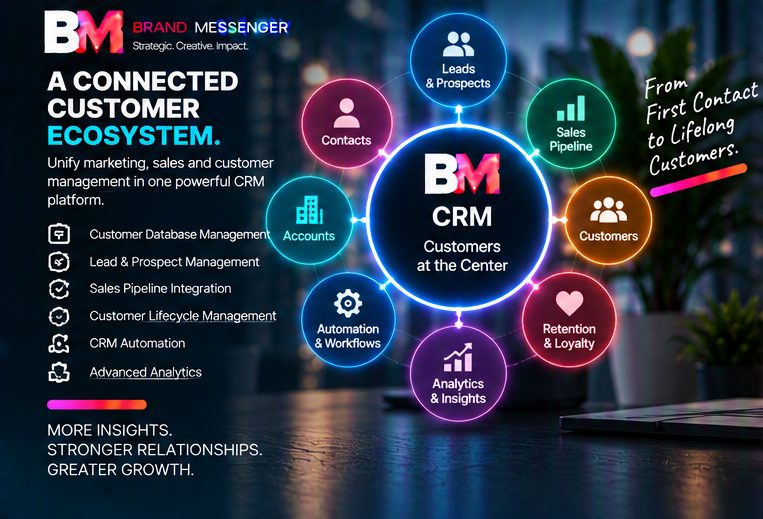
Our approach transforms CRM from a simple contact database into a connected customer management environment:
Prospect → Lead → Opportunity → Customer → Relationship → Retention → Growth → Loyalty
Our CRM & Customer Management Technology Services
Brand Messenger provides comprehensive CRM and customer management capabilities, including:
CRM Strategy & Implementation
Customer Database Management Lead Management Prospect Management Sales Pipeline Integration Contact Management Account Management Customer Lifecycle Management CRM Automation CRM Analytics CRM Data Architecture Lead Capture & Routing
Lead Scoring & Qualification Opportunity Management Customer Interaction Management Customer Segmentation Customer History & Timeline Sales & Marketing Alignment CRM Integration Customer Retention Management CRM Dashboards & Reporting AI-Assisted Customer Intelligence
Successful CRM implementation begins with understanding how an organization actually acquires, manages, converts, serves, and retains customers.
Business Requirements
Customer Journey Lead Management Process Sales Process Customer Lifecycle User Roles Teams & Departments Data Requirements CRM Workflows Automation Requirements Marketing Integration Reporting Requirements Customer Service Connections Existing Technology Integration Data Migration Requirements Performance Measurement The objective is to create a CRM environment that supports real business processes rather than forcing teams into unnecessary technology complexity. Customer information can originate from many different sources. Customer Profile Contact Information Organization Details Lead Source Customer Status Product or Service Interest Previous Interactions Campaign Engagement Purchase History Customer Preferences Account Information Sales Activity Customer Lifecycle Stage Relationship History Assigned Team or Representative A well-structured customer database creates the foundation for CRM, automation, segmentation, personalization, analytics, and customer lifecycle management. Lead generation creates little value when enquiries are not properly captured, assigned, followed up, and measured. Website Leads Advertising Leads Landing Page Leads Social Media Leads Event Leads Referral Leads Telephone Enquiries Email Enquiries Campaign Responses Partner Leads Sales-Generated Leads Offline Leads Each lead can be organized according to status, source, interest, priority, owner, activity, and next action. CRM technology can automatically capture and distribute incoming leads according to predefined business rules. Product or Service
Geographic Market
Customer Type
Industry
Lead Source
Campaign
Sales Territory
Account Ownership
Lead Priority
Team Availability
Business Unit
A connected process can operate as:
Enquiry → CRM Record → Qualification → Assignment → Notification → Follow-Up
This reduces manual administration and helps improve response consistency. Not every prospect is ready to become an immediate sales opportunity. Prospect Profiles Interest Tracking Communication History Marketing Engagement Content Engagement Meeting History Follow-Up Activities Lead Scores Qualification Status Product Interests Sales Readiness Nurturing Status Prospects can move progressively through marketing and sales processes as their level of interest changes.
Brand Messenger can create lead qualification frameworks using customer information, business rules, engagement signals, and where appropriate AI-assisted analysis. Customer Profile Company Profile Product Interest Website Activity Campaign Engagement Content Downloads Email Engagement Event Participation Demo Requests Pricing Enquiries Previous Conversations Purchase Intent Sales Activity Qualified leads can automatically move into appropriate sales pipelines, nurturing journeys, or priority follow-up processes.
CRM should provide a clear bridge between marketing-generated interest and the sales process. Products Services Business Units Sales Teams Markets Customer Types Enterprise Accounts Geographic Regions This provides marketing and sales teams with a shared view of how customer opportunities progress toward conversion.
Once a lead becomes a qualified commercial opportunity, CRM can help manage the complete sales process. Opportunity Value Sales Stage Probability Expected Close Date Products or Services Decision-Makers Customer Requirements Meetings Proposals Quotations Follow-Up Activities Sales Notes Opportunity History Win/Loss Status This provides organizations with clearer visibility into active business opportunities and potential revenue.
Contact Management provides structured information about the individuals an organization communicates with. Contact Details Organization Role Relationship Communication Preferences Previous Interactions Campaign Activity Sales Activity Customer Status Assigned Representative Notes Tasks Meetings Relevant Documents Customer Journey Stage This helps teams understand the context of the relationship before every interaction.
For B2B, enterprise, government, professional services, and account-based environments, customer relationships often involve entire organizations rather than individual contacts. Company Profiles Multiple Contacts Decision-Makers Account Owners Account Segmentation Opportunity History Purchase History Account Value Customer Activities Relationship History Cross-Sell Opportunities Renewal Opportunities Strategic Account Planning
This creates a more complete view of complex organizational relationships. Customer relationships develop through many interactions. Calls Meetings Website Enquiries Campaign Responses Sales Activities Customer Requests Event Participation Purchases Renewals Support Interactions Internal Notes Follow-Up Tasks
A connected interaction history gives teams greater context when communicating with customers.
Brand Messenger can help organizations structure customer timelines showing how a relationship has developed.
CRM should not stop when an opportunity becomes a customer.
Brand Messenger helps organizations manage customers across the complete lifecycle:
Prospect → Lead → Qualified → Opportunity → Customer → Onboarding → Active Customer → Retention → Renewal → Loyalty → Advocacy → Re-Engagement
Lifecycle Management can support: Customer Acquisition Onboarding Customer Engagement Product Adoption Cross-Selling Upselling Retention Renewal Loyalty Customer Win-Back Advocacy
Different lifecycle stages can trigger different communications, workflows, campaigns, tasks, and customer experiences.
CRM information can be used to build customer segments based on appropriate attributes and behavior.
Segments can include: New Leads Qualified Leads Existing Customers High-Value Customers Repeat Customers Inactive Customers Lapsed Customers Renewal Customers Loyalty Customers Product Interest Groups Geographic Segments Industry Segments Enterprise Accounts Customer Value Segments
These segments can connect directly with marketing automation, personalization, campaigns, analytics, and AdTech audience activation where appropriate.
Brand Messenger can automate repetitive CRM processes while maintaining structured customer records.
CRM automation can support: Lead Creation Lead Assignment Lead Routing Status Updates Follow-Up Tasks Sales Notifications Customer Segmentation Pipeline Movement Customer Onboarding Renewal Reminders Re-Engagement Internal Notifications Marketing Automation Customer Lifecycle Changes Data Synchronization
For example:
New Lead → CRM Record → Lead Score → Sales Assignment → Follow-Up Task → Nurturing Journey
or:
Customer Purchase → CRM Status Updated → Onboarding Started → Retargeting Exclusion → Retention Journey
Automation helps CRM become an active business system rather than a passive database.
CRM and Marketing Automation become significantly more powerful when they operate together.
Brand Messenger can connect:
CRM Data → Customer Segment → Automation Trigger → Personalized Communication → Customer Response → CRM Update → Next Journey
This can support: Lead Nurturing Customer Onboarding Promotional Campaigns Customer Retention Renewal Campaigns Loyalty Programs Re-Engagement Cross-Sell Upsell Customer Education
The CRM provides customer context while marketing automation determines how that context can activate relevant customer journeys.
Customer relationships can span multiple communication environments.
Brand Messenger can help connect CRM with appropriate channels such as:
Email → SMS → WhatsApp → Website → Mobile App → Customer Portal → Sales → Customer Service
This can help organizations maintain greater continuity as customers move between channels.
Customer history, lifecycle stage, preferences, previous activity, and current status can provide context for future engagement.
CRM becomes more valuable when connected with the systems surrounding the customer.
Brand Messenger can help integrate CRM with: Websites Landing Pages Customer Data Platforms Marketing Automation Email Marketing SMS WhatsApp E-Commerce Mobile Applications Customer Portals Analytics Advertising Platforms Business Intelligence Other Appropriate Business Systems
Integration can use APIs, webhooks, data synchronization, and structured workflows where supported.
CRM and CDP technologies perform different but complementary roles.
CRM can manage operational customer relationships, leads, opportunities, sales activity, and customer interactions.
CRM information can also support Brand Messenger's wider AdTech ecosystem.
Where appropriate permissions and platform capabilities exist, CRM integration can support: First-Party Audience Activation Customer Match CRM Audience Retargeting Existing Customer Exclusion High-Value Audience Strategies Customer Re-Engagement Lookalike or Similar Audiences Conversion Feedback Customer Acquisition Analysis
This creates a bridge between customer management and paid advertising.
AI can help organizations analyze CRM information and identify patterns that support customer, marketing, and sales decisions.
Brand Messenger can incorporate AI-assisted intelligence around: Lead Scoring Sales Opportunity Prioritization Purchase Intent Customer Segmentation Churn Indicators Customer Lifetime Value Next-Best Action Cross-Sell Opportunities Upsell Opportunities Renewal Probability Customer Engagement Sales Forecasting Relationship Trends
AI supports the decision-making process while teams retain appropriate business oversight and customer context.
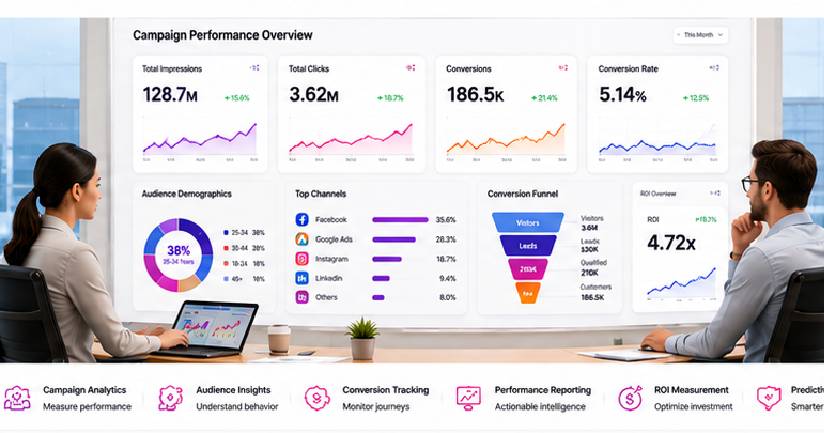
Brand Messenger can transform CRM activity into structured customer and business intelligence.
CRM Analytics can cover:, Lead Volume Lead Sources Lead Conversion Sales Pipeline Opportunity Value Conversion Rate Sales Cycle Customer Acquisition Customer Retention Renewal Performance Customer Lifetime Value Account Performance Customer Segments Sales Team Performance Campaign Contribution Revenue Trends These insights help organizations understand how marketing and customer relationships contribute to business performance.
Brand Messenger can create dashboards for different teams and decision-makers.
Customers, pipeline value, acquisition, retention, revenue, forecasts, and growth indicators.
This helps move CRM reporting beyond activity counts toward business intelligence.
Disconnected marketing and sales systems can create gaps in customer journeys.
Brand Messenger helps establish a connected process:
Marketing Campaign → Lead → Qualification → CRM → Nurturing → Sales Opportunity → Conversion → Customer → Retention
Marketing teams can understand which campaigns create stronger opportunities, while sales teams gain greater context about customer interests and previous engagement.
This creates greater alignment around shared customer and revenue objectives.
CRM & Customer Management Technology acts as a central relationship layer within the wider Brand Messenger MarTech ecosystem and can connect with: Marketing Automation Customer Data Platforms Customer Data & Identity Customer Journey Orchestration Personalization Technology Omnichannel Customer Engagement Lead Management & Revenue Marketing Content & Digital Experience Technology Customer Experience Technology Marketing Analytics AI Marketing Intelligence Marketing Dashboards & Business Intelligence MarTech Integration & Data Infrastructure Brand Messenger AdTech Together, these technologies can create a connected customer lifecycle:
Acquire → Capture → Qualify → Nurture → Sell → Onboard → Engage → Retain → Grow → Measure
Brand Messenger can structure CRM environments for different operational models, including: B2C Customer Management B2B CRM Enterprise Account Management Sales CRM Marketing CRM Membership Management Subscription Customer Management Professional Services CRM Franchise & Multi-Location CRM Partner & Distributor Management Event Lead Management Government & Public Sector Relationship Management The technology and workflows can be adapted according to the organization's customer model rather than forcing every organization into the same CRM structure.
Brand Messenger CRM & Customer Management Technology can support organizations across: Retail & E-Commerce B2B & Enterprise Technology & SaaS Financial Services Telecommunications Automotive Real Estate Travel & Tourism Hospitality Healthcare Education Entertainment & Media Professional Services Events & Exhibitions Subscription Businesses Franchise & Multi-Location Businesses Membership Organizations Non-Profit Organizations Government & Public Sector Startups & Scale-Ups
Brand Messenger helps organizations: Centralize customer information Create structured customer databases Improve lead management Manage prospects more effectively Connect marketing with sales pipelines Improve contact and account management Maintain customer interaction histories Understand complete customer relationships Automate repetitive CRM processes Improve lead routing and follow-up Support lead scoring and qualification Manage the complete customer lifecycle Improve customer retention Identify cross-sell and upsell opportunities Coordinate renewals and re-engagement Connect CRM with marketing automation Connect CRM with CDP and customer data Connect CRM with AdTech Create a stronger foundation for long-term customer growth
Brand Messenger combines MarTech, CRM strategy, customer data, lead management, sales pipeline technology, customer lifecycle management, marketing automation, AI-assisted intelligence, analytics, integration, and customer experience within one connected customer management framework.CRM Strategy & Implementation
Build CRM Around the Business not the Other Way Around
Brand Messenger helps organizations develop CRM strategies around their business structure, customer journeys, teams, sales processes, marketing activities, and customer management requirements.
CRM strategy can address:
Customer Database Management,
Create a Reliable Foundation for Customer Intelligence
Brand Messenger helps organizations organize customer information into more structured and useful databases.
Customer records can include appropriate information such as:Lead Management,
Capture, Organize and Progress Every Opportunity
Brand Messenger helps organizations create structured lead management processes connecting:
Lead Capture → Classification → Assignment → Qualification → Nurturing → Sales Opportunity → Conversion
Lead Management can support:Lead Capture & Routing,
Get New Opportunities to the Right Team Faster
Lead routing can consider:Prospect Management,
Manage Potential Customers Before They Become Sales Opportunities
Brand Messenger helps organizations maintain structured prospect records and engagement histories so potential customers can be developed over time.
Prospect Management can include:Lead Scoring & Qualification,
Help Teams Prioritize Stronger Opportunities
Lead scoring can consider:Sales Pipeline Integration,
Connect Marketing Activity with Revenue Opportunities
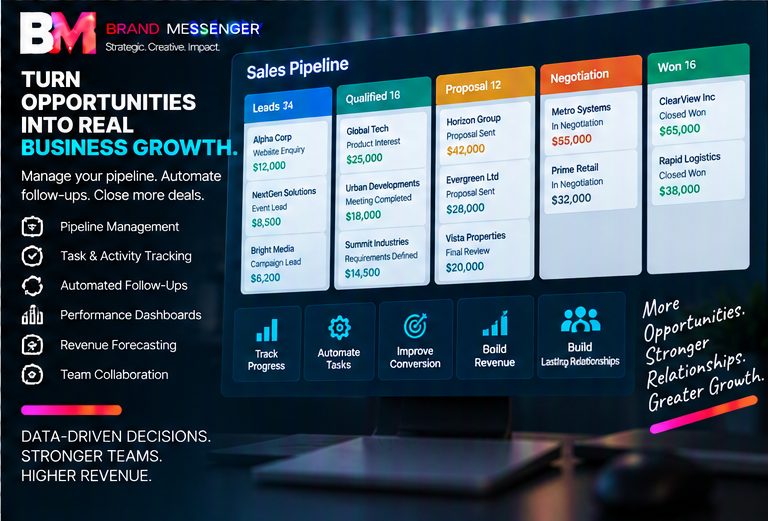
Brand Messenger can integrate customer and lead management with structured sales pipelines such as:
New Lead → Qualified Lead → Discovery → Proposal → Negotiation → Won / Lost
Pipeline structures can be customized around different:Opportunity Management,
Manage Potential Revenue from Interest to Decision
Opportunity Management can support:Contact Management,
Keep Customer Relationships Organized in One Connected View
Customer contact profiles can include:Account Management,
Manage Organizations, Relationships and Multiple Stakeholders
Brand Messenger can structure CRM around:
Account → Departments → Contacts → Opportunities → Activities → Contracts → Customer Relationship
Account Management can support:Customer Interaction Management,
Create a Continuous Record of the Customer Relationship
CRM technology can maintain appropriate histories across activities such as:Customer Timeline & Relationship History,
See the Journey, Not Just the Current Record
A timeline might show:
First Campaign Interaction → Website Enquiry → Lead Created → Sales Call → Proposal → Purchase → Onboarding → Support → Renewal → Loyalty
This provides marketing, sales, and customer teams with a more meaningful understanding of the complete relationship.Customer Lifecycle Management,
Manage Relationships Beyond the Initial Sale
Customer Segmentation,
Organize Customers into Actionable Groups
CRM Automation,
Automate Customer Management Without Losing Relationship Context
CRM & Marketing Automation,
Connect Customer Records with Automated Engagement
CRM & Omnichannel Customer Engagement,
CRM Integration
Connect CRM with the Wider Business Technology Ecosystem
CRM & Customer Data Platform Integration,
Connect Operational Customer Management with Unified Customer Intelligence
A Customer Data Platform can help unify customer information from multiple digital and business sources.
Together, they can support:
Customer Data → Unified Profile → CRM Relationship → Segmentation → Marketing Activation → Customer Interaction → Analytics
Brand Messenger can help organizations define how these technologies should exchange appropriate customer information.CRM & AdTech Integration,
Connect Customer Relationships with Advertising
AI-Assisted CRM Intelligence,
Turn Customer Records into Decision Support
CRM Analytics,
Understand Customers, Pipelines and Relationships Through Data
CRM Dashboards & Executive Reporting,
Turn Customer and Sales Data into Decision-Ready Intelligence
Marketing Dashboard
Lead sources, campaign responses, customer segments, conversions, and customer journeys.
Sales Dashboard
Pipeline, opportunities, sales stages, conversion rates, revenue, and sales activities.
Customer Dashboard
Customer lifecycle, retention, renewals, engagement, and relationship value.
Executive Dashboard
CRM for Marketing & Sales Alignment,
Create One Connected View of Customer Opportunities
CRM Across Brand Messenger MarTech,
CRM Technology for Different Organizations,
Industries We Serve,
Benefits of CRM & Customer Management Technology,
Why Choose Brand Messenger?
We do not view CRM simply as software for storing names, phone numbers, and email addresses.
We approach CRM as the relationship and operational layer of the wider customer technology ecosystem:
Customer Data → Prospect → Lead → Opportunity → Customer → Engagement → Retention → Loyalty → Intelligence → Growth
Our CRM & Customer Management Technology capabilities span CRM Strategy & Implementation, Customer Database Management, Lead Management, Prospect Management, Sales Pipeline Integration, Contact Management, Account Management, Customer Lifecycle Management, CRM Automation, CRM Analytics, lead scoring, opportunity management, customer segmentation, integration, and executive reporting.
Because CRM operates within the wider Brand Messenger MarTech ecosystem, organizations can connect customer management directly with Marketing Automation, CDP, Customer Journey Orchestration, Personalization, Omnichannel Engagement, Marketing Analytics, AI Marketing Intelligence, AdTech, and Business Intelligence.
The result is more than a customer database. It is a connected relationship environment designed to help organizations capture opportunities, understand customers, coordinate teams, automate processes, strengthen relationships, improve retention, and create measurable customer growth.
Connect Every Customer. Manage Every Opportunity. Grow Every Relationship.
Read More