





Field Marketing
Put the Brand Where the Market Happens. Connect People, Products, Retail Locations and Sales Opportunities Through Professional On-the-Ground Marketing Execution.
Not every customer relationship begins online.
For many organizations, some of the most important marketing moments happen inside stores, across retail networks, at commercial locations, during product demonstrations, through face-to-face conversations and wherever customers physically encounter the brand.
This is where Field Marketing becomes an important part of the wider marketing ecosystem.
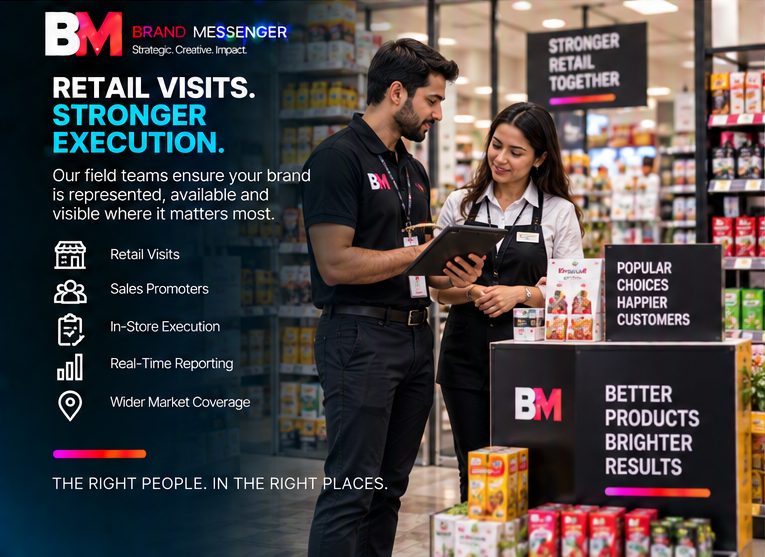
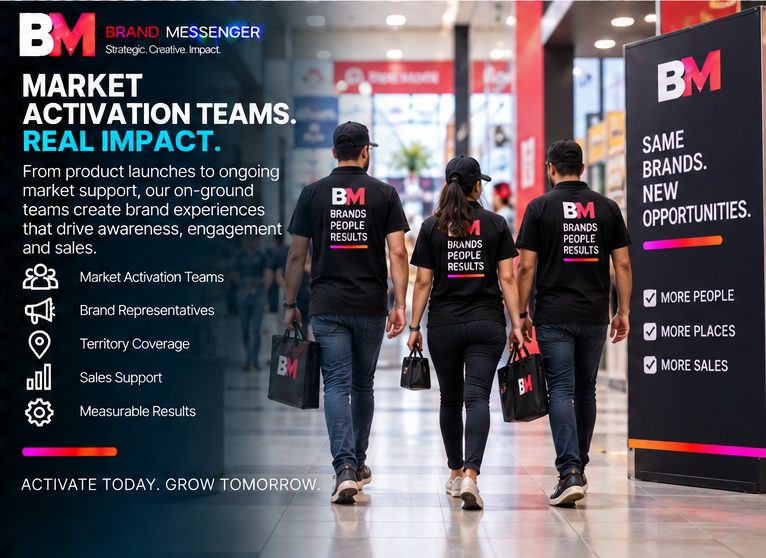
Field Marketing connects marketing strategy with real-world execution through trained brand representatives, sales promoters, retail visits, market activation teams, product demonstrations, merchandising support, lead generation, location audits, campaign execution and field intelligence.
For enterprise organizations, the challenge is larger than simply deploying promotional staff.
A company may need to coordinate hundreds of locations, maintain consistent brand standards, monitor retail execution, manage field teams, capture structured market information, support sales channels, verify campaign activity and connect what happens in the field with wider marketing and business intelligence.
The question becomes:
How Do We Turn Distributed On-the-Ground Marketing Activity into a Consistent, Measurable and Scalable Field Marketing Operation?
At Brand Messenger, our Field Marketing service combines field strategy, brand representatives, sales promoters, retail visits, market activation teams, product demonstrations, merchandising support, retail execution, lead generation, location activation, field reporting, campaign management, CRM, marketing technology, analytics and AI-assisted field intelligence.
Our core capabilities include:
Brand Representatives
Sales Promoters
Retail Visits
Market Activation Teams
Our wider capabilities can support product launches, retail campaigns, in-store promotions, demonstrations, sampling, merchandising, channel activation, trade marketing, roadshows, exhibitions, events, B2B field campaigns, lead generation, market audits, competitor observations, mystery-shopping coordination, territory campaigns and multi-location field operations.
The architecture becomes:
Brand → Market → Territory → Location → Field Team → Customer / Retailer → Interaction → Action → Field Data → Intelligence → Optimization
The objective is not simply:
Put More People in the Market.
It is:
Build a Professional Field Marketing System That Connects Strategy, People, Locations, Customer Interaction, Retail Execution and Market Intelligence.
What Is Field Marketing?
Field Marketing is the execution of marketing activities directly within physical markets and customer environments.
It can place trained teams close to:
Customers
Retailers
Distributors
Products
Stores
Events
Business Prospects
Local Markets
Field Marketing can include:
People + Places + Products + Promotion + Sales Support + Data
Unlike campaigns conducted entirely through media, Field Marketing can create direct human interaction between the organization and the market.
The basic architecture becomes:
Marketing Strategy → Field Execution → Customer Interaction → Market Response → Data → Learning
Field Marketing Is More Than Promotional Staffing
Providing personnel is only one component.
Enterprise Field Marketing can require:
Territory Planning
Location Selection
Team Structure
Training
Campaign Briefing
Brand Standards
Scheduling
Task Management
Retail Execution
Data Collection
Evidence
Reporting
Performance Measurement
Quality Control
Optimization
Brand Messenger approaches Field Marketing as an operational marketing system, not simply a staffing exercise.
Brand Messenger Field Marketing Services
Our capabilities can include:
Field Marketing Strategy
Field Campaign Planning
Brand Representative Programs
Brand Ambassador Programs
Sales Promoter Programs
Retail Promoters
Product Specialists
Product Demonstration Teams
Market Activation Teams
Retail Activation Teams
In-Store Activation
Product Sampling
Product Trials
Retail Visits
Store Audits
Retail Execution
Merchandising Support
Point-of-Sale Execution
Promotional Material Checks
Display Compliance Checks
Shelf & Product Visibility Checks
Retail Campaign Monitoring
Channel Activation
Trade Marketing Activation
Dealer & Distributor Activation
Territory Marketing
Local Market Activation
Roadshows
Mobile Activation Teams
Street Teams where appropriate
Shopping Mall Activations
Exhibition Teams
Event Activation Teams
Lead Generation Teams
B2B Field Marketing
Appointment Generation Support
Customer Surveys
Retailer Feedback
Market Feedback
Competitor Observations
Field Research
Mystery Shopping Coordination
New Product Launch Activation
Market Entry Activation
Multi-Location Campaigns
Franchise Field Marketing
Field Team Scheduling
Territory Assignment
Task Management
Field Reporting
Visit Verification
Photo / Activity Evidence
Digital Forms
Lead Capture
CRM Integration
Campaign Dashboards
Field Performance Analytics
Retail Intelligence
Market Intelligence
AI-Assisted Field Marketing Intelligence
The Brand Messenger Field Marketing Architecture
A connected enterprise field operation can follow:
Business Objective
↓
Market
↓
Territory
↓
Location / Account
↓
Field Team
↓
Assigned Activity
↓
Customer / Retail Interaction
↓
Product / Brand Experience
↓
Lead / Sale / Feedback / Retail Action
↓
Field Data
↓
Dashboard
↓
Management Intelligence
↓
Optimization
The objective is:
Turn Every Field Visit into Both an Execution Opportunity and a Learning Opportunity.
Field Marketing Strategy
Determine Where Human Presence Creates Marketing Value
Not every marketing objective requires a field team.
Brand Messenger can help determine where direct physical execution can add value across:
Product Education
Demonstration
Retail Support
Customer Acquisition
Lead Generation
Market Entry
Product Launch
Brand Awareness
Channel Relationships
Local Market Development
The process becomes:
Objective → Market → Audience → Location → Field Activity → Measurement
Brand Representatives
Put Trained People Behind the Brand
Brand representatives can become an important human touchpoint between the organization and its customers.
Depending on the campaign, representatives can:
Introduce the Brand
Explain Products
Answer Approved Product Questions
Demonstrate Features
Support Promotions
Collect Leads
Direct Customers
Support Events
Capture Feedback
The objective is:
Represent the Brand Professionally, Consistently and Humanly.
Brand Representative Training
A representative should understand more than a campaign slogan.
Training can cover:
Brand Positioning
Product Information
Campaign Objectives
Customer Approach
Key Messages
Approved Claims
FAQs
Lead Capture
Escalation Procedures
Reporting
Professional Conduct
The architecture becomes:
Recruit / Assign → Train → Brief → Deploy → Support → Measure → Improve
Brand Representative Standards
Field teams should reflect appropriate standards around:
Professionalism
Appearance
Communication
Brand Accuracy
Customer Respect
Data Handling
Reporting
Conduct
The representative is not simply standing beside the brand.
For the Customer, the Representative Can Temporarily Become the Brand.
Sales Promoters
Turn Product Interest into Informed Customer Action
Sales promoters can support products and services that benefit from direct explanation.
Their role can include:
Product Introduction
Feature Explanation
Demonstration
Offer Communication
Customer Questions
Purchase Guidance
Lead Capture
Sales Support
The objective should not be aggressive selling.
It is:
Help the Customer Understand the Product and Make an Informed Purchase Decision.
Retail Sales Promoters
Retail promoters can operate within appropriate:
Supermarkets
Shopping Centers
Electronics Stores
Department Stores
Specialty Retail
Dealer Locations
Brand Stores
They can connect:
Product → Customer Need → Demonstration → Question → Purchase Opportunity
Product Specialists
Some products require greater technical knowledge.
Brand Messenger can structure product-specialist programs around:
Technology
Electronics
Appliances
Automotive
B2B Solutions
Other Products Requiring Detailed Demonstration
Product specialists should communicate within their approved knowledge and avoid unsupported technical or performance claims.
Product Demonstrations
Show the Product in Action
Demonstration can reduce the distance between:
Seeing the Product
and:
Understanding the Product
Brand Messenger can support:
Demonstration Scripts
Product Presentation
Demo Stations
Customer Interaction
Lead Capture
Feedback
The journey becomes:
Attention → Demonstration → Understanding → Question → Interest → Action
Product Sampling
For appropriate consumer categories, Field Marketing can support product sampling.
The architecture becomes:
Product Trial → Experience → Feedback → Purchase Opportunity
Sampling programs can be coordinated around:
Location
Audience
Inventory
Distribution
Team Performance
Customer Feedback
In-Store Activation
Turn Retail Presence into Customer Engagement
A product being available in a store does not automatically mean customers notice or understand it.
In-store activation can support:
Product Launches
Promotions
Demonstrations
Sampling
Displays
Brand Representatives
Sales Promoters
The architecture becomes:
Store Traffic → Brand Visibility → Interaction → Product Experience → Purchase Opportunity
Retail Visits
See What Is Actually Happening Across the Retail Network
Retail visits can provide structured visibility into physical execution.
Field teams can be assigned to verify appropriate elements such as:
Product Availability
Display Presence
Promotional Materials
Campaign Execution
Product Positioning
Pricing Information where relevant
Retailer Feedback
Competitive Activity
The objective is:
Turn Distributed Retail Locations into a Visible, Manageable Marketing Network.
Retail Visit Management
Enterprise organizations may operate across:
Tens
Hundreds
Thousands
of retail locations.
Brand Messenger can structure:
Territory → Store → Visit Schedule → Task → Evidence → Report → Exception → Follow-Up
This helps move retail management away from fragmented calls, spreadsheets and informal updates.
Store Audits
Field teams can conduct structured audits according to approved checklists.
Audit areas can include:
Campaign Materials
Display Execution
Product Visibility
Promotional Compliance
Merchandising
Stock Observations
Competitor Presence
where relevant to the engagement.
The audit should report observed conditions rather than convert observations into unsupported conclusions.
Retail Execution
Make the Campaign Appear in the Market the Way It Was Planned
Marketing teams may design excellent retail campaigns centrally.
Execution can vary significantly across locations.
Brand Messenger can help connect:
Central Campaign Strategy → Local Retail Execution → Verification → Correction
This creates greater consistency across distributed markets.
Merchandising Support
Field teams can support approved merchandising activities around:
Product Placement
Display
Promotional Material
Shelf Presentation
Product Information
depending on retailer agreements and campaign requirements.
The objective is:
Improve Product Visibility While Respecting Retailer Requirements and Available Placement Rights.
Point-of-Sale Material Execution
Campaigns can include:
Posters
Counter Displays
Standee Materials
Shelf Communication
Promotional Graphics
Digital Displays
Field teams can help verify that approved materials are present and appropriately installed.
Display Compliance
Where a campaign defines specific display requirements, teams can record whether the execution matches the approved plan.
The workflow becomes:
Campaign Standard → Store Visit → Observation → Evidence → Compliance Status → Follow-Up
This creates a more structured view of campaign execution.
Market Activation Teams
Take the Campaign Directly into the Market
Market activation teams can support:
Product Launches
Promotional Campaigns
Market Entry
Brand Awareness
Sampling
Demonstrations
Lead Generation
Retail Campaigns
Community Activations
Events
The architecture becomes:
Campaign → Location → Activation Team → Audience → Experience → Response → Data
Local Market Activation
National brands often operate within very different local market environments.
Brand Messenger can adapt activation according to:
Territory
Location
Retail Environment
Audience
Language
Cultural Context
Campaign Objective
while maintaining central brand standards.
The principle is:
Central Brand. Local Execution. Connected Intelligence.
Mobile Activation Teams
Some campaigns benefit from teams moving between multiple locations.
Mobile activation programs can support:
Roadshows
Product Demonstrations
Community Campaigns
Market Entry
Retail Networks
Events
The route architecture becomes:
Territory → Location 01 → Location 02 → Location 03 → Performance Data → Route Optimization
Roadshows
Take the Brand Across Markets
Brand Messenger can coordinate marketing around:
Product Roadshows
Technology Demonstrations
Corporate Roadshows
Consumer Activations
Mobile Experiences
A roadshow can combine:
Brand Representatives
Demonstrations
Content
Events
Lead Generation
CRM
Local Media
Shopping Mall Activations
Shopping centers can provide opportunities for:
Product Demonstrations
Sampling
Brand Experiences
Lead Generation
Product Launches
Brand Messenger can connect mall activation with:
Ambient Advertising
Digital Media
Social Media
Experiential Marketing
to create a wider campaign environment.
Event Field Marketing
Brand Messenger's Field Marketing teams can support:
Conferences
Exhibitions
Trade Shows
Product Launches
Festivals
Sporting Events
Corporate Events
through:
Brand Representatives
Registration Support
Lead Capture
Product Demonstrations
Sponsor Activation
Visitor Guidance
Promotional Teams
Exhibition Teams
At exhibitions, field teams can support:
Visitor → Booth → Conversation → Demonstration → Lead → CRM → Follow-Up
This connects physical exhibition participation with the wider sales and marketing journey.
B2B Field Marketing
Bring Marketing Directly to Business Markets
Field Marketing can also support B2B organizations through:
Business District Activations
Trade Events
Industry Exhibitions
Product Demonstrations
Account Visits
Lead Generation
Partner Activation
Dealer Programs
The objective is to connect physical market activity with the B2B demand-generation system.
Field Lead Generation
Field teams can capture appropriate:
Name
Business Information
Contact Details
Product Interest
Follow-Up Preference
according to the campaign and applicable data requirements.
The journey becomes:
Physical Interaction → Qualified Interest → Lead Capture → CRM → Sales Follow-Up
Lead Qualification in the Field
Where appropriate, representatives can ask approved qualification questions.
This can help distinguish:
General Interest
Potential Customer
Business Opportunity
Follow-Up Requirement
Field staff should not make unsupported assumptions about lead quality beyond the agreed criteria.
Field Marketing + CRM
Do Not Let Valuable Face-to-Face Leads Disappear After the Activation
Brand Messenger can connect appropriate field activity with CRM workflows.
The architecture becomes:
Representative → Interaction → Lead → CRM → Assignment → Follow-Up → Opportunity → Customer
This creates continuity between physical marketing and digital sales processes.
Digital Lead Capture
Instead of relying entirely on paper forms, field teams can use appropriate:
Mobile Forms
Tablets
QR Codes
Landing Pages
Digital Registration
to capture customer interest.
This can improve:
Data Structure
Speed
Follow-Up
Reporting
Field Marketing + Marketing Automation
Once an appropriate lead enters the marketing system, automation can support:
Welcome Communication
Product Information
Event Follow-Up
Lead Nurturing
Appointment Reminders
The principle remains:
Automate the Follow-Up Do Not Automate Away the Human Relationship.
Territory Marketing
Organize Field Activity by Market Opportunity
Brand Messenger can structure field campaigns across:
Country
Region
Province / State
City
District
Sales Territory
Retail Network
The architecture becomes:
National Strategy → Regional Plan → Territory → Location → Team → Activity → Performance
Territory Assignment
Field teams can be assigned according to:
Geography
Store Network
Account
Campaign
Product
Schedule
This helps reduce duplication and improve operational visibility.
Route Planning
Where field teams need to visit multiple locations, route planning can help organize:
Visit Sequences
Geographic Coverage
Time
Priority Locations
Repeat Visits
The objective is:
More Productive Field Coverage not Simply More Travel.
Visit Scheduling
Field operations can define:
Visit Frequency
Priority
Campaign Period
Task Requirements
Follow-Up Visits
A structured schedule can help ensure important locations are not overlooked.
Field Task Management
Each visit can contain defined activities such as:
Check Display
Meet Retailer
Demonstrate Product
Capture Lead
Verify Promotion
Collect Feedback
Record Competitor Observation
The architecture becomes:
Visit → Task → Completion → Evidence → Report
Field Team Management
Coordinate Distributed People as One Marketing Operation
Brand Messenger can structure field operations around:
Team Assignment
Territories
Scheduling
Briefing
Task Management
Reporting
Performance
Escalation
The objective is:
One Campaign Strategy. Many Field Teams. Consistent Execution.
Field Team Briefing
Before deployment, teams can receive:
Campaign Objectives
Brand Guidelines
Product Information
Location Details
Scripts
Tasks
Reporting Requirements
Escalation Procedures
This helps reduce inconsistent execution.
Field Communication
Managers may need to communicate:
Campaign Updates
Product Changes
New Offers
Schedule Changes
Operational Instructions
to distributed teams.
A structured communication workflow can reduce reliance on fragmented informal messages.
Field Performance Management
Performance can be evaluated against appropriate metrics such as:
Visits Completed
Tasks Completed
Leads Captured
Demonstrations
Samples Distributed
Retail Execution
Campaign Compliance
Follow-Up Requirements
Metrics should reflect the actual role.
Do Not Evaluate Every Field Role Only by Immediate Sales.
Some roles exist primarily for awareness, demonstration, merchandising, research or relationship development.
Visit Verification
Where appropriate and authorized, field activity can be supported by:
Time Records
Location Check-In
Activity Forms
Photographic Evidence
Supervisor Review
These mechanisms should be proportionate to operational needs and deployed transparently.
The objective is:
Verify Campaign Execution Without Creating Unnecessary Employee Surveillance.
Photo Evidence
Field teams can capture authorized images of:
Displays
Promotional Materials
Activation Areas
Product Placement
where appropriate.
Photography should avoid unnecessarily collecting identifiable customer information.
Field Reporting
Turn Field Activity into Structured Business Information
Field reports can capture:
Visit
Location
Activity
Outcome
Customer Feedback
Retailer Feedback
Product Observations
Competitor Observations
Issues
Evidence
Follow-Up
The architecture becomes:
Field Activity → Structured Data → Dashboard → Decision
Market Feedback
Field teams can hear questions and objections that may never appear in digital analytics.
Feedback can reveal:
Customer Questions
Product Confusion
Retailer Concerns
Pricing Reactions
Promotion Responses
Emerging Needs
Brand Messenger can structure these observations for marketing analysis.
Customer Surveys
Field campaigns can collect appropriate customer feedback through structured surveys.
The objective should be:
Ask Questions That Support a Real Decision not Collect Data Simply Because the Team Is Present.
Retailer Feedback
Retail partners can provide valuable information around:
Product Demand
Customer Questions
Promotion
Competition
Operational Issues
These observations can support decision-making when interpreted within their actual context.
Competitor Observations
Field teams can record publicly observable competitor activity such as:
Product Presence
Promotional Displays
Offers
Visible Campaigns
The principle is:
Observe the Market Professionally. Do Not Obtain Confidential Competitor Information Improperly.
Field Research
Field teams can support structured market research through:
Location Observations
Retail Audits
Surveys
Product Feedback
Market Mapping
This can complement digital and secondary research.
Mystery Shopping Coordination
Where appropriate, Brand Messenger can support structured mystery-shopping programs to evaluate defined aspects of:
Customer Experience
Service
Product Knowledge
Retail Execution
The criteria should be standardized so results are more comparable across locations.
Trade Marketing Activation
Strengthen the Connection Between Brand, Channel and Customer
Field Marketing can connect with Trade Marketing across:
Retailers
Dealers
Distributors
Channel Partners
The architecture becomes:
Brand → Distributor / Dealer → Retailer → Customer
Brand Messenger can support marketing activation across these layers.
Dealer Marketing
Dealer networks may require:
Campaign Materials
Product Training
Local Promotions
Retail Visits
Lead Support
Brand Compliance
Brand Messenger can coordinate central marketing with distributed dealer execution.
Distributor Activation
Field teams can support:
Distributor Communication
Product Launches
Promotional Programs
Channel Campaigns
Market Feedback
where appropriate to the client engagement.
Channel Marketing
Field Marketing can form part of a wider channel strategy connecting:
Manufacturer / Brand → Channel Partner → Market → Customer
The objective is to create more consistent execution across the route to market.
New Product Launch Field Marketing
Put People Behind the Launch
A product launch can combine:
Advertising
Social Media
Retail
Events
Product Demonstrations
Sampling
Sales Promoters
Brand Messenger can connect these channels into one launch architecture:
Launch Campaign → Retail Activation → Demonstration → Customer Interaction → Lead / Sale → Feedback → Optimization
Market Entry Field Marketing
When brands enter new geographic markets, Field Marketing can provide local execution around:
Retail
Product Demonstrations
Local Activations
Dealer Networks
Events
Market Feedback
This can connect directly with Brand Messenger's Market Entry capabilities.
The architecture becomes:
New Market → Territory → Local Team → Customer → Feedback → Learning → Expansion
Franchise Field Marketing
Franchise systems can use Field Marketing to support:
Location Visits
Local Campaigns
Brand Execution
Promotional Compliance
Local Activation
Market Feedback
Brand Messenger can connect this with our wider Franchise Marketing capabilities.
Multi-Location Field Marketing
Enterprise brands operating many locations can create:
Central Marketing → Regional Management → Field Team → Location → Customer
Brand Messenger can help coordinate the marketing layer across the network.
Field Marketing + Ambient Advertising
Physical market activation can connect naturally with Ambient Advertising.
For example:
Ambient Placement → Customer Attention → Brand Representative → Product Demonstration → Digital Action
This creates a connected physical advertising and field activation experience.
Field Marketing + Experiential Marketing
Field teams can support experiential campaigns by helping audiences:
Discover
Participate
Understand
Register
Purchase
The architecture becomes:
Brand Experience → Human Interaction → Participation → Relationship
Field Marketing + Event Marketing
Brand Messenger can connect Field Marketing with:
Conferences
Exhibitions
Product Launches
Sports Events
Festivals
Corporate Events
Field teams can support both event operations and marketing objectives.
Field Marketing + Sports Marketing
Sports environments can use field teams for:
Sponsor Activations
Fan Engagement
Product Demonstrations
Merchandise Promotions
Lead Capture
Brand Messenger can integrate this with our wider Sports Marketing ecosystem.
Field Marketing + Tourism Marketing
Tourism environments can use field teams for appropriate:
Visitor Information
Destination Promotion
Attraction Marketing
Event Activation
Hospitality Campaigns
The objective should be to improve visitor engagement rather than create intrusive promotional experiences.
Field Marketing + Startup Marketing
Startups entering physical markets can use field teams for:
Product Launch
Demonstration
Customer Feedback
Lead Generation
Market Testing
This can provide direct market learning alongside digital acquisition.
Field Marketing + Multicultural Marketing
Field teams operating across diverse markets may need:
Appropriate Languages
Local Market Knowledge
Cultural Awareness
Adapted Communication
Brand Messenger can connect Field Marketing with our Multicultural Marketing capabilities.
The principle is:
One Brand Standard. Locally Relevant Human Communication.
Field Marketing + AdTech
Field activity can be supported by digital advertising.
For example:
Geo-Relevant Digital Campaign
↓
Retail / Event Location
↓
Field Activation
↓
Lead / Sale
↓
Remarketing where appropriate
This creates a connected physical and digital campaign.
Field Marketing + MarTech
Brand Messenger's MarTech ecosystem can connect field operations with:
CRM
Marketing Automation
Campaign Management
Customer Journeys
Analytics
The architecture becomes:
Field Interaction → Data → CRM → Communication → Customer Journey → Business Outcome
Field Marketing + First-Party Data
Face-to-face interactions can create legitimate opportunities to build direct customer relationships.
However, customers should understand when and why their information is being collected.
The principle is:
A Conversation with a Brand Representative Is Not Automatic Permission for Unlimited Future Marketing.
Field Marketing Automation
Automation can support operational workflows such as:
Visit Assignment
Task Distribution
Follow-Up
Reporting
Alerts
CRM Routing
Automation should improve operational efficiency while maintaining human management of field teams.
Field Marketing Dashboard
See What Is Happening Across the Market
A Brand Messenger Field Marketing dashboard can potentially organize:
Territories
Teams
Locations
Visits
Tasks
Leads
Retail Execution
Activations
Feedback
↓
Field Marketing Intelligence
This can provide management with a more connected view of distributed marketing activity.
Territory Dashboard
Managers can view appropriate performance across:
Country → Region → City → Territory → Location
This can help identify:
Coverage
Activity
Execution
Exceptions
Follow-Up Requirements
Retail Execution Dashboard
Retail teams can potentially monitor:
Visits
Display Compliance
Promotional Execution
Product Visibility
Issues
Follow-Up
across locations.
The objective is:
Make Retail Execution Visible Before Problems Become Permanent.
Field Lead Dashboard
Lead-generation campaigns can track:
Location → Representative → Leads → Qualification → CRM → Follow-Up → Outcome
This helps connect field marketing activity with later sales performance.
Field Marketing Analytics
Brand Messenger can measure appropriate performance across:
Coverage
Locations Visited
Territories Covered
Visits Completed
Execution
Tasks Completed
Campaign Compliance
Display Execution
Engagement
Demonstrations
Interactions
Samples where relevant
Lead Generation
Leads Captured
Qualified Leads
Appointments where relevant
Sales Support
Conversions where directly measurable
Market Intelligence
Customer Feedback
Retailer Feedback
Observed Market Trends
Field Marketing Attribution
A customer may experience:
Digital Advertisement → Retail Visit → Sales Promoter → Product Demonstration → Purchase
or:
Event Activation → Lead → CRM → Sales Follow-Up → Customer
Brand Messenger can connect available touchpoints.
However:
A Field Interaction Before a Purchase Does Not Automatically Prove That the Interaction Caused the Purchase.
Attribution should reflect the evidence available.
Field Marketing ROI
Campaign economics can be evaluated against the appropriate objective.
Depending on the campaign, analysis can include:
Cost per Visit
Cost per Interaction
Cost per Demonstration
Cost per Lead
Cost per Acquisition
Sales Contribution where measurable
Revenue Contribution where measurable
Not every Field Marketing program should be evaluated exclusively through direct sales.
Retail Intelligence
Turn Store-Level Observations into Market-Level Understanding
When field teams collect standardized data across many locations, Brand Messenger can analyze:
Retail Execution
Product Presence
Promotion
Customer Questions
Retailer Feedback
Competitive Activity
The architecture becomes:
Store Observations → Structured Data → Market Patterns → Business Intelligence
AI-Assisted Field Marketing Intelligence
AI can assist with appropriate analysis across:
Field Reports
Retail Observations
Campaign Performance
Customer Feedback
Territory Performance
Lead Patterns
Location Performance
The architecture becomes:
Field Data → AI Analysis → Patterns → Insights → Human Review → Marketing Decision
AI-Assisted Field Report Analysis
Large field teams can generate substantial amounts of written feedback.
AI can help categorize recurring themes such as:
Customer Questions
Product Issues
Retail Concerns
Campaign Problems
Competitive Observations
This can help managers identify patterns that would be difficult to find manually.
AI-Assisted Image Review
Where appropriate, authorized and technically suitable, computer vision may assist in reviewing field images for defined operational elements such as:
Presence of Promotional Materials
Display Conditions
Approved Campaign Elements
Human review should remain available, particularly where image quality or context can affect interpretation.
Predictive Field Intelligence
Where sufficient historical data exists, analytics may support estimates around:
Location Performance
Campaign Response
Lead Generation
Visit Prioritization
These estimates are decision-support tools.
They do not guarantee future performance.
Territory Prioritization
Data can help teams identify where additional attention may be useful.
The architecture becomes:
Market Data + Field Data + Performance → Priority Signal → Manager Review → Territory Decision
A model should support—not automatically replace—field management judgment.
Field Team Performance Intelligence
Field performance should be interpreted in context.
A representative working in:
Different Locations
Different Traffic Conditions
Different Products
Different Territories
may face very different opportunities.
Therefore:
Performance Data Should Inform Management not Reduce People to a Single Number.
Field Marketing & Privacy
Field Marketing can involve:
Customer Information
Location Data
Employee Activity
Photographs
Lead Data
Brand Messenger's approach should apply:
Purpose Limitation
Data Minimization
Appropriate Permissions
Security
Retention Controls
Transparent Collection
The principle is:
Collect the Data the Campaign Needs not Everything the Technology Can Capture.
Employee & Field-Team Privacy
Technology can help manage distributed teams.
But operational visibility should not become disproportionate surveillance.
Organizations should clearly define:
What Is Collected
Why It Is Collected
When It Is Collected
How It Is Used
Who Can Access It
Field technology should support legitimate operational management.
Responsible Field Marketing
Brand Messenger's approach is built around:
Professionalism
Represent the client brand appropriately.
Accuracy
Use approved product and campaign information.
Customer Respect
Avoid aggressive or misleading selling practices.
Transparency
Make the representative's brand relationship clear.
Privacy
Handle customer and field data responsibly.
Safety
Operate appropriately within physical environments.
Local Relevance
Adapt communication where necessary while maintaining brand standards.
Evidence
Report what actually happened in the field.
Human Oversight
Use technology and AI to support field management not replace responsible management.
Field Marketing Quality Control
Consistency at Scale Requires Verification
Quality control can include:
Team Training
Supervisor Reviews
Field Audits
Visit Evidence
Campaign Checklists
Issue Escalation
Corrective Actions
The cycle becomes:
Standard → Execute → Verify → Identify Gap → Correct → Recheck
Exception Management
Not every visit will go according to plan.
Potential issues can include:
Store Closed
Product Unavailable
Display Missing
Promotional Material Damaged
Retailer Issue
Campaign Misconfiguration
Field systems can help record:
Exception → Evidence → Responsible Team → Follow-Up → Resolution
Field Marketing Maturity Model
Level 01 — Manual Field Activity
Promoters + Store Visits + Basic Reports
Level 02 — Structured Field Marketing
Territories + Teams + Schedules + Tasks + Standardized Reporting
Level 03 — Connected Field Operations
Mobile Reporting + Digital Lead Capture + Retail Execution + CRM
Level 04 — Integrated Field Marketing
Field Teams + AdTech + MarTech + CRM + Automation + Multi-Location Campaigns
Level 05 — Field & Retail Intelligence
Territory → Location → Activity → Customer / Retail Response → Business Performance
Level 06 — AI-Assisted Field Marketing Intelligence
Connected Field Data + Retail Analytics + Predictive Signals + AI-Assisted Reporting + Executive Dashboards + Human Oversight
The objective is not:
Deploy More Representatives.
It is:
Build a Better-Connected Field Marketing Operation Capable of Executing, Measuring, Learning and Scaling Across Markets.
Complete Brand Messenger Field Marketing Process
A comprehensive Field Marketing engagement can follow:
Business Objective
↓
Market
↓
Audience
↓
Territory
↓
Locations
↓
Campaign Strategy
↓
Field Team Structure
↓
Recruitment / Assignment
↓
Training & Briefing
↓
Scheduling
↓
Deployment
↓
Retail Visit / Activation
↓
Customer Interaction
↓
Product Demonstration / Lead / Retail Execution
↓
Field Data
↓
CRM / Marketing Systems
↓
Reporting
↓
Analytics
↓
AI-Assisted Field Intelligence
↓
Management Review
↓
Optimization
↓
Scale
The lifecycle becomes:
Plan → Prepare → Train → Deploy → Activate → Engage → Capture → Verify → Measure → Learn → Optimize → Scale
Across the Brand Messenger Field Marketing Ecosystem
Marketing Strategy
Define the Market Objective
↓
Territory & Location Strategy
Determine Where Field Activity Should Happen
↓
Team Planning
Build the Human Execution Layer
↓
Field Marketing
Brand Representatives • Sales Promoters • Retail Visits • Market Activation Teams
↓
Retail & Channel Activation
Connect Brands with Stores, Dealers and Distributors
↓
Product Demonstration & Sampling
Create Direct Product Experiences
↓
Lead Generation
Turn Face-to-Face Interest into Structured Opportunities
↓
Experiential & Ambient Advertising
Build Wider Physical Brand Experiences
↓
Events & Exhibitions
Connect Field Teams with Live Marketing
↓
AdTech
Support Physical Campaigns with Digital Media
↓
MarTech & CRM
Connect Field Interactions with Customer Journeys
↓
Field Reporting
Capture Structured Market Information
↓
Retail & Market Analytics
Turn Distributed Activity into Intelligence
↓
AI-Assisted Field Marketing Intelligence
Identify Patterns and Support Better Field Decisions
The complete architecture becomes:
Brand → Territory → Location → Team → Customer → Interaction → Data → Intelligence → Action → Growth
Industries We Can Support
Brand Messenger Field Marketing can support appropriate applications across:
Consumer Goods
FMCG
Retail
Electronics
Technology
Telecommunications
Appliances
Automotive
Financial Services
B2B Services
Software & Technology Demonstrations
Food & Beverage
Fashion
Beauty & Personal Care
Healthcare Products where appropriate
Hospitality
Tourism
Real Estate
Education
Entertainment
Sports
Events
E-Commerce Brands Expanding Offline
Startups
Franchise Networks
Multi-Location Businesses
Dealer Networks
Distributor Networks
Enterprise Brands
Field Environments We Can Support
Field campaigns can be developed for appropriate:
Retail Stores
Supermarkets
Shopping Centers
Brand Stores
Dealer Locations
Distributor Networks
Business Districts
Corporate Locations
Exhibitions
Conferences
Trade Shows
Events
Stadiums
Entertainment Venues
Hotels
Tourism Locations
Campuses
Authorized Public Activation Areas
Other Suitable Commercial Environments
Benefits of Field Marketing
Brand Messenger can help organizations:
Build structured field marketing programs
Deploy professional brand representation
Support sales promotion
Create product demonstrations
Execute sampling campaigns
Coordinate retail visits
Improve retail campaign visibility
Support merchandising execution
Monitor promotional materials
Develop market activation teams
Run local market campaigns
Coordinate multi-location activation
Support dealer and distributor networks
Generate field leads
Connect physical leads with CRM
Improve follow-up through automation
Collect structured customer feedback
Capture retailer feedback
Build market intelligence
Coordinate territory coverage
Manage field tasks and schedules
Develop field reporting systems
Verify campaign execution
Build field dashboards
Measure location and territory performance
Connect Field Marketing with AdTech and MarTech
Analyze retail and field data
Apply AI-assisted field intelligence
Scale field operations across larger markets
Why Choose Brand Messenger?
Brand Messenger combines marketing strategy, human brand representation, retail execution, market activation, experiential marketing, events, lead generation, trade marketing, AdTech, MarTech, CRM, automation, analytics and AI-assisted intelligence within one connected Field Marketing ecosystem.
We do not approach Field Marketing as:
Hire Promoters → Send Them to Stores → Collect Reports → End the Campaign.
We approach it as:
Understand the Market → Define the Territory → Select the Locations → Build the Team → Train the Representatives → Execute the Campaign → Engage Customers → Support Retailers → Capture Leads and Feedback → Verify Execution → Connect the Data → Measure Performance → Learn → Optimize → Scale.
The distinction matters.
Brand Representatives create professional human connections between organizations and customers.
Sales Promoters turn product interest into informed customer action.
Retail Visits provide visibility into what is actually happening across physical markets.
Market Activation Teams take campaigns directly into communities, retail environments, events and commercial locations.
Product Demonstrations & Sampling allow customers to experience products directly.
Retail & Trade Marketing connect brands with retailers, dealers and distributors.
Lead Generation transforms face-to-face engagement into structured sales opportunities.
Experiential & Ambient Advertising extend field activity into wider physical brand experiences.
Events & Exhibitions create concentrated environments for customer and business engagement.
AdTech connects physical activation with supporting digital media.
MarTech, CRM & Automation ensure valuable field interactions can continue after the representative leaves.
Field Analytics & BI transform visits, activations, leads and retail observations into management information.
And AI-Assisted Field Marketing Intelligence can help organizations identify patterns across territories, locations, campaigns and field reports while keeping operational decisions under human management.
The result is not simply promotional staffing.
It is a connected enterprise Field Marketing ecosystem designed to help brands deploy people intelligently, execute consistently across physical markets, connect customer interactions with digital systems and transform on-the-ground activity into measurable marketing and business intelligence.
Enter the Market. Represent the Brand. Activate the Location. Engage the Customer. Capture the Opportunity. Connect the Intelligence.
Brand Representatives. Sales Promoters. Retail Visits. Market Activation Teams. One Connected Field Marketing Ecosystem.