




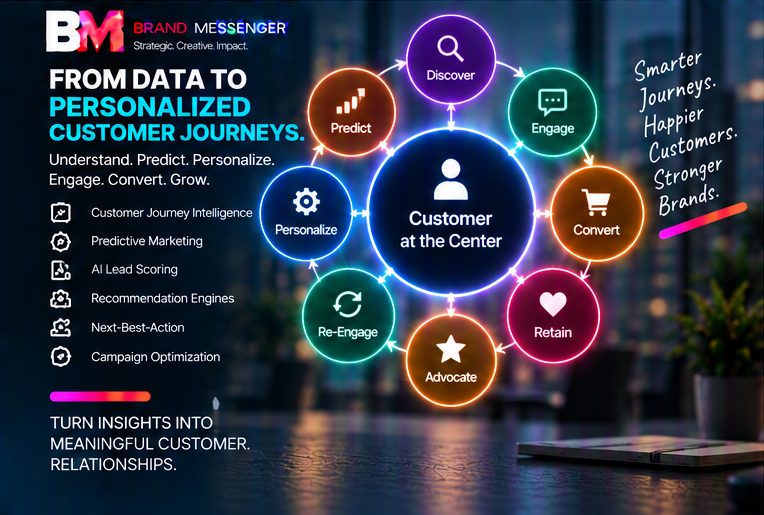
Understand Every Journey. Connect Every Touchpoint. Turn Customer Intent into Meaningful Action.
Turn Customer Data into Intelligence. Turn Intelligence into Personalized Growth.
Modern marketing generates enormous volumes of customer, campaign, behavioral, transactional, and engagement data. The competitive advantage comes not simply from collecting that information, but from using it to understand customers, anticipate behavior, personalize experiences, identify opportunities, and continuously improve marketing decisions.
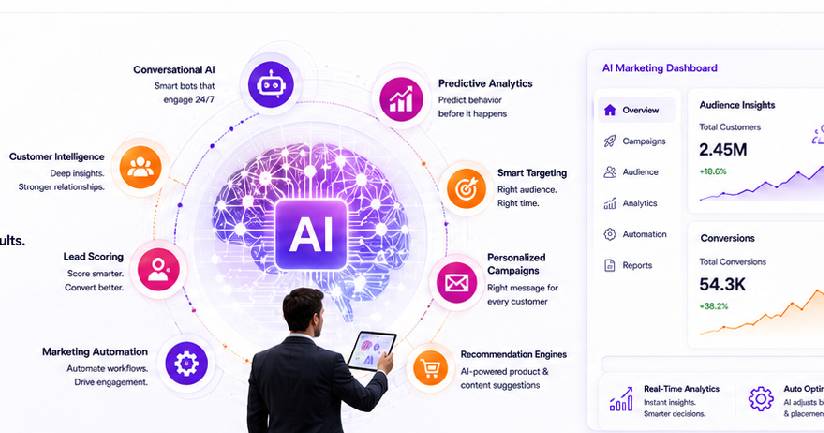
At Brand Messenger, our AI Marketing & Personalization services bring artificial intelligence into the wider MarTech ecosystem to help organizations move from traditional rule-based marketing toward more intelligent, predictive, and adaptive customer engagement.
From AI Marketing Intelligence, Predictive Marketing, AI Audience Segmentation, and AI Personalization to Recommendation Engines, Predictive Customer Behavior, Purchase Intent Prediction, AI Lead Scoring, Next-Best-Offer, Next-Best-Action, and AI Campaign Optimization, we help organizations transform customer and marketing data into actionable intelligence.
Our approach connects:
Customer Data → AI Intelligence → Prediction → Segmentation → Personalization → Decision → Action → Customer Response → Learning → Optimization
Understand Earlier. Predict Smarter. Personalize Better. Optimize Continuously.
Our AI Marketing & Personalization Services
Brand Messenger provides comprehensive AI-powered marketing capabilities, including:
AI Marketing Intelligence
Predictive Marketing
AI Audience Segmentation
AI Personalization
Recommendation Engines
Predictive Customer Behavior
Purchase Intent Prediction
AI Lead Scoring
Next-Best-Offer
Next-Best-Action
AI Campaign Optimization
Customer Propensity Modeling
Customer Churn Intelligence
Customer Lifetime Value Intelligence
Product Affinity Analysis
Behavioral Pattern Analysis
Predictive Customer Segmentation
Journey Intelligence
AI-Assisted Content Personalization
AI Marketing Performance Analysis
Marketing Forecasting
AI-Assisted Decision Intelligence
AI Marketing Intelligence
Transform Marketing Data into Decision Intelligence
Marketing teams often have access to large amounts of information but still struggle to answer fundamental questions: Who are our most valuable customers? Which audiences are most likely to convert? Which customers are losing interest? What products are customers likely to want next? Which campaigns are creating meaningful business results? What should we do next? Brand Messenger uses AI-assisted Marketing Intelligence to help organizations identify patterns across customer, campaign, channel, journey, CRM, and performance data. AI Marketing Intelligence can support:
Customer Behavior Analysis
Audience Intelligence
Campaign Intelligence
Customer Journey Intelligence
Conversion Intelligence
Product Interest Analysis
Engagement Analysis
Customer Value Analysis
Retention Intelligence
Marketing Performance Analysis
Opportunity Identification
Marketing Forecasting
The objective is to move from reporting what happened toward understanding why it happened, what may happen next, and what action may be appropriate.Predictive Marketing
Move from Reactive Marketing to Forward-Looking Decisions
Traditional marketing often responds after customer behavior has already occurred. Predictive Marketing uses historical and current information to help estimate potential future customer actions and marketing outcomes. Brand Messenger can apply predictive approaches to areas such as:
Conversion Propensity
Purchase Propensity
Customer Churn
Customer Retention
Product Interest
Customer Lifetime Value
Lead Conversion
Customer Re-Engagement
Campaign Response
Renewal Probability
Cross-Sell Opportunities
Upsell Opportunities
Marketing Performance
Predictive intelligence can help marketing teams prioritize opportunities and allocate attention more effectively.AI Audience Segmentation
Discover More Meaningful Customer Groups
Traditional audience segmentation often relies on manually defined characteristics such as age, location, customer status, or purchase history. AI-assisted segmentation can help identify more complex patterns across customer data. Brand Messenger can use customer information to support segments based on:
Customer Behavior
Engagement Patterns
Purchase Behavior
Product Affinity
Customer Value
Conversion Propensity
Lifecycle Stage
Churn Risk
Content Interest
Channel Engagement
Frequency of Interaction
Customer Journey Patterns
Similar Behavioral Characteristics
This can help uncover meaningful audience groups that may not be obvious through basic segmentation alone.Predictive Customer Segmentation
Let Customer Segments Evolve with Customer Behavior
Customers continuously change. A new customer can become a repeat customer. A highly engaged customer can become inactive. A low-value customer can develop into a high-value relationship. Brand Messenger can use predictive intelligence to support dynamic customer segments such as:
High Purchase Propensity
Likely to Churn
High Lifetime Value Potential
Likely to Renew
Likely to Upgrade
Likely to Re-Engage
Strong Product Affinity
These segments can connect with marketing automation, personalization, customer journeys, CRM, and appropriate advertising activation.AI Personalization
Create Experiences Around Customer Context
Personalization becomes more powerful when it goes beyond fixed rules. Brand Messenger can combine customer data, behavior, journey stage, and AI-assisted intelligence to help determine more relevant customer experiences. AI Personalization can support:
Personalized Website Content
Product Recommendations
Content Recommendations
Personalized Email
Personalized Offers
Customer Portal Experiences
Mobile App Experiences
Landing Page Personalization
Customer Journey Personalization
Cross-Sell Recommendations
Upsell Recommendations
Re-Engagement Content
The objective is to help organizations move toward:
Different Customer → Different Context → Different Experience rather than delivering the same marketing experience to every customer.Real-Time Personalization
Respond as Customer Context Changes
Where supported by the organization's technology environment, personalization can respond to customer actions as they occur. For example: Customer Views Product → Interest Signal → Profile Updated → Relevant Recommendation or: Returning Customer → Customer Recognized → Lifecycle & Interest Evaluated → Personalized Experience or: Customer Converts → Acquisition Journey Stops → Onboarding Experience Begins This creates a more responsive relationship between customer behavior and marketing technology.
Recommendation Engines
Help Customers Discover What Matters to Them
Recommendation Engines use customer, product, content, and behavioral information to identify potentially relevant items or experiences. Brand Messenger can develop recommendation strategies for:
Products
Services
Content
Articles
Videos
Entertainment
Packages
Offers
Upgrades
Related Products
Cross-Sell Opportunities
Customer Resources
Next Content
Recommendation models can consider signals such as:Previous Purchases
Browsing Behavior
Customer Segment
Product Affinity
Content Engagement
Similar Customer Behavior
Customer Lifecycle
Recent Activity
Customer Preferences
Recommendations can then be delivered through websites, applications, email, customer portals, and other appropriate customer experiences.Predictive Customer Behavior
Understand What Customers May Do Next
Customer behavior produces patterns. Brand Messenger can use appropriate customer information to identify potential behavioral outcomes such as:
Likelihood to Purchase
Likelihood to Convert
Likelihood to Return
Likelihood to Renew
Likelihood to Upgrade
Likelihood to Churn
Likelihood to Respond
Likelihood to Re-Engage
Likelihood to Become High Value
Likelihood to Show Interest in Another Product
These predictions can help determine which customers may require attention and which marketing actions may be appropriate.Purchase Intent Prediction
Identify Stronger Signals of Customer Readiness
Not every visitor or lead has the same level of purchase intent. Brand Messenger can analyze appropriate behavioral and customer signals to help identify customers who may be moving closer to a purchase decision. Signals can include:
Repeat Website Visits
Product Page Activity
Pricing Page Visits
Product Comparisons
Content Engagement
Form Activity
Demo Requests
Previous Purchases
Campaign Engagement
Email Engagement
Search Behavior
Customer Journey Stage
Customers with stronger intent signals can enter appropriate journeys such as: High Intent → Personalized Offer → Sales Notification → Priority Follow-Up while lower-intent customers can continue through educational or nurturing journeys.Customer Propensity Modeling
Estimate the Likelihood of Important Customer Actions
Propensity models can help organizations estimate the likelihood of specific outcomes. Brand Messenger can apply propensity analysis to:
Purchase
Conversion
Renewal
Upgrade
Cross-Sell
Campaign Response
Product Interest
Customer Retention
Re-Engagement
Churn
These insights can help prioritize audiences and inform customer journey decisions.AI Lead Scoring
Help Marketing and Sales Focus on Stronger Opportunities
Traditional lead scoring often assigns fixed points to predefined activities. AI-assisted lead scoring can incorporate wider patterns across customer profiles, engagement, behavior, campaign responses, and historical outcomes. Signals can include:
Lead Source
Customer Profile
Company Profile
Website Behavior
Product Interest
Content Engagement
Campaign Responses
Email Engagement
Event Activity
Demo Requests
Pricing Interest
Previous Interactions
The process can connect: Lead → Data → AI-Assisted Score → Qualification → CRM → Nurturing / Sales This helps marketing and sales teams prioritize leads according to stronger signals of potential conversion.Next-Best-Offer
Identify the Most Relevant Commercial Opportunity
Different customers may require different offers depending on their relationship with the organization. Brand Messenger can use customer context and predictive intelligence to support Next-Best-Offer strategies. Possible recommendations can include:
Product Offer
Service Package
Upgrade
Cross-Sell
Subscription
Renewal Offer
Loyalty Reward
Promotional Offer
Product Bundle
Personalized Incentive
The decision can consider: Customer Profile + Purchase History + Product Affinity + Lifecycle Stage + Engagement + Predictive Intelligence The objective is to improve relevance rather than simply increasing promotional volume.Next-Best-Action
Determine What Should Happen Next for Each Customer
Sometimes the best next action is not an offer. It might be education, customer service, nurturing, onboarding, a sales conversation—or no marketing communication at all. Brand Messenger's Next-Best-Action approach can help determine whether the next step should be:
Send Content
Recommend a Product
Present an Offer
Send a Reminder
Start a Nurturing Journey
Trigger an Email
Send an SMS
Start a WhatsApp Interaction
Personalize a Website
Notify Sales
Begin Customer Onboarding
Initiate Renewal
Start Re-Engagement
Offer Customer Support
Take No Immediate Action
The decision framework can combine customer data, business rules, predictive signals, lifecycle stage, and previous interactions.Customer Churn Intelligence
Identify Relationships That May Be at Risk
Customer retention often becomes more difficult once a customer has already left. AI-assisted churn intelligence can help identify patterns associated with declining engagement. Potential signals can include:
Reduced Purchase Frequency
Declining Engagement
Reduced Website Activity
Missed Renewals
Decreased Product Usage
Communication Disengagement
Customer Service Patterns
Changes in Purchase Behavior
Customers identified as potentially at risk can enter appropriate retention or re-engagement journeys. For example: Churn Signal → At-Risk Segment → Retention Journey → Personalized Engagement → Customer Response → Updated RiskCustomer Lifetime Value Intelligence
Understand the Long-Term Value of Customer Relationships
Not all customers contribute the same value over time. Brand Messenger can use customer and transaction information to support Customer Lifetime Value analysis. This can help identify:
High-Value Customers
High-Potential Customers
Repeat Customers
Profitable Customer Segments
Loyalty Opportunities
Retention Priorities
Cross-Sell Opportunities
Upsell Opportunities
Customer value intelligence can help organizations focus not only on immediate conversions but also on longer-term relationship growth.Product Affinity Intelligence
Understand What Customers Are Most Likely to Want
Brand Messenger can analyze customer and product relationships to identify patterns of affinity. For example: Customers Interested in Product A → Frequently Engage with Product B → Potential Recommendation Product affinity intelligence can support:
Recommendations
Cross-Selling
Bundling
Upselling
Personalized Content
Customer Journeys
Audience Segmentation
Promotional Strategies
This can be particularly valuable for organizations with large product, service, content, or subscription portfolios.AI Campaign Optimization
Learn from Campaign Performance and Continuously Improve
Campaign optimization should not happen only after a campaign has finished. Brand Messenger can use AI-assisted analysis to evaluate campaign information and identify opportunities for improvement. AI Campaign Optimization can support analysis of:
Audience Performance
Customer Segments
Channel Performance
Campaign Timing
Message Performance
Creative Performance
Customer Engagement
Conversion Rates
Funnel Performance
Customer Journey Performance
Cost & Revenue Performance
Retention Outcomes
These insights can inform changes to audience selection, journey logic, communication, timing, offers, personalization, and campaign strategy.AI-Assisted Marketing Forecasting
Use Historical Performance to Support Future Planning
Marketing teams need to make decisions before outcomes are known. Brand Messenger can use historical and current data to support forecasting around:
Lead Volume
Conversion
Campaign Response
Customer Acquisition
Revenue Contribution
Customer Retention
Renewals
Customer Growth
Audience Performance
Marketing Demand
Customer Lifetime Value
Campaign Performance
Forecasting provides another intelligence layer for planning marketing activity and resources.AI & Customer Journey Orchestration
Make Customer Journeys More Adaptive
AI Marketing & Personalization can work directly with Brand Messenger's Customer Journey Orchestration capabilities. Instead of relying entirely on fixed journeys:
Customer Enters → Message A → Wait → Message B an intelligent journey can consider: Customer → Profile → Behavior → Predictive Signal → Journey Context → Next-Best Action → Response → Updated Intelligence This can make journeys more responsive to changing customer behavior.AI & Marketing Automation
Add Decision Intelligence to Automated Workflows
Marketing Automation determines how workflows execute. AI can help inform which workflow, segment, offer, recommendation, or action may be more appropriate. Together: Customer Event → Data → AI Analysis → Decision → Automation → Personalized Action → Customer Response Examples can include:
Predictive Lead Nurturing
Churn-Based Retention
Intelligent Re-Engagement
Personalized Onboarding
Predictive Renewal
Product Recommendations
High-Intent Sales Notifications
Customer Value Journeys
This moves automation beyond simple schedules toward more adaptive customer engagement.AI & Customer Data Platforms
Put Unified Customer Data Behind Marketing Intelligence
AI capabilities depend heavily on the quality and relevance of underlying information. Brand Messenger's Customer Data Platform & First-Party Data capabilities can provide a stronger foundation for AI-powered marketing. The architecture can operate as:
Customer Touchpoints → First-Party Data → CDP → Unified Customer Profile → AI Intelligence → Segment / Prediction / Recommendation → Activation Customer responses can then return to the data environment: Customer Action → Updated Profile → New Intelligence → Next Decision This creates a continuous learning cycle.AI & CRM Intelligence
CRM contains valuable information about leads, customers, opportunities, accounts, interactions, and sales activity. Brand Messenger can connect CRM data with AI-assisted marketing intelligence to support:
AI Lead Scoring
Opportunity Prioritization
Purchase Intent
Customer Value
Cross-Sell Opportunities
Upsell Opportunities
Renewal Intelligence
Churn Indicators
Next-Best Action
Customer Segmentation This helps transform CRM from a record-management environment into a stronger source of customer and revenue intelligence.AI & Omnichannel Personalization
Coordinate Intelligent Experiences Across Customer Channels
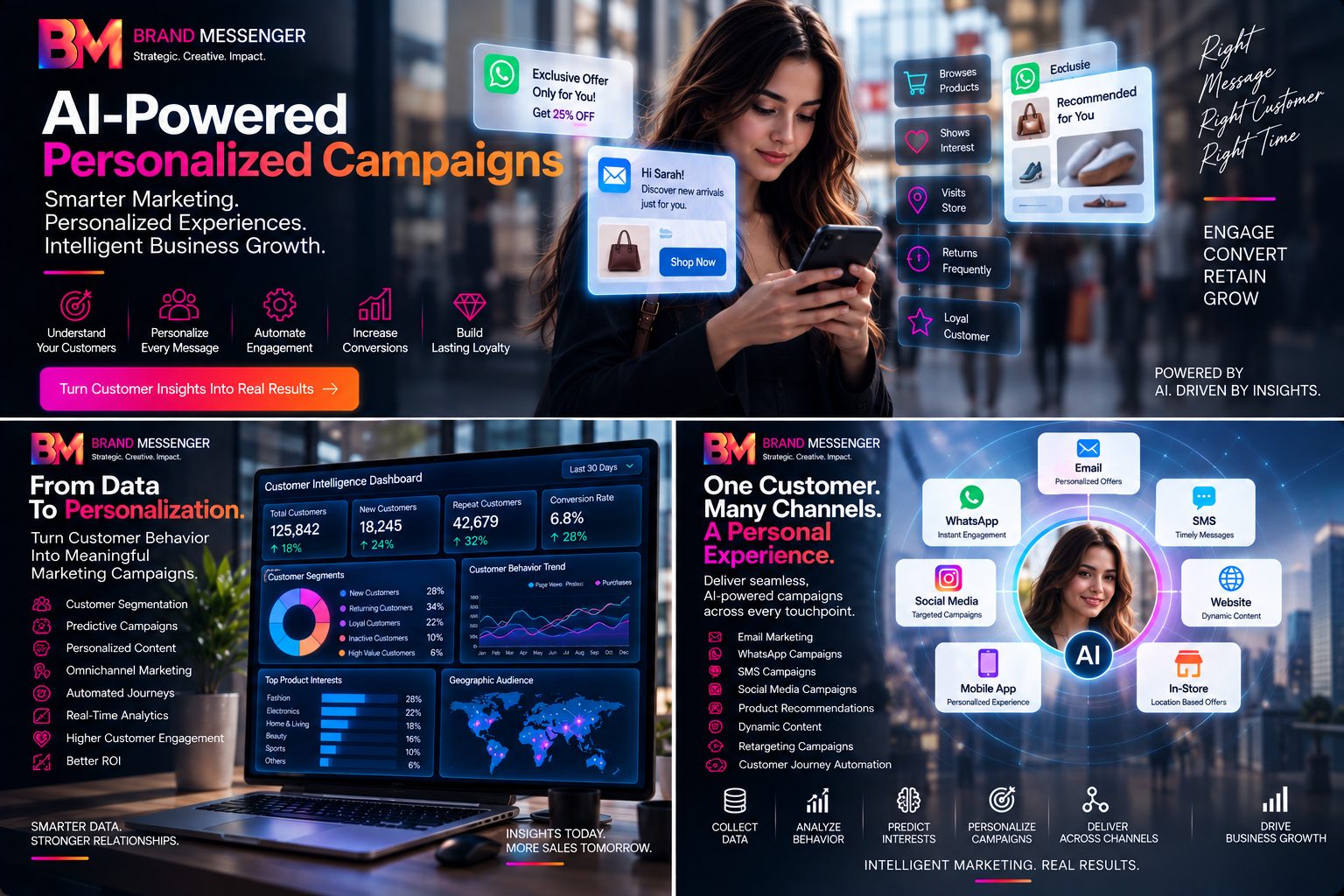
AI Personalization can connect with Brand Messenger Omnichannel Marketing Technology across: Email → SMS → WhatsApp → Web → Mobile → Push → Social Messaging → CRM → Customer Portal Customer context can help determine:
Which Channel
Which Message
Which Content
Which Offer
Which Recommendation
Which Journey
Which Timing
Which Next Action
The objective is not to maximize communication frequency. It is to make communication more relevant to the customer and their current relationship with the organization.AI-Powered Customer Decision Engine
Intelligence at the Center of the MarTech Ecosystem
Brand Messenger can structure AI-assisted marketing around a customer decision layer. The model can connect:
CUSTOMER DATA
↓Unified Customer Profile
↓AI Intelligence
↓Prediction + Segmentation + Propensity + Recommendation
↓Decision
↓Next-Best Action / Next-Best Offer
↓Marketing Automation + Customer Journey + Personalization
↓Customer Response
↓Measurement & Learning
This decision layer can sit between customer intelligence and marketing execution.From Rules-Based to Intelligent Marketing
Traditional MarTech often operates through fixed rules: IF Customer Does X → Send Y Rules remain valuable and often necessary. AI adds another layer: Customer Context + Historical Behavior + Current Signals + Predicted Outcome → Recommended Action Brand Messenger can combine both approaches. Business rules provide structure and control, while AI-assisted intelligence can help identify patterns, prioritize opportunities, and recommend actions.
Responsible AI & Customer Data
Intelligent Marketing Requires Responsible Data Practices
AI-powered personalization depends on customer information. Appropriate governance should therefore be built into the wider MarTech architecture. Brand Messenger's approach can incorporate considerations around:
First-Party Data
Customer Consent
Data Minimization
Customer Preferences
Access Controls
Data Quality
Audience Eligibility
Model Inputs
Human Oversight
Marketing Governance
Customer Data Governance
Appropriate Automation Controls
Requirements can vary according to jurisdiction, industry, data type, platform, and use case. The objective is to build AI-assisted marketing that remains aligned with the organization's applicable policies and governance requirements.AI Marketing Analytics & Intelligence Dashboards
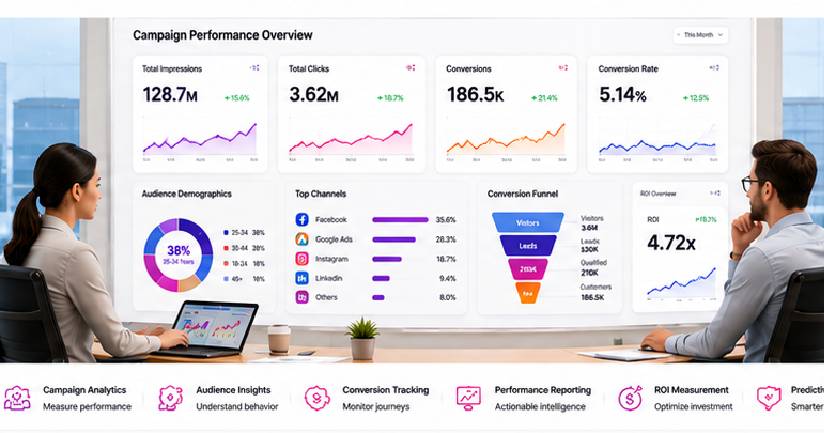
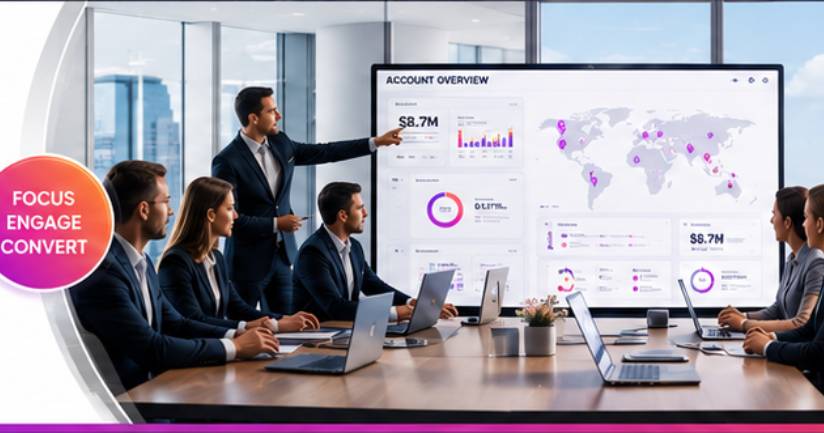
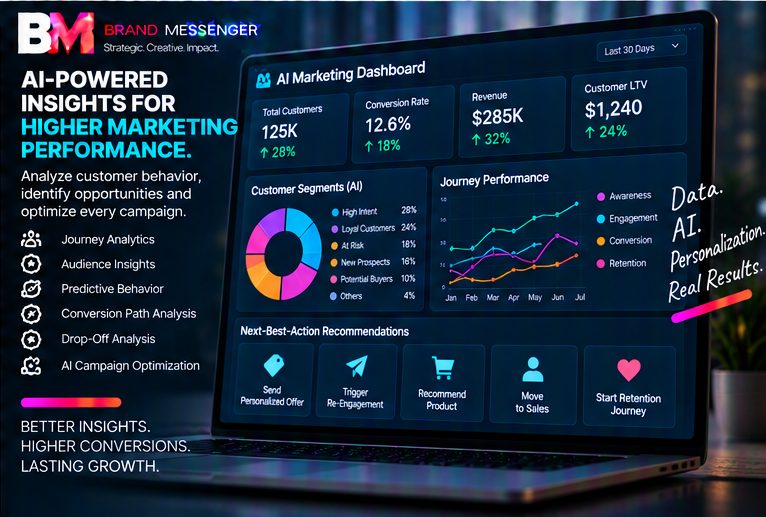
Brand Messenger can create dashboards that bring predictive and marketing intelligence into decision-making environments. Customer Intelligence Customer Segments • Engagement • Customer Value • Lifecycle • Behavioral Trends Predictive Intelligence Purchase Propensity • Conversion Propensity • Churn Indicators • Renewal Probability • Customer Value Lead Intelligence Lead Scores • High-Intent Leads • Qualification • Conversion Probability • Pipeline Opportunities Recommendation Intelligence Product Affinity • Recommendations • Cross-Sell • Upsell • Next-Best Offer Journey Intelligence Journey Progression • Drop-Off Risk • Next-Best Action • Conversion Paths Campaign Intelligence Campaign Performance • Audience Performance • Conversion • Optimization Opportunities Executive AI Marketing Intelligence Customer Growth • Revenue • Retention • Forecasting • Opportunities • Emerging Trends This helps move AI outputs from isolated models into practical marketing decision environments.
AI Marketing & Personalization Across Brand Messenger MarTech
AI Marketing & Personalization can operate as the intelligence and decision layer across the wider Brand Messenger MarTech ecosystem. It can connect with:
Marketing Automation
CRM & Customer Management Technology
Customer Data Platform & First-Party Data
Omnichannel Marketing Technology
Customer Journey Orchestration
Personalization & Experience Technology
Lead Management
Customer Experience Technology
Content & Digital Experience Technology
Marketing Analytics
Marketing Dashboards & Business Intelligence
MarTech Integration & Data Infrastructure
Brand Messenger AdTech
Together: Data → Customer Intelligence → Prediction → Decision → Personalization → Automation → Journey → Engagement → Conversion → Measurement → LearningConnecting AI-Powered MarTech & AdTech
AI intelligence can also help connect owned customer relationships with paid advertising. For example:
First-Party Data → CDP → AI Audience Segment → Eligible AdTech Audience → Campaign → Engagement → CRM → Customer Journey Or: High Purchase Intent → Audience Activation → Advertising + Personalized MarTech Journey → Conversion Or: Existing Customer → High Cross-Sell Propensity → Personalized Offer / Appropriate Advertising → Customer Response This can create stronger coordination between customer intelligence, MarTech engagement, and AdTech activation.AI Across the Complete Customer Lifecycle
Brand Messenger AI Marketing & Personalization can support intelligence throughout the customer relationship:
Discover
Audience Intelligence • Predictive SegmentationEngage
Personalized Content • Recommendation EnginesAcquire
Purchase Intent • AI Lead ScoringNurture
Predictive Engagement • Next-Best ActionConvert
Propensity Intelligence • Next-Best OfferOnboard
Personalized Customer JourneysGrow
Cross-Sell • Upsell • Product AffinityRetain
Churn Intelligence • Customer Value
Renew Re-Engage Advocate Brand Messenger AI Marketing & Personalization can support organizations across: Retail & E-Commerce FMCG & Consumer Brands B2B & Enterprise Technology & SaaS Financial Services Telecommunications Automotive Real Estate Travel & Tourism Hospitality Healthcare Education Entertainment & Media Professional Services Events & Exhibitions Subscription Businesses Franchise & Multi-Location Businesses Membership Organizations Non-Profit Organizations Government & Public Sector Startups & Scale-Ups Brand Messenger helps organizations: Transform customer data into actionable intelligence Understand customer behavior more deeply Identify meaningful audience segments Predict potential customer actions Identify purchase intent Prioritize stronger leads Personalize customer experiences Deliver more relevant recommendations Identify cross-sell and upsell opportunities Predict potential customer churn Understand customer lifetime value Determine next-best actions Determine relevant next-best offers Improve customer journey decisions Strengthen marketing automation Improve campaign optimization Personalize omnichannel engagement Improve marketing forecasting Connect MarTech and AdTech intelligence Support more informed marketing decisions Industries We Serve
Benefits of AI Marketing & Personalization