






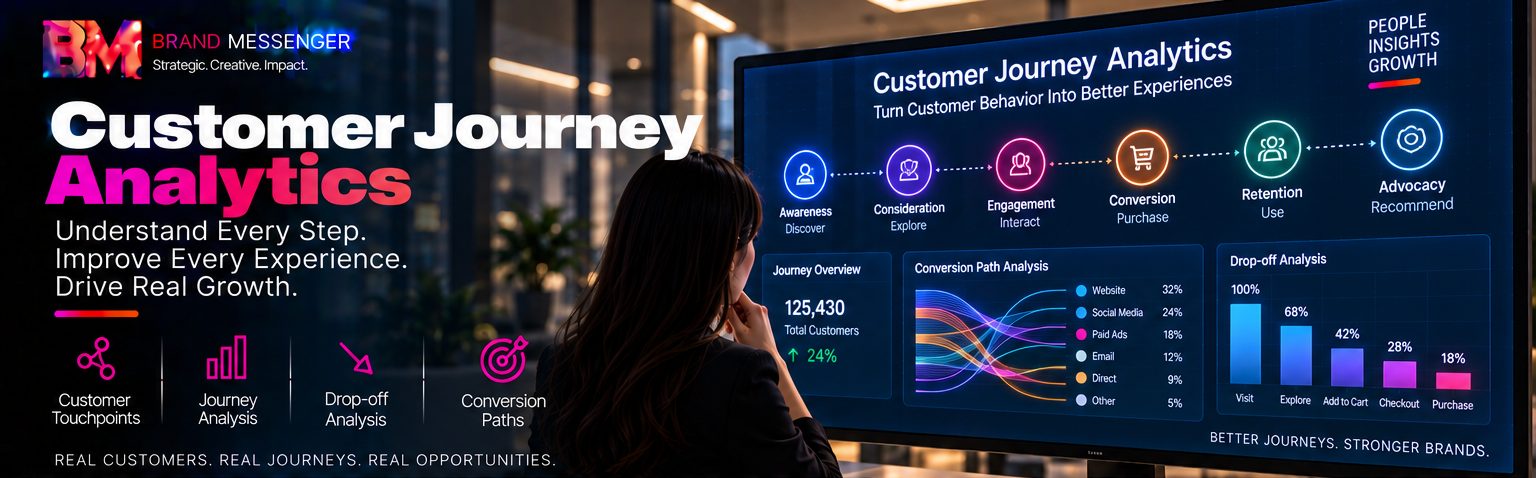
Customer Journey Analytics
Understand Every Touchpoint. See How Customers Move. Discover Where Journeys Break. Build Better Paths to Conversion.
Customers rarely move from awareness to conversion through one simple interaction.
They may discover a brand through advertising, visit a website, read content, compare products, return through search, engage with social media, open an email, visit a physical location, speak with sales, use an app and finally convert days or weeks later.
Traditional reporting often measures these interactions separately.
Customer Journey Analytics connects them into a broader view of how customers actually move through the relationship.
At Brand Messenger, our Customer Journey Analytics service combines customer touchpoint measurement, journey analysis, drop-off analysis, conversion-path analysis, CRM and CDP data, digital analytics, campaign data, customer behavior intelligence, AI-assisted pattern discovery and, where appropriate, physical-space intelligence from Face Signatures by Messenger2050 Technologies.
Our four core capabilities are:
Customer Touchpoints
Journey Analysis
Drop-off Analysis
Conversion Paths
Our wider capabilities can extend across cross-channel journeys, journey visualization, funnel analysis, path analysis, journey segmentation, journey-stage analytics, behavioral analytics, digital-to-physical journeys, journey performance, friction analysis, time-to-conversion, repeat journeys, customer lifecycle analytics, AI journey intelligence and executive dashboards.
The objective is not simply to count interactions.
It is to understand:
Where Customers Begin. What They Experience. Where They Go Next. Where They Stop. What Paths Lead to Conversion.
What Is Customer Journey Analytics?
Customer Journey Analytics examines the sequence of interactions customers have with a brand across different channels, systems and stages.
A journey might look like:
Paid Ad → Website → Product Page → Exit → Email → Return Visit → Product Comparison → Store Visit → Purchase
Another customer may follow:
Organic Search → Blog → Newsletter → Social Media → Website → Demo Request → Sales Call → Customer
Customer Journey Analytics attempts to understand these sequences rather than evaluating every interaction independently.
The architecture becomes:
Customer → Touchpoints → Events → Journey → Stages → Paths → Friction → Conversion / Outcome → Analysis → Improvement
Customer Journey Analytics Is Different from Attribution
This distinction is important within Brand Messenger's service structure.
Both analyze customer interactions, but they answer different questions.
Customer Journey Analytics
Customer Journey Analytics asks:
How did the customer move through the experience?
It focuses on:
Touchpoints
Sequence
Journey Stages
Paths
Behavior
Drop-Off
Friction
Time Between Interactions
Conversion Paths
Journey Completion
Attribution
Attribution asks:
How should conversion credit be assigned across marketing or advertising interactions?
It focuses more heavily on:
Conversion Credit
Channel Contribution
Campaign Contribution
Media Effectiveness
Attribution Models
Advertising Measurement
Therefore:
Journey Analytics Explains the Path.
Attribution Evaluates Contribution to the Outcome.
They can work together, but they are not the same service.
A Simple Example
Consider:
Social Ad → Website → Email → Search → Website → Purchase
Customer Journey Analytics examines:
What happened first?
What happened next?
How long did the journey take?
Which pages were visited?
Where did engagement increase?
Did the customer leave and return?
What sequence ended in purchase?
Attribution examines:
How much conversion credit should be associated with:
Social? Email? Search?
This distinction allows Brand Messenger to provide both services without unnecessary overlap.
Brand Messenger Customer Journey Analytics Services
Our capabilities can include:
Customer Journey Analytics Strategy
Customer Touchpoint Mapping
Touchpoint Measurement
Journey Data Integration
Journey Visualization
Customer Journey Mapping
Digital Journey Analytics
Omnichannel Journey Analytics
Cross-Channel Journey Analytics
Online-to-Offline Journey Analysis where appropriately measurable
Journey Sequence Analysis
Journey Stage Analysis
Journey Path Analysis
Conversion Path Analysis
Drop-Off Analysis
Funnel Analysis
Friction Analysis
Abandonment Analysis
Entry-Point Analysis
Exit-Point Analysis
Journey Completion Analysis
Time-to-Conversion Analysis
Time-Between-Touchpoints Analysis
Repeat-Visit Analysis
Returning-Customer Journey Analysis
New-Customer Journey Analysis
Pre-Purchase Journey Analysis
Post-Purchase Journey Analysis
Customer Lifecycle Analytics
Journey Segmentation
Audience Journey Comparison
Channel Journey Analysis
Campaign Journey Analysis
Content Journey Analysis
Product Journey Analysis
E-Commerce Journey Analytics
Lead Journey Analytics
B2B Buying Journey Analytics
Retail Customer Journey Analytics
Event Journey Analytics
Physical-Space Journey Intelligence
Face Signatures Integration where appropriate
CRM Journey Analytics
CDP Journey Analytics
Marketing Automation Journey Analytics
DXP Journey Analytics
Customer-Service Journey Analytics
AI-Assisted Journey Analysis
Journey Pattern Discovery
Journey Performance Dashboards
Executive Journey Intelligence
Journey Optimization Insights
Privacy-Aware Journey Analytics
Continuous Journey Measurement
Customer Touchpoints
Understand Every Meaningful Interaction Across the Customer Relationship
A customer touchpoint is an interaction between a customer and the brand.
Touchpoints can exist before, during and after conversion.
Potential touchpoints include:
Advertising
Search Ads Social Ads Display Programmatic Video CTV Digital Audio DOOH
Digital
Website Landing Pages Mobile App Customer Portal E-Commerce Content Search
Communication
Email SMS WhatsApp Push Notifications Chat Voice Assistants
Social & Community
Social Media Community Platforms Influencer Content User-Generated Content
Physical
Store Branch Showroom Event Exhibition Experience Center Interactive Kiosk Smart Display
Human
Sales Representative Customer Support Consultant Account Manager
Post-Purchase
Order Communication Onboarding Customer Service Loyalty Renewal Retention
Customer Journey Analytics connects these touchpoints into a meaningful sequence.
Touchpoint Mapping
Before analyzing journeys, Brand Messenger can help identify:
Which touchpoints actually exist?
The process can become:
Customer Stage → Channel → Touchpoint → Interaction → Data Source → Measurement
This creates a measurable journey architecture rather than relying entirely on conceptual journey maps.
Touchpoint Measurement
Different touchpoints generate different types of information.
A website may provide:
Page Views
Sessions
Product Views
Forms
Conversions
CRM may provide:
Leads
Opportunities
Sales Interactions
Customer Status
An event platform may provide:
Registration
Check-In
Sessions
Booth Engagement
A retail environment may provide appropriate:
Visitor Traffic
Return Visits
Zone Activity
Interaction Signals
Brand Messenger brings relevant signals together where reliable integration and appropriate permissions exist.
Touchpoint Sequence
The order of interactions can matter.
Consider:
Ad → Product Page → Purchase
versus:
Ad → Product Page → Comparison → Email → Search → Review → Return → Purchase
Both result in conversion.
But the journeys are very different.
Customer Journey Analytics reveals that difference.
Journey Analysis
Understand How Customers Actually Move Through the Brand Experience
Journey Analysis studies the sequence, timing, direction and outcomes of customer interactions.
The model becomes:
Entry → Exploration → Engagement → Consideration → Action → Conversion → Relationship
Real customer journeys may move backward and forward rather than following a perfect funnel.
For example:
Discovery → Consideration → Discovery → Comparison → Exit → Return → Conversion
Brand Messenger therefore analyzes the journey as behavior—not merely as a predefined diagram.
Journey Stages
Organizations can define meaningful stages such as:
Awareness: Customer discovers the brand.
Discovery
Customer begins exploring.
Engagement
Customer interacts more deeply.
Consideration
Customer evaluates an offer.
Conversion
Customer completes the intended action.
Onboarding
The new relationship begins.
Retention
The organization maintains engagement.
Loyalty
The relationship strengthens.
Advocacy
The customer may recommend or support the brand.
The exact stages depend on the business model.
Journey Stage Analytics
Brand Messenger can analyze:
Number of Customers Entering a Stage
Progression to Next Stage
Time Spent in Stage
Return to Previous Stage
Drop-Off
Channel Usage
Conversion
This helps organizations understand where customer movement becomes difficult.
Journey Visualization
Turn Complex Customer Behavior into Understandable Paths
Journey visualization can represent customer movement as:
Entry Point → Touchpoint A → Touchpoint B → Touchpoint C → Conversion
Alternative paths can appear alongside the primary journey.
This helps teams see:
Common Paths
Long Paths
Short Paths
Loops
Repeated Touchpoints
Drop-Off Points
Conversion Routes
Journey Flow Analysis
Journey Flow Analysis examines how customers move from one interaction to another.
For example:
Homepage
→ Product Page — 45%
→ Content — 25%
→ Search — 15%
→ Exit — 15%
These flows can help teams identify where customers naturally go next.
Path Analysis
Discover the Routes Customers Take
Path Analysis identifies recurring sequences within customer journeys.
For example:
Path A
Search → Product → Purchase
Path B
Social → Content → Email → Product → Purchase
Path C
Ad → Landing Page → Exit
Path D
Event → Website → Demo → Sales → Customer
The objective is to understand actual journey structures.
Common Journey Paths
Brand Messenger can identify frequently occurring paths.
This can help answer:
Which journeys happen most often?
Which are shortest?
Which require many interactions?
Which frequently end in conversion?
Which frequently end in abandonment?
A common path is not automatically the best path; frequency and performance should be analyzed separately.
Conversion Paths
Understand the Sequences That Lead to Business Outcomes
Conversion Path Analysis focuses on the touchpoint sequences associated with a defined conversion.
Potential conversions include:
Purchase
Lead
Demo Request
Booking
Registration
Subscription
Account Creation
Qualified Opportunity
The architecture becomes:
Entry → Touchpoints → Engagement → Decision → Conversion
Pre-Conversion Path Analysis
Brand Messenger can analyze the interactions occurring before conversion.
For example:
Search → Article → Email Signup → Email → Product Page → Purchase
This can reveal the role of:
Content
Channels
Campaigns
Product Experiences
Communication
without automatically assigning attribution credit.
Post-Conversion Journey Analytics
The customer journey does not end when a purchase occurs.
Brand Messenger can analyze:
Purchase → Onboarding → Product Usage / Service → Support → Repeat Purchase → Loyalty
This extends Journey Analytics into retention and customer growth.
Conversion Path Length
Some customers convert after:
1–2 Touchpoints
Others may require:
5–10+ Touchpoints
Brand Messenger can analyze:
Number of Interactions
Number of Sessions
Number of Channels
Journey Duration
This helps organizations understand the complexity of the buying journey.
Time to Conversion
Customer Journey Analytics can measure:
First Relevant Interaction → Conversion
Potential analysis can include:
Minutes
Hours
Days
Weeks
Longer Sales Cycles
This can be particularly useful when comparing different products, audiences or customer types.
Time Between Touchpoints
The intervals between interactions can also reveal journey patterns.
For example:
Ad → Website: Immediate
Website → Email: 2 Days
Email → Return Visit: 1 Day
Return Visit → Purchase: 3 Hours
This helps organizations understand journey timing.
Drop-Off Analysis
Discover Where Customers Stop Moving Forward
Drop-Off Analysis identifies points where customers leave a journey or fail to continue toward an intended next step.
The basic model becomes:
Stage A → Stage B → Stage C → Exit
The important question is:
Why Are Customers Leaving Here?
Analytics can identify where the drop-off occurs.
Additional research and testing may be required to determine why.
Funnel Drop-Off Analysis
A conversion funnel might be:
10,000 Visitors → 4,000 Product Views → 1,500 Cart Additions → 900 Checkout Starts → 600 Purchases
Drop-off analysis examines the reduction between each stage.
Website Drop-Off
Potential friction points can include:
Landing Pages
Product Pages
Forms
Registration
Checkout
Pricing Pages
Account Creation
Analytics can identify where abandonment occurs.
It should not automatically assume the reason without supporting evidence.
Form Drop-Off Analysis
Brand Messenger can analyze appropriate form stages such as:
Form Started → Field Progress → Form Completed
Potential friction may relate to:
Form Length
Required Information
Technical Errors
User Uncertainty
Testing can help determine the actual cause.
Checkout Drop-Off
E-commerce journey analytics can examine:
Product → Cart → Checkout → Payment → Confirmation
Drop-off may occur at different stages.
Possible causes should be investigated rather than inferred solely from analytics.
Lead Funnel Drop-Off
For B2B journeys:
Visitor → Lead → MQL → SQL → Opportunity → Customer
Brand Messenger can identify where progression slows or stops.
This connects Journey Analytics with Lead Management & Revenue Marketing.
Journey Friction Analysis
Identify Where the Experience Becomes Difficult
Friction can appear as:
Repeated Steps
Unexpected Exits
Repeated Search
Long Delays
Form Abandonment
Checkout Abandonment
Customer-Service Escalation
Repeated Support Contact
These signals can indicate areas worth investigating.
They do not automatically explain the customer's reason.
Abandonment Analysis
Abandonment can occur across:
Shopping Cart
Checkout
Registration
Booking
Application
Lead Form
Customer Onboarding
Subscription
Brand Messenger can connect abandonment points with preceding journey behavior.
Entry-Point Analysis
Understand Where Journeys Begin
Journeys may begin through:
Search
Advertising
Social
Direct Website Visit
Referral
Event
Physical Store
QR Code
Mobile App
Brand Messenger can compare how customers entering through different points move afterward.
Exit-Point Analysis
Exit analysis identifies where journeys commonly end without the intended outcome.
For example:
Landing Page → Exit
Product Comparison → Exit
Checkout → Exit
The objective is to identify where further investigation and optimization may be valuable.
Journey Completion Analysis
Not every journey has to end in a purchase.
A completed journey could mean:
Support Issue Resolved
Booking Completed
Registration Completed
Information Found
Application Submitted
Onboarding Completed
Journey Analytics should therefore define success according to the actual customer objective.
Digital Journey Analytics
Brand Messenger can analyze digital interactions across:
Website + App + E-Commerce + Portal + Content + Campaigns: This can provide a more connected picture than separate channel reports.
Website Journey Analytics
Potential website journey analysis can include:
Entry Pages
Page Sequences
Product Exploration
Search
Content Consumption
Form Interaction
Checkout
Exit
Return Visits
This helps organizations understand how the website participates in the broader customer journey.
Mobile App Journey Analytics
App journeys may include:
Install / Access → Onboarding → Feature Usage → Engagement → Conversion / Retention
Brand Messenger can connect app behavior with broader customer information where appropriate.
E-Commerce Journey Analytics
Understand the Journey from Discovery to Purchase and Beyond
A commerce journey may become:
Ad / Search → Product Discovery → Product Detail → Comparison → Cart → Checkout → Purchase → Delivery → Repeat Purchase
Brand Messenger can analyze each stage and the paths between them.
Product Journey Analytics
Different products may generate different customer journeys.
For example:
Low-Consideration Product
Discovery → Product → Purchase
High-Consideration Product
Discovery → Research → Comparison → Reviews → Return Visit → Purchase
Understanding these differences can improve marketing and experience strategy.
Content Journey Analytics
Content may play a role before conversion.
The journey might become:
Search → Article → Related Content → Newsletter → Product → Conversion
Brand Messenger can analyze how content fits within journeys without assuming that every content interaction directly caused the conversion.
Campaign Journey Analytics
A campaign should not necessarily be evaluated only at the first click.
Brand Messenger can analyze:
Campaign Exposure / Interaction → Landing Experience → Subsequent Touchpoints → Conversion / Other Outcome
This connects campaign performance with the broader customer experience.
Omnichannel Customer Journey Analytics
Understand Journeys That Move Across Channels
Modern customer journeys may cross:
Advertising → Website → Email → App → Store → Customer Service
Omnichannel Journey Analytics attempts to understand these connected interactions where appropriate identity, data and permissions make reliable linkage possible.
The architecture becomes:
Multiple Channels → Customer / Journey Data Layer → Journey Analytics → Customer Intelligence
Cross-Channel Journey Analysis
Brand Messenger can compare how channels interact within journeys.
For example:
Social → Website → Email
Search → Website → Store
Event → CRM → Sales
Email → App → Purchase
The objective is to understand channel sequences rather than evaluate each channel in isolation.
Online-to-Offline Journeys
For suitable businesses, the customer journey may move from digital into physical environments.
For example:
Digital Ad → Website → Store Visit → Purchase
or:
Event Registration → Physical Event → Website → Sales Inquiry
Connecting these interactions requires appropriate measurement architecture and privacy controls.
Offline-to-Online Journeys
The reverse can also occur:
Store → QR → Website
Event → App
Exhibition → CRM Follow-Up
Experience Center → Digital Account
This helps organizations understand how physical experiences contribute to continuing digital relationships.
Face Signatures + Customer Journey Analytics
Add Appropriate Physical-Space Intelligence to the Customer Journey
For suitable physical environments, Face Signatures by Messenger2050 Technologies can provide an additional intelligence layer.
Potential signals may include appropriate:
Visitor Traffic
Return-Visit Patterns
Movement Patterns
Zone Activity
Audience Flow
Event Attendance
Retail Activity
Physical-Space Engagement
The architecture can become:
Physical Environment → Face Signatures Intelligence → Appropriate Visitor / Behavioral Signals → Brand Messenger Customer Journey Analytics → Physical + Digital Journey Intelligence
Individual identification is not required for every journey-analysis objective.
Where aggregated visitor and movement intelligence is sufficient, it should generally be preferred.
Retail Customer Journey Analytics
A retail journey can involve:
Advertising → Website → Store → Product Zone → Purchase → Loyalty
Brand Messenger can connect appropriate:
Digital Behavior
Store Activity
CRM
Commerce
Loyalty
Face Signatures Intelligence where suitable
to create a broader view of retail journeys.
Smart Retail + Journey Analytics
Brand Messenger's Smart Retail Experiences can generate additional touchpoints through:
Smart Stores
Digital Shelves
Interactive Retail
Smart Displays
Kiosks
Connected Experiences
These interactions can become part of the customer journey measurement framework.
Store Journey Analysis
Within a physical environment, aggregated journey analysis can examine patterns such as:
Entrance → Zone A → Zone B → Checkout
or:
Entrance → Promotional Display → Product Zone → Exit
This can support retail experience and layout analysis without automatically requiring individual identification.
Event Customer Journey Analytics
An event journey can begin before the attendee enters the venue:
Campaign → Registration → Confirmation → Check-In → Session → Exhibition → Networking → Follow-Up → Sales / Relationship
Brand Messenger can analyze the complete event journey.
Smart Event Technology + Journey Analytics
Brand Messenger's Smart Event Technology can provide touchpoints through:
AI Registration
Smart Badges
Event Apps
Interactive Exhibitions
Event Dashboards
Session Activity
These can support richer journey analysis where appropriate.
Event Drop-Off Analysis
Event organizers can analyze stages such as:
Registration Started → Registration Completed → Attended → Session Participation → Post-Event Engagement
This can reveal where attendee journeys weaken.
B2B Customer Journey Analytics
Understand Complex, Longer Buying Journeys
B2B journeys may involve:
Advertising
Content
Website
Webinar
Event
Demo
Sales
Proposal
Procurement
Contract
The path can take weeks or months.
Brand Messenger can connect marketing and CRM information to understand the broader buying journey.
Account-Level Journey Analytics
B2B buying decisions may involve multiple people from the same organization.
Where appropriate data exists, Brand Messenger can analyze both:
Individual Contact Journeys
and
Account-Level Engagement
These should not automatically be treated as the same thing.
Lead Journey Analytics
A lead journey might become:
Ad → Landing Page → Lead → Email Nurture → Demo → Sales → Opportunity → Customer
Journey Analytics can identify:
Entry Source
Marketing Interactions
Sales Handoff
Time to Opportunity
Drop-Off
Conversion Path
CRM + Customer Journey Analytics
CRM provides important downstream journey information.
The architecture can become:
Marketing Touchpoints → Lead → CRM → Sales Activity → Opportunity → Customer
Without CRM integration, analysis may stop at:
Form Submitted.
With appropriate CRM integration, the journey can continue into actual business outcomes.
CDP + Customer Journey Analytics
A Customer Data Platform can help connect customer information from multiple systems.
The architecture becomes:
Website + App + CRM + Commerce + Campaigns → CDP → Unified Customer / Event Data → Journey Analytics → Customer Intelligence
This can support more consistent cross-channel journey analysis.
DXP + Journey Analytics
Brand Messenger's Digital Experience Platforms can connect:
Website
App
Portal
Content
Personalization
Customer Data
Journey Analytics can help evaluate how customers move across these digital experiences.
Marketing Automation + Journey Analytics
Marketing Automation creates planned journeys.
Customer Journey Analytics reveals what customers actually do.
For example:
Planned Journey
Email 1 → Email 2 → Offer → Conversion
But the actual journey might be:
Email 1 → Website → Search → Social → Email 2 → Product → Conversion
This distinction is valuable.
Journey Orchestration Designs the Journey.
Journey Analytics Measures the Journey That Actually Happened.
Customer Journey Orchestration vs. Customer Journey Analytics
These Brand Messenger services should remain distinct.
Customer Journey Orchestration
Determines:
What experience should happen next?
It manages:
Triggers
Workflows
Touchpoints
Next Actions
Omnichannel Experiences
Customer Journey Analytics
Determines:
What journey actually occurred and how did it perform?
It analyzes:
Paths
Touchpoints
Drop-Off
Timing
Conversion
Together:
Analytics Understands → Orchestration Responds → Analytics Measures Again
Audience Segmentation + Journey Analytics
Different audience segments may follow different journeys.
For example:
New Customers
Ad → Website → Research → Purchase
Returning Customers
Email → Product → Purchase
Loyal Customers
App → New Product → Purchase
Brand Messenger can compare journey behavior across appropriate segments.
Behavioral Segmentation + Journey Analytics
Behavioral segments can be created using journey information such as:
Frequent Visitors
Repeat Researchers
High-Engagement Users
Abandoners
Returning Customers
This connects Journey Analytics with Brand Messenger's Audience Segmentation capabilities.
AI Customer Journey Analytics
Use AI to Discover Patterns Across Complex Customer Paths
Large journey datasets can contain thousands or millions of interaction sequences.
AI-assisted analytics can help identify:
Recurring Journey Patterns
Common Sequences
Unusual Paths
Drop-Off Patterns
Segment Differences
Journey Clusters
Potential Friction Points
The architecture becomes:
Journey Data → AI Analysis → Pattern Discovery → Human Interpretation → Experience Decision
AI Journey Pattern Discovery
Instead of manually defining every possible path, AI-assisted methods can identify groups of similar journeys.
For example:
Fast Conversion Journeys
Research-Heavy Journeys
Repeated Return Journeys
High-Abandonment Journeys
Multi-Channel Journeys
These labels should be based on measurable behavior rather than unsupported assumptions about customer motivations.
Journey Clustering
AI can potentially group similar journey sequences.
The process becomes:
Thousands of Paths → Pattern Analysis → Journey Clusters → Business Interpretation
This can simplify complex journey datasets.
Predictive Journey Intelligence
Historical journey patterns may support estimates around outcomes such as:
Conversion Propensity
Drop-Off Risk
Next Likely Stage
Retention Risk
These are probabilistic estimates, not guarantees about what an individual customer will do.
Next-Step Intelligence
Journey information can support recommendations around what experience may be appropriate next.
This can connect with:
Customer Journey Orchestration
Personalization
Marketing Automation
Conversational AI
The architecture becomes:
Journey History → Current Context → AI / Business Rules → Recommended Next Experience
Important customer decisions should remain subject to appropriate business rules and governance.
Journey Analytics + AI Marketing Intelligence
Brand Messenger can connect journey information with wider AI Marketing Intelligence.
The model becomes:
Customer Data
Campaign Data
Behavioral Data
Journey Data
Transaction Data
Appropriate Physical-Space Signals → AI Marketing Intelligence → Customer Journey Intelligence → Marketing & Experience Decisions
Journey Analytics + Conversion Optimization
Drop-off and path analysis can identify areas for further optimization.
For example:
Landing Page → High Drop-Off
may justify:
UX Review
Content Review
Technical Review
A/B Testing
Analytics identifies the opportunity.
Testing helps determine what change actually improves the experience.
Journey Analytics + A/B Testing
Journey Analytics can help identify:
Where should we test?
A/B testing can then evaluate:
Which version performs differently?
Together:
Journey Analytics → Friction Point → Experiment → Measurement → Learning
Journey Analytics + Personalization
Journey context can support appropriate personalization.
For example:
A first-time visitor may receive a different experience from a returning customer.
A customer who has already completed onboarding should not necessarily receive introductory onboarding content again.
The model becomes:
Journey Stage → Context → Appropriate Experience
Journey Analytics + Conversational AI
Interactions with:
AI Chatbots
Voice Assistants
Customer Assistants
can become measurable journey touchpoints.
For example:
Website → AI Assistant → Product Recommendation → Product Page → Conversion
This helps organizations understand whether conversational experiences support or interrupt customer journeys.
Journey Analytics + Interactive Kiosks
Physical kiosks can become measurable touchpoints.
For example:
Store Entry → Kiosk → Product Discovery → Product Zone → Purchase
This connects Brand Messenger's Interactive Kiosks & Smart Displays with Customer Journey Analytics.
Journey Analytics + Digital Signage
Interactive signage can also participate in measurable customer journeys where suitable interaction mechanisms exist.
For example:
Digital Display → QR Interaction → Mobile Experience → Product Page
This creates a physical-to-digital path.
Journey Analytics + IoT Customer Experiences
Connected devices and sensor-based environments can create appropriate event signals.
The architecture can become:
Physical Interaction → IoT Signal → Customer / Journey Data → Journey Analytics
Only signals necessary for the defined business purpose should be collected.
Journey Analytics + Digital Twins
Digital Twins can provide spatial and operational context for physical journeys.
For appropriate environments:
Physical Environment → Digital Twin → Movement / Interaction Data → Journey Intelligence
This can be useful across:
Retail
Events
Experience Centers
Smart Buildings
Journey Analytics + Voice & Audio Experiences
Voice interactions can become part of the journey.
For example:
Voice Assistant → Product Information → Mobile Continuation → Purchase
This connects screenless interactions with the broader customer experience.
Journey Analytics + Mixed Reality & XR
Immersive experiences can also generate journey stages.
For example:
Event → MR Product Experience → Product Information → Sales Inquiry
The objective is to understand immersive technology as part of the customer journey—not as an isolated novelty.
Journey Analytics + Metaverse Experiences
Virtual environments may create journeys such as:
Campaign → Virtual Event → Virtual Showroom → Product Interaction → Website → Conversion
Where appropriate measurement exists, these can be connected with wider journey analytics.
Journey Analytics + AdTech
Paid advertising can provide journey entry points and re-entry points.
For example:
Programmatic Ad → Website → Exit → Retargeting → Return → Conversion
Journey Analytics examines the sequence.
Brand Messenger's Advertising Measurement & Attribution can separately analyze advertising contribution.
Journey Analytics + MarTech
MarTech systems manage many customer touchpoints:
CRM
CDP
SMS
Push
Marketing Automation
DXP
Personalization
Customer Journey Analytics can connect these systems into a broader understanding of customer movement.
Customer Journey Analytics + Revenue Marketing
For revenue-oriented organizations, the journey can extend through:
Visitor → Lead → MQL → SQL → Opportunity → Customer → Revenue
This allows marketing and sales teams to analyze the complete commercial journey rather than stopping at lead generation.
Customer Journey Analytics + Customer Service
Post-purchase journeys may involve:
Customer → Support → Resolution → Follow-Up → Retention
Brand Messenger can incorporate customer-service interactions into broader journey analysis where appropriate.
Repeated support interactions can help identify journey friction requiring investigation.
Customer Journey Analytics + Loyalty
The relationship continues after purchase:
Customer → Repeat Purchase → Loyalty Program → Engagement → Advocacy
Journey Analytics can help organizations understand how customers move toward stronger or weaker relationships over time.
Journey Analytics + Retention
Retention journeys may include:
Active Customer → Declining Engagement → Re-Engagement → Retained
or:
Active Customer → Declining Engagement → Inactive
Understanding these paths can support Brand Messenger's Loyalty, Retention & Customer Growth Technology.
Journey Analytics vs. Funnel Analytics
Funnels and journeys are related but not identical.
Funnel Analytics
Usually examines predefined stages:
Visit → Product → Cart → Checkout → Purchase
Journey Analytics
Can examine the broader, less linear path:
Social → Website → Exit → Email → Search → Product → Cart → Exit → App → Purchase
Therefore:
Funnels Measure Progress Through Defined Stages.
Journey Analytics Examines the Actual Paths Between and Around Those Stages.
Journey Analytics vs. Behavioral Analytics
Behavioral Analytics studies actions and patterns.
Journey Analytics adds the sequence and progression of those actions across a journey.
For example:
Behavioral Analytics may identify:
Customer Viewed Product 5 Times.
Journey Analytics asks:
Where did those product views occur within the path to conversion?
Journey Analytics vs. Customer Journey Mapping
These should also be distinguished.
Customer Journey Mapping
Usually creates a strategic representation of the expected or researched customer experience.
Customer Journey Analytics
Uses measurable interaction data to understand actual customer journeys.
The strongest approach can combine:
Journey Mapping → Expected Experience
with
Journey Analytics → Observed Experience
The difference between them can reveal valuable opportunities.
Journey Analytics vs. Attribution
To keep the service architecture especially clear:
The services complement each other without being interchangeable.
Customer Journey Data Architecture
A broader Brand Messenger architecture can become:
Touchpoint Sources
Advertising • Website • App • CRM • CDP • Commerce • Email • Messaging • Social • Retail • Events • Customer Service • Appropriate Face Signatures Signals → Integration Layer
APIs • Data Pipelines • Event Collection • Customer / Identity Resolution Where Appropriate → Journey Data Layer
Customer Events • Sessions • Channels • Touchpoints • Stages • Timing → Journey Intelligence Layer
Path Analysis • Funnel Analysis • Drop-Off • Conversion Paths • AI Pattern Discovery → Experience & Marketing Layer
DXP • CRM • Marketing Automation • Personalization • Customer Journey Orchestration → Measurement Layer
Journey KPIs • Analytics • BI • Conversion • Retention • Revenue
Journey Identity & Data Resolution
Connecting customer interactions across channels can require some form of identity or event resolution.
Not every interaction can or should be linked to a named individual.
Brand Messenger can distinguish between:
Anonymous Journey Analytics: Analyzing anonymous or aggregated sessions and behavioral paths.
Known Customer Journey Analytics
Connecting interactions with a known customer where an appropriate customer relationship and data basis exists.
Aggregated Journey Intelligence
Analyzing population-level patterns without needing individual identification.
The least intrusive approach that meets the business objective should be considered.
Cross-Device Journey Limitations
A customer may use:
Phone → Laptop → Tablet → Store
Connecting those interactions perfectly is not always possible.
Cross-device analysis depends on:
Authentication
Customer Accounts
Platform Capabilities
Identity Resolution
Consent
Available Data
Brand Messenger should not claim a complete customer journey where the data only supports a partial one.
Journey Data Quality
A Journey Is Only as Complete as the Data Behind It
Missing tracking can create misleading paths.
For example:
Website → Unknown → Purchase
may appear to be a short journey when important interactions were simply not measured.
Brand Messenger can assess:
Missing Touchpoints
Tracking Gaps
Duplicate Events
Inconsistent Customer IDs
Time Synchronization
Channel Definitions
Conversion Definitions
The principle is:
Do Not Confuse an Unmeasured Touchpoint with a Touchpoint That Never Happened.
Privacy-Aware Customer Journey Analytics
Journey Analytics can involve significant customer information.
Brand Messenger can structure deployments around principles such as:
Data Minimization
Purpose Limitation
Appropriate Consent
Transparency
Preference Management
Controlled Access
Retention Controls
Security
Aggregation where appropriate
Governance
Auditability
The objective is to understand journeys without unnecessarily reconstructing every detail of an individual's life.
Face Signatures & Physical Journey Governance
Where Face Signatures contributes physical-space intelligence, additional consideration may be required around:
Legal Basis
Necessity
Proportionality
Consent or Notice where applicable
Biometric Regulations
Purpose Restrictions
Security
Retention
Access Controls
Auditability
Where the business question can be answered using anonymous or aggregated flow intelligence, individual identity should not automatically be introduced.
Measure the Journey at the Level Necessary for the Business Purpose.
Sensitive Journey Data
Customer journeys can reveal sensitive information indirectly.
For example, interactions involving:
Healthcare
Financial Services
Religion
Political Content
Employment
Other Sensitive Services
may require stronger restrictions.
Journey Analytics should not automatically turn every interaction into a marketing profile.
AI Journey Analytics & Responsible Use
AI can identify patterns, but patterns require interpretation.
An AI system may identify:
Journey Pattern A has a higher historical conversion rate.
It should not automatically conclude:
Every customer following Journey Pattern A will convert.
AI should support analysis rather than make unsupported claims about individual intention.
Journey Analytics Does Not Automatically Prove Causation
Suppose customers who watch a product video convert more frequently.
Journey Analytics may show:
Product Video View → Higher Observed Conversion Rate
That does not automatically prove:
The video caused the higher conversion rate.
Customers already more interested in the product may simply be more likely to watch the video.
Experiments or other causal methods may be required for stronger conclusions.
Journey Analytics KPIs
Depending on the business objective, Brand Messenger can measure:
Journey Volume
Number of Journeys
Journey Completion
Percentage Reaching Defined Outcome
Drop-Off
Where Customers Leave
Journey Length
Number of Touchpoints
Journey Duration
Time from Entry to Outcome
Channel Count
Number of Channels Used
Repeat Visits
Return Interactions
Conversion Path
Sequence Before Conversion
Stage Progression
Movement Between Journey Stages
Post-Conversion Engagement
Behavior After Conversion
Customer Journey Dashboard
A Brand Messenger Customer Journey Analytics dashboard can include:
Journey Overview
Journeys • Customers • Touchpoints • Outcomes
Journey Flow
Entry → Interaction → Stage → Conversion
Drop-Off
Stages • Exit Points • Abandonment
Conversion Paths
Common Paths • Journey Length • Journey Duration
Channels
Web • App • CRM • Messaging • Physical
Audiences
Segment Journey Comparisons
Performance
Conversion • Retention • Revenue where appropriately connected
Executive Journey Intelligence
Senior leadership may require a simplified view:
Where are customers entering?
Where are they progressing?
Where are they leaving?
How long do journeys take?
Which journey patterns are changing?
Where should the organization investigate customer friction?
Brand Messenger can translate complex journey data into decision-oriented dashboards.
Journey Performance Benchmarking
Organizations can compare:
Current Period vs. Previous Period
Segment A vs. Segment B
Market A vs. Market B
Product A vs. Product B
New Customer vs. Returning Customer
The objective is to understand meaningful differences not automatically label one journey universally superior.
Journey Optimization Framework
Journey Analytics becomes most valuable when insights lead to controlled improvement.
The framework can become:
Measure → Identify → Investigate → Prioritize → Test → Improve → Measure Again
This creates continuous customer-experience optimization.
Customer Journey Analytics Maturity Model
Organizations can develop Journey Analytics progressively.
Level 01 — Touchpoint Measurement
Website • Campaigns • Basic Conversion Tracking
Level 02 — Funnel Analytics
Stages • Progression • Drop-Off
Level 03 — Journey Analytics
Paths • Sequences • Timing • Conversion Paths
Level 04 — Omnichannel Journey Analytics
Website + App + CRM + Commerce + Marketing Channels
Level 05 — Digital + Physical Journey Intelligence
Digital Touchpoints + Retail / Event / Appropriate Face Signatures Intelligence
Level 06 — AI-Powered Customer Journey Intelligence
Unified Data + AI Pattern Discovery + Journey Segmentation + Prediction + Orchestration + Continuous Optimization
The objective is not maximum complexity.
It is sufficient visibility to make better customer and business decisions.
Complete Brand Messenger Customer Journey Analytics Process
A comprehensive engagement can follow:
Business Objective → Customer Journey Definition → Journey Stages → Touchpoint Mapping → Data Source Assessment → Measurement & Tracking Audit → Privacy & Governance Review → CRM / CDP / Commerce Integration → Digital Analytics Integration → Physical-Space Intelligence Integration Where Appropriate → Journey Data Architecture → Journey Visualization → Path Analysis → Drop-Off Analysis → Conversion Path Analysis → Audience / Segment Journey Analysis → AI-Assisted Pattern Discovery → Journey Performance Dashboard → Friction Investigation → Optimization Opportunities → Testing → Customer Journey Orchestration / Personalization Where Appropriate → Continuous Measurement
The lifecycle becomes:
Connect → Observe → Map → Analyze → Understand → Investigate → Improve → Measure → Learn
Across the Brand Messenger Customer Journey Intelligence Ecosystem
Customer Journey Analytics connects with Brand Messenger's wider capabilities:
Audience Segmentation
Understand Different Customer Groups → Customer Touchpoints
Measure Interactions → CRM + CDP
Connect Customer Information → Customer Journey Analytics
Understand Actual Paths → Behavioral Analytics
Understand Actions → AI Marketing Intelligence
Discover Broader Patterns → Drop-Off Analysis
Identify Journey Breaks → Conversion Path Analysis
Understand Routes to Outcomes → Advertising Measurement & Attribution
Analyze Marketing Contribution Separately → Customer Journey Orchestration
Design Appropriate Next Experiences → DXP + Personalization
Deliver Connected Digital Experiences → Marketing Automation
Continue Customer Communication → Conversion Optimization
Test Journey Improvements → Loyalty & Retention
Extend the Post-Conversion Relationship → Analytics & BI
Measure Business Performance
The complete intelligence cycle becomes:
Touchpoints → Paths → Behavior → Friction → Conversion → Intelligence → Experience → Measurement → Improvement
Industries & Environments We Serve
Brand Messenger Customer Journey Analytics can support appropriate applications across:
Retail
E-Commerce
B2B
SaaS
Financial Services
Technology
Telecommunications
Hospitality
Travel
Automotive
Real Estate
Healthcare
Education
Entertainment
Media
Events
Exhibitions
Consumer Brands
Professional Services
Subscription Businesses
Customer Service
Membership Organizations
Experience Centers
Multi-Location Enterprises
Sensitive and regulated industries may require additional restrictions around customer data and identity linkage.
Benefits of Customer Journey Analytics
Brand Messenger can help organizations:
Understand customer touchpoints
Visualize customer journeys
Connect cross-channel interactions
Analyze journey sequences
Identify common customer paths
Measure conversion paths
Find journey drop-off points
Analyze funnel abandonment
Investigate customer friction
Measure journey length
Understand time to conversion
Compare new and returning customer journeys
Analyze digital journeys
Connect CRM and sales journeys
Analyze B2B buying journeys
Understand e-commerce journeys
Connect physical and digital journeys where appropriate
Integrate suitable Face Signatures intelligence
Compare journeys across audience segments
Use AI to identify journey patterns
Connect journey insights with personalization
Improve customer journey orchestration
Support conversion optimization
Extend analytics beyond conversion into retention
Build customer journey dashboards
Provide executive journey intelligence
Separate journey analysis clearly from attribution
Why Choose Brand Messenger?
Brand Messenger combines Customer Touchpoint Analytics, Journey Analysis, Drop-Off Analysis, Conversion Path Analysis, Behavioral Analytics, Audience Segmentation, CRM, CDP, MarTech, DXP, Smart Retail, Smart Event Technology, AI Marketing Intelligence and Analytics & BI within one connected Customer Journey Intelligence ecosystem.
Through Face Signatures by Messenger2050 Technologies, appropriate physical environments can contribute an additional behavioral and visitor-intelligence layer where suitable.
We do not approach Customer Journey Analytics as:
Ad → Click → Conversion.
Real journeys are rarely that simple.
We approach them as:
Customer → Touchpoint → Interaction → Channel → Return → Exploration → Friction → Another Touchpoint → Decision → Conversion → Relationship
The distinction matters.
Customer Touchpoint Analytics reveals where customers interact.
Journey Analysis reveals how those interactions connect.
Drop-Off Analysis identifies where customers stop progressing.
Conversion Path Analysis shows the sequences associated with successful outcomes.
Behavioral Analytics adds deeper understanding of customer actions.
Audience Segmentation reveals how journeys differ between customer groups.
CRM and CDP extend journeys into known customer relationships.
Face Signatures can add appropriate physical-space behavioral intelligence.
AI Marketing Intelligence can discover broader journey patterns.
Journey Orchestration can respond to those insights by designing better next experiences.
And Attribution remains a separate measurement discipline, focused on evaluating contribution to conversion rather than simply understanding the path.
A touchpoint tells you that something happened.
A funnel tells you how many customers progressed.
A path tells you where customers went.
Drop-off tells you where they stopped.
Journey Analytics connects those pieces into the larger customer story.
See Every Touchpoint. Understand Every Path. Discover Where Customers Drop Off. Learn How Journeys Reach Conversion.
Customer Touchpoints. Journey Analysis. Drop-Off Analysis. Conversion Paths. One Connected Customer Journey Intelligence Ecosystem.