





Connect Every Customer Relationship. Manage Every Opportunity. Build a Smarter Customer Lifecycle.
Unify Customer Data. Build Stronger Profiles. Activate First-Party Intelligence Across the Customer Journey.
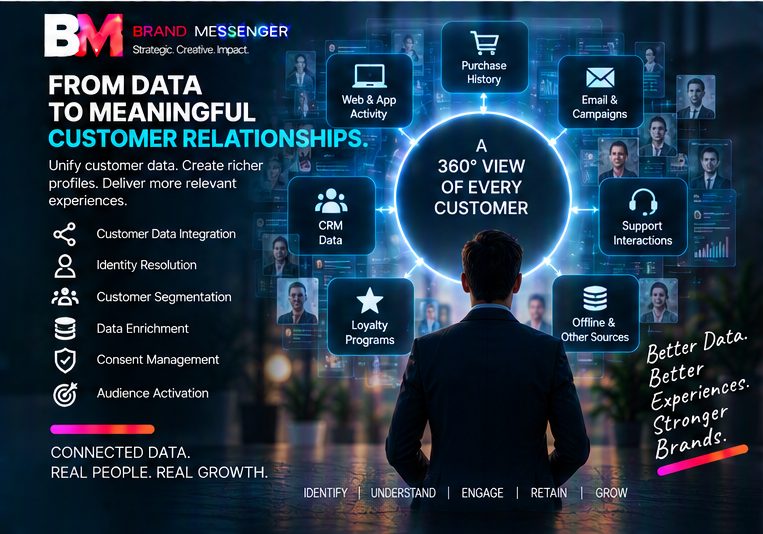
Customer information is generated everywhere websites, mobile applications, CRM systems, e-commerce platforms, marketing campaigns, customer service, sales interactions, subscriptions, loyalty programs, events, and digital experiences.
The challenge is not simply collecting more data. The challenge is connecting fragmented customer information, understanding who the customer is, managing how information can be used, creating actionable customer segments, and turning first-party data into better marketing and customer experiences.
At Brand Messenger, our Customer Data Platform & First-Party Data services help organizations create a connected customer data foundation across their wider MarTech ecosystem.
From Customer Data Platforms (CDP), First-Party Data Strategy, Unified Customer Profiles, Customer Data Integration, and Identity Resolution to Consent Management, Segmentation, Audience Activation, Data Enrichment, and Customer Data Governance, we help transform disconnected customer information into usable customer intelligence.
Our approach connects:
Collect → Integrate → Resolve → Govern → Understand → Segment → Activate → Measure → Learn
Own Your Customer Intelligence. Understand Every Relationship. Activate Data with Purpose.
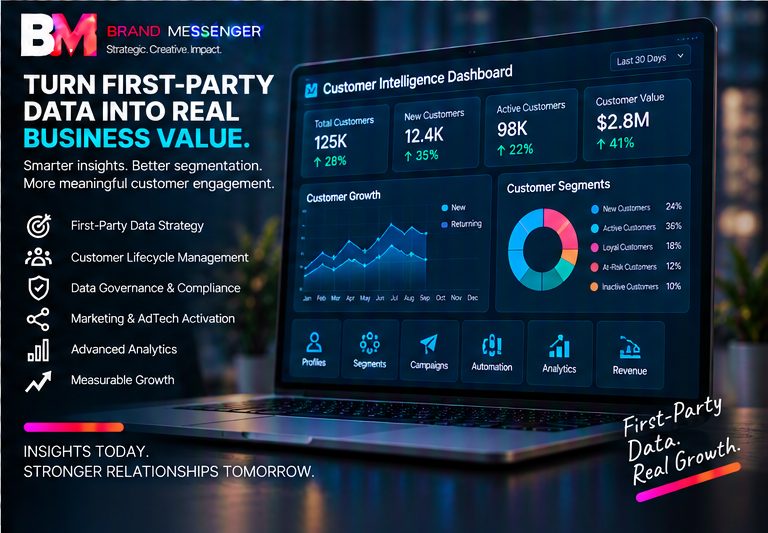
Our Customer Data Platform & First-Party Data Services
Brand Messenger provides comprehensive customer data and first-party data capabilities, including:
Customer Data Platform (CDP)
First-Party Data Strategy
Unified Customer Profiles
Customer Data Integration
Identity Resolution
Consent Management
Customer Data Segmentation
Audience Activation
Data Enrichment
Customer Data Governance
Customer Data Architecture
Customer Data Collection Strategy
Customer Profile Management
Customer Identity Management
Data Source Integration
Customer Data Mapping
Customer Data Quality Management
Audience Management
Behavioral Data Integration
Transaction Data Integration
CRM & CDP Integration
Marketing Automation Integration
AdTech Audience Integration
Customer Analytics
AI-Assisted Customer Intelligence
A Customer Data Platform can help organizations collect and organize customer information from multiple systems into persistent, usable customer profiles.
Brand Messenger helps organizations develop CDP strategies and integrations around their existing marketing, sales, customer experience, and technology environments.
A CDP ecosystem can connect information from: Websites
Mobile Applications
CRM
E-Commerce
Marketing Automation
Email Marketing
SMS
WhatsApp
Customer Portals
Sales Systems
Loyalty Programs
Subscription Platforms
Customer Service
Events
Advertising Platforms
Analytics Systems
Other Relevant Customer Touchpoints
The objective is to create a customer data layer that can support segmentation, personalization, automation, analytics, customer journeys, and audience activation. First-party data is information an organization collects through its own direct interactions and relationships with customers and audiences.
It can include appropriate information generated through: Website Activity
Customer Registrations
CRM Records
Purchases
Mobile Applications
Customer Accounts
Lead Forms
Email Engagement
Customer Service
Loyalty Programs
Surveys
Event Registrations
Subscriptions
Customer Preferences
Product Interactions
Transaction History
Brand Messenger helps organizations determine what customer information is valuable, where it originates, how it should be organized, and how it can support marketing and customer experience objectives.
A structured first-party data strategy can strengthen an organization's ability to understand and engage customers without depending entirely on external audience data. Effective customer data strategies begin with clearly defined business objectives.
Brand Messenger can help organizations map customer data requirements around areas such as: Customer Acquisition
Lead Generation
Personalization
Customer Experience
Marketing Automation
Product Recommendations
Retention
Loyalty
Cross-Selling
Upselling
Customer Service
Customer Analytics
Marketing Measurement
This helps create a more purposeful approach to customer data collection. A customer can appear differently across multiple systems.
The same individual might exist as: A Website Visitor
A Newsletter Subscriber
A CRM Lead
An E-Commerce Customer
A Mobile App User
An Event Attendee
A Loyalty Member
A Customer Service Record
Brand Messenger helps organizations bring relevant customer information together into more unified profiles.
A unified profile can include appropriate information such as: Customer Identity
Contact Information
CRM Status
Customer Segment
Purchase History
Engagement History
Product Interests
Website Behavior
Campaign Activity
Customer Preferences
Lifecycle Stage
Loyalty Status
Customer Value
Consent & Communication Preferences
The objective is to help different marketing and customer systems work from a more consistent understanding of the customer.
Customer intelligence becomes fragmented when every system maintains isolated information.
Brand Messenger can help connect appropriate customer data across:
Website → Mobile App → CRM → E-Commerce → CDP → Marketing Automation → Customer Engagement → Analytics → AdTech
Customer Data Integration can support: Profile Synchronization Customer Record Mapping Behavioral Data Transaction Data Campaign Engagement Customer Preferences Product Information Lifecycle Information Lead Information Customer Service Data Loyalty Information Conversion Data Integration can use appropriate APIs, webhooks, data pipelines, batch synchronization, and platform integrations according to the organization's technology environment. Before customer data can be unified, organizations need to understand their data ecosystem.
Brand Messenger can help map:
Data Source → Data Type → Customer Identifier → Destination → Business Use → Activation
Customer data mapping can identify: Customer Data Sources Duplicate Data Missing Information Customer Identifiers Data Relationships Integration Requirements Customer Profile Fields Data Destinations Activation Requirements Reporting Requirements This provides a clearer foundation for CDP architecture and integration. A customer may interact through different devices, systems, accounts, channels, and touchpoints.
Identity Resolution helps determine which appropriate records and interactions belong to the same customer or customer profile.
Brand Messenger can help develop identity workflows around: Customer Record Matching Duplicate Identification Profile Consolidation CRM Identity Mapping Customer Account Matching Cross-System Identity Known Customer Recognition Customer Identifier Mapping Audience Deduplication Profile Updating Identity Resolution supports a more consistent understanding of customer relationships across the MarTech environment. Customer information is not static.
People update contact information, change preferences, make purchases, become inactive, subscribe to new services, join loyalty programs, and move through different lifecycle stages.
Customer Identity Management can help maintain: Customer Identifiers Profile Relationships Account Associations Profile Updates Duplicate Management Identity Mapping Customer Status Data Source Relationships This helps maintain the integrity of customer profiles over time. Customer data activation should take appropriate account of permissions, preferences, applicable requirements, platform policies, and the context in which information was collected.
Brand Messenger can help organizations connect consent and preference information with their MarTech workflows.
Consent Management can support: Consent Capture Communication Preferences Channel Preferences Subscription Status Marketing Permissions Preference Updates Customer Opt-Outs Suppression Rules Audience Eligibility Data Usage Rules Consent Records For example:
Customer Data → Consent Status → Eligibility Check → Audience / Journey → Communication
Requirements vary by jurisdiction, industry, platform, data type, and intended use. Brand Messenger can help structure technology workflows around the organization's applicable requirements and policies. Unified customer information becomes more useful when customers can be organized into meaningful groups.
Brand Messenger can help create customer segments based on appropriate characteristics such as: New Prospects
Qualified Leads New Customers Existing Customers Repeat Customers High-Value Customers Loyal Customers Inactive Customers Lapsed Customers Renewal Customers Product Interest Purchase Behavior Engagement Level Geographic Location Customer Lifecycle Account Type Subscription Status
Segments can then support personalization, automation, campaigns, analytics, and advertising activation. Behavioral information can provide a stronger indication of customer interest than profile information alone.
Brand Messenger can help create segments using appropriate signals such as: Website Visits Product Views Content Engagement Downloads Search Activity Form Submissions Email Engagement Campaign Responses Purchases Repeat Purchases Customer Inactivity Event Participation Application Activity Behavioral segments can dynamically change as customer activity changes. Brand Messenger can organize audiences around lifecycle stages such as:
Prospect → Lead → Qualified → Customer → Active → Repeat → High-Value → Loyal → At-Risk → Inactive → Re-Engaged
Lifecycle segmentation can connect directly with Marketing Automation and Customer Journey Orchestration so customer status can influence what happens next. Collecting and organizing customer data creates value only when insights can support meaningful action.
Brand Messenger can help activate eligible customer segments across appropriate marketing environments, including: Marketing Automation Email SMS WhatsApp Website Personalization Mobile Applications Push Notifications Customer Portals CRM Customer Journey Platforms Advertising Platforms Analytics A connected activation process can operate as:
Customer Data → Unified Profile → Segment → Eligibility → Activation → Engagement → Conversion → Measurement First-party audiences can support many customer strategies, including: Lead Nurturing Customer Onboarding Product Recommendations Customer Retention Cross-Selling Upselling Renewal Loyalty Re-Engagement High-Value Customer Programs Customer Exclusions Personalized Campaigns Where supported and appropriate, eligible audiences can also connect with Brand Messenger AdTech for paid media activation. Where supported by the organization's technology stack, customer events can trigger audience or journey changes.
For example:
Product Purchase → Customer Profile Updated → Acquisition Campaign Suppressed → Onboarding Journey Started
or:
Customer Inactivity → At-Risk Segment → Re-Engagement Journey → Customer Returns → Active Segment
This allows customer data to become an active part of marketing operations. Data Enrichment can enhance existing customer profiles with additional appropriate information where available, permitted, and relevant to the business objective.
Enrichment can support areas such as:
Customer Classification Geographic Information Product Interests Engagement Level Customer Value Lifecycle Stage Purchase Behavior Account Attributes Industry Information for B2B Relationship Status Marketing Engagement The objective is not simply to add more fields. It is to add context that improves customer understanding, segmentation, personalization, and decision-making. Poor-quality customer data can create inaccurate segmentation, duplicate communication, weak personalization, and misleading analytics.
Brand Messenger can help establish processes around: Duplicate Detection Data Standardization Missing Information Record Matching Data Validation Profile Consolidation Data Synchronization Customer Identifier Consistency Data Completeness data Quality Monitoring
Better data quality creates a stronger foundation for every downstream MarTech capability. As customer data becomes connected across more technologies, organizations need clear rules around how information is collected, stored, accessed, synchronized, activated, and maintained.
Brand Messenger can help establish customer data governance frameworks covering areas such as: Data Ownership Data Access User Roles Data Classification Customer Identifiers Consent Information Data Quality Data Retention Audience Eligibility Data Synchronization Integration Responsibilities Data Usage Controls Auditability Internal Governance Processes Governance helps ensure that customer data technology remains manageable as the organization's MarTech ecosystem grows. Customer data infrastructure should be designed around appropriate data management principles from the beginning.
Depending on the organization's requirements, Brand Messenger can incorporate considerations such as: Data Minimization Purpose-Based Data Collection Consent Awareness Preference Management Role-Based Access Customer Data Controls Suppression Data Retention Secure Integration Governance Platform Requirements Specific legal and regulatory obligations vary by jurisdiction and use case, so technology architecture should be aligned with applicable requirements. CRM and CDP technologies serve complementary purposes. Turn Customer Intelligence into Automated Journeys
Brand Messenger can connect CDP audiences with Marketing Automation so customer profile changes can influence communication. Lead Nurturing Customer Onboarding Personalized Campaigns Cross-Selling Upselling Retention Loyalty Renewal Re-Engagement The CDP provides customer intelligence while automation turns that intelligence into coordinated action. Use Customer Context to Create More Relevant Experiences
Unified profiles and segmentation can support personalization across appropriate digital touchpoints. Customer Segment Lifecycle Stage Product Interest Purchase History Previous Engagement Customer Value Content Interest Loyalty Status Geographic Context This can support more relevant: Website Experiences Content Product Recommendations Offers Messages Customer Journeys Landing Pages Customer Portals Customer Data Platform & First-Party Data is one of the most important bridges between Brand Messenger MarTech and Brand Messenger AdTech.
Brand Messenger can analyze customer data to provide insight into areas such as: Customer Acquisition Customer Segments Customer Engagement Purchase Behavior Product Interests Customer Retention Churn Indicators Customer Lifetime Value Repeat Purchase Behavior Customer Journey Campaign Response Customer Loyalty Customer Growth Audience Performance This helps organizations move from simply storing customer information toward understanding what that information means.
AI-assisted analysis can help organizations identify patterns within larger customer datasets and support marketing decision-making. Predictive Segmentation Lead Propensity Purchase Propensity Churn Indicators Customer Lifetime Value Analysis Customer Behavior Patterns Product Affinity Next-Best Action Customer Engagement Prediction Audience Modeling Customer Journey Analysis Customer Trend Detection AI can operate as an intelligence layer on top of the wider customer data ecosystem while appropriate business rules and human oversight remain part of decision-making. T
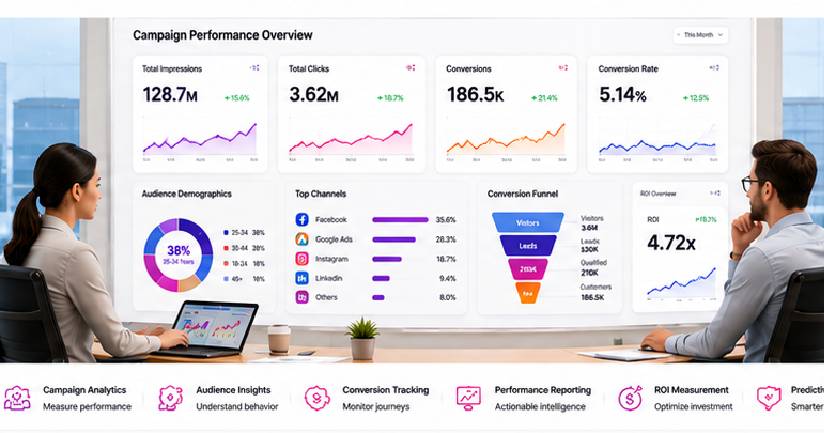
Brand Messenger can develop dashboards providing different views of customer information, including:
Customer Data Platform & First-Party Data provides a core data and intelligence layer across the Brand Messenger MarTech ecosystem.
It can connect with: Marketing Automation CRM & Customer Management Technology Customer Journey Orchestration Personalization Technology Omnichannel Customer Engagement Lead Management Content & Digital Experience Technology Customer Experience Technology Marketing Analytics AI Marketing Intelligence Marketing Dashboards & Business Intelligence MarTech Integration & Data Infrastructure Brand Messenger AdTech The connected ecosystem can operate as:
Brand Messenger can help organizations use customer data throughout the complete relationship:
Brand Messenger Customer Data Platform & First-Party Data services can support: Retail & E-Commerce FMCG & Consumer Brands B2B & Enterprise Technology & SaaS Financial Services Telecommunications Automotive Real Estate Travel & Tourism Hospitality Healthcare Education Entertainment & Media Professional Services Events & Exhibitions Subscription Businesses Franchise & Multi-Location Businesses Membership Organizations Non-Profit Organizations Government & Public Sector Startups & Scale-Ups
Brand Messenger helps organizations: Build stronger first-party data capabilities Connect fragmented customer information Create more unified customer profiles Improve customer identity management Reduce duplicate customer records Connect CRM and CDP environments Improve customer segmentation Activate audiences across marketing channels Improve personalization Strengthen marketing automation Coordinate customer journeys Improve customer data quality Manage customer preferences and consent information Establish stronger customer data governance Improve customer analytics Identify high-value customers Improve retention and loyalty intelligence Connect MarTech with AdTech Reduce dependence on disconnected audience data Build a scalable customer intelligence foundation
Why Choose Brand Messenger?
Brand Messenger combines MarTech, Customer Data Platforms, first-party data strategy, CRM, customer identity, data integration, segmentation, marketing automation, personalization, customer journeys, analytics, AI-assisted intelligence, AdTech integration, and data governance within one connected customer data framework.Customer Data Platform (CDP)
Create a Connected Customer Intelligence Foundation
First-Party Data Strategy
Build Marketing Intelligence Around Direct Customer Relationships
First-Party Data Collection Strategy
Collect What Creates Value not Simply More Data
Unified Customer Profiles
Build a More Complete View of Each Customer
Customer Data Integration
Connect Customer Information Across the Technology Ecosystem
Customer Data Mapping
Understand Where Customer Data Comes From and Where It Needs to Go
Identity Resolution
Connect Customer Signals into More Meaningful Profiles
Customer Identity Management
Maintain Consistency as Customer Information Changes
Consent Management
Connect Customer Preferences with Marketing Activation
Customer Data Segmentation
Transform Customer Profiles into Actionable Audiences
Behavioral Customer Segmentation
Understand Customers by What They Actually Do
Customer Lifecycle Segmentation
Customers at different stages require different marketing strategies.
Audience Activation
Turn Customer Intelligence into Marketing Action
First-Party Audience Activation
Use Direct Customer Relationships to Power Smarter Marketing
Real-Time & Event-Based Audience Activation
Customer behavior can sometimes require an immediate marketing response.
Data Enrichment
Add Useful Context to Customer Profiles
Customer Data Quality Management
Better Customer Intelligence Starts with Better Data
Customer Data Governance
Create Structure Around How Customer Data Is Managed
Privacy-Aware Customer Data Architecture
Build Customer Intelligence with Responsible Data Practices in Mind
CRM & CDP Integration
Connect Customer Relationships with Customer Intelligence
CRM typically manages operational relationships such as:
Leads → Contacts → Accounts → Opportunities → Customers → Activities
CDP technology can help unify information across broader customer touchpoints:
Website → App → Transactions → Engagement → Customer Behavior → Customer Profile
Connecting them can create:
CDP Customer Intelligence ↔ CRM Customer Relationship
This provides a stronger foundation for customer journeys, automation, sales activity, personalization, and analytics.CDP & Marketing Automation Integration
For example:
Customer Segment → Marketing Journey → Customer Action → CDP Update → New Segment → Next Journey
This can support:CDP & Personalization
Personalization can use information such as:Connecting MarTech & AdTech
Turn First-Party Customer Intelligence into Connected Audience Strategy
MarTech can organize and understand the customer relationship:
CRM → CDP → Unified Profile → Segmentation → Customer Intelligence
AdTech can use eligible audience information for appropriate paid media strategies:
Audience → Advertising Platform → Campaign → Engagement → Conversion → Measurement
Together:
First-Party Data → Identity → Consent → Customer Profile → Audience → MarTech Activation / AdTech Activation → Conversion → Customer Data → Analytics
This creates a continuous customer intelligence cycle.Customer Data Analytics
Turn Unified Profiles into Customer Intelligence
AI-Assisted Customer Intelligence
Discover Patterns Across Customer Data
Capabilities can include:Customer Data Dashboards & Intelligence
Customer Overview
Total customers, new customers, active customers, customer growth, and lifecycle distribution.
Audience Intelligence
Segments, audience size, engagement, customer value, and behavioral groups.
Customer Lifecycle
Prospects, leads, new customers, active customers, repeat customers, loyal customers, at-risk customers, and re-engaged customers.
Customer Value
Revenue, repeat purchases, average customer value, high-value customers, and lifetime value indicators.
Data Quality
Profile completeness, duplicate records, integration status, and data synchronization.
Executive Customer Intelligence
Customer growth, retention, acquisition, customer value, lifecycle performance, and key trends.Customer Data Across Brand Messenger MarTech
Customer Touchpoints → First-Party Data → CDP → Unified Profiles → Segmentation → Intelligence → Automation → Personalization → Engagement → Conversion → MeasurementCustomer Data Across the Complete Lifecycle
Discover → Identify → Understand → Acquire → Nurture → Convert → Onboard → Engage → Retain → Grow → Reward →
Re-Engage
At each stage, customer data can help determine:
Who is the customer?
What has happened before?
What are they interested in?
What stage are they in?
What should happen next?
How did they respond?
This transforms customer data from static records into operational marketing intelligence.Industries We Serve
Benefits of Customer Data Platform & First-Party Data
Why Choose Brand Messenger?
We do not view a CDP simply as another database.
The objective is to create a customer intelligence and activation layer connecting the technologies surrounding the customer:
Customer Touchpoints → First-Party Data → Identity → Unified Profile → Consent → Segmentation → Intelligence →
Activation → Experience → Measurement
Our Customer Data Platform & First-Party Data capabilities cover CDP, First-Party Data Strategy, Unified Customer Profiles, Customer Data Integration, Identity Resolution, Consent Management, Customer Data Segmentation, Audience Activation, Data Enrichment, Customer Data Governance, data quality, analytics, and AI-assisted customer intelligence.
Because these capabilities operate within the wider Brand Messenger MarTech and AdTech ecosystems, customer intelligence can connect directly with CRM, marketing automation, personalization, omnichannel engagement, customer journey orchestration, analytics, advertising activation, and business intelligence.
The result is not simply more customer data.
It is a connected first-party customer intelligence foundation designed to help organizations understand customers better, build stronger relationships, create more relevant experiences, and turn customer data into measurable business value.
Unify Your Data. Understand Every Customer. Activate Intelligence. Build Stronger Relationships.
Read More