






Purpose-Driven & ESG Marketing
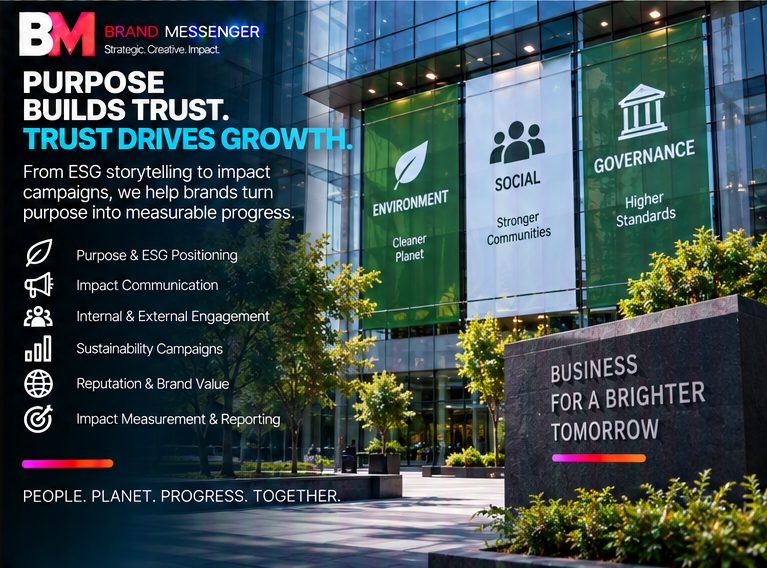
Turn Purpose into Credible Communication. Connect Sustainability, Responsibility and Social Impact with Brand, Stakeholders and Long-Term Business Value.
Organizations are increasingly expected to communicate more than what they sell.
Customers, employees, investors, business partners, communities and other stakeholders may also want to understand how an organization approaches environmental responsibility, people, governance, supply chains, communities and its wider impact.
This creates an important marketing and communication challenge.
Organizations need to communicate progress and commitments without turning complex environmental or social issues into vague slogans, exaggerated promises or disconnected campaigns.
The question is not simply:
How Do We Make the Brand Look Sustainable or Responsible?
It is:
What Is the Organization Actually Doing, What Can It Demonstrate, Why Does It Matter to Its Stakeholders, and How Can That Story Be Communicated Clearly, Credibly and Consistently?
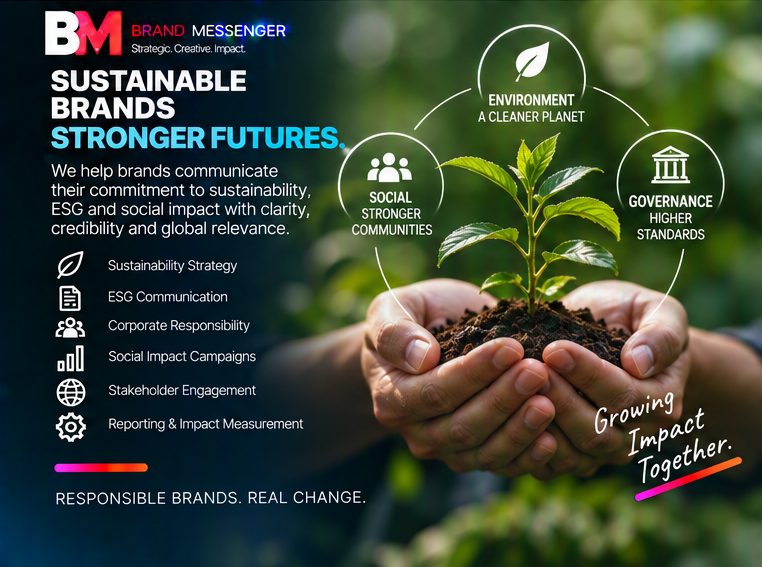
At Brand Messenger, our Purpose-Driven & ESG Marketing service connects brand purpose, sustainability communication, ESG communication, corporate responsibility, social impact, stakeholder engagement, content, campaigns, digital media, community communication, employee communication, events, reporting communication, MarTech, analytics and AI-assisted intelligence.
Our core capabilities include:
Sustainability
ESG Communication
Corporate Responsibility
Social Impact
Our wider capabilities can extend across purpose-driven brand strategy, sustainability campaigns, environmental communication, responsible-business communication, ESG content, impact storytelling, stakeholder communication, employee engagement, community initiatives, corporate citizenship, responsible sourcing communication, climate and environmental initiatives, sustainability reports, ESG reports, impact reports, responsible advertising, events, digital campaigns and performance analytics.
Our architecture becomes:
Purpose → Commitments → Actions → Evidence → Stakeholders → Communication → Engagement → Measurement → Accountability → Progress
The objective is not:
Make Responsibility Look Good.
It is:
Make Genuine Responsibility Understandable, Verifiable and Meaningful to the Audiences Who Need to Understand It.
What Is Purpose-Driven & ESG Marketing?
Purpose-Driven & ESG Marketing is the strategic communication of an organization's:
Purpose
Environmental Initiatives
Social Commitments
Governance-Related Communication
Corporate Responsibility
Sustainability Progress
Community Programs
Social Impact
Responsible Business Practices
across appropriate audiences and communication channels.
It can connect corporate strategy with:
Brand + Communication + Stakeholders + Evidence + Engagement
The marketing function does not create ESG performance by itself.
It helps organizations communicate genuine strategy, initiatives, progress and evidence effectively.
Purpose-Driven Marketing
Connect What the Organization Stands For with What It Actually Does
Purpose-driven marketing connects a brand with a meaningful organizational purpose beyond immediate product promotion.
A strong purpose should connect:
Purpose → Business → Behavior → Action → Evidence → Communication
If purpose exists only in advertising, audiences may see a gap between the message and the organization.
Brand Messenger can help translate genuine organizational purpose into:
Brand Positioning
Campaigns
Content
Employee Communication
Community Engagement
Customer Communication
Partnerships
Events
Digital Experiences
Purpose Is Not a Slogan
Statements such as:
“Building a Better Future.”
“Creating Positive Change.”
can sound powerful.
But without specific actions, they provide limited information.
Brand Messenger's approach asks:
What Does the Organization Mean?
What Is It Doing?
What Has Changed?
What Evidence Exists?
What Remains to Be Done?
The principle is:
Purpose Becomes Stronger When Communication Can Point to Action.
Purpose-Driven & ESG Marketing Is an Evolution of Cause and Green Marketing
Purpose-Driven & ESG Marketing can incorporate ideas found in both Cause Marketing and Green Marketing, while operating across a broader organizational framework.
Cause Marketing
Often connects a brand, product or campaign with a particular social cause.
Green Marketing
Focuses primarily on environmental characteristics, initiatives, products or sustainability-related positioning.
Purpose-Driven & ESG Marketing
Can connect a broader combination of:
Environmental Responsibility
Social Responsibility
Governance Communication
Corporate Purpose
Stakeholder Relationships
Social Impact
Organizational Accountability
A simplified evolution is:
Cause → Environmental Responsibility → Corporate Responsibility → ESG → Purpose + Evidence + Stakeholder Communication
These disciplines can overlap, but each retains its own role.
Brand Messenger Purpose-Driven & ESG Marketing Services
Our capabilities can include:
Purpose-Driven Marketing Strategy
Corporate Purpose Communication
ESG Communication Strategy
Sustainability Marketing
Sustainability Communication
Corporate Responsibility Marketing
CSR Communication
Social Impact Marketing
Environmental Communication
Climate Initiative Communication
Responsible Business Communication
Sustainable Product Communication
Responsible Sourcing Communication
Circular Economy Communication
Community Impact Communication
Corporate Citizenship Communication
Employee Responsibility Campaigns
ESG Content Strategy
Sustainability Content
Impact Storytelling
ESG Report Communication
Sustainability Report Communication
Impact Report Communication
Annual Report ESG Content Support
ESG Data Visualization
Sustainability Infographics
ESG Video Production
Sustainability Films
Social Impact Films
Digital Sustainability Campaigns
Social Media Campaigns
Stakeholder Communication
Employee Engagement
Community Engagement
Partnership Communication
ESG Events
Sustainability Conferences
Stakeholder Forums
Hybrid ESG Events
Responsible Paid Media
Search & Content Marketing
Community Marketing
Campaign Analytics
Stakeholder Engagement Analytics
ESG Communication Dashboards
Reputation Intelligence
AI-Assisted ESG Communication Intelligence
The Brand Messenger ESG Communication Architecture
A credible ESG communication system can follow:
Organizational Strategy
↓
ESG Priorities
↓
Commitments
↓
Programs & Actions
↓
Performance Data
↓
Evidence
↓
Stakeholder-Relevant Communication
↓
Engagement
↓
Feedback
↓
Measurement
↓
Progress
↓
Future Communication
The key principle is:
Evidence Before Amplification.
ESG: Environmental, Social & Governance
ESG commonly organizes business-related environmental, social and governance topics into three broad dimensions.
For communication purposes, these areas can help organizations structure complex responsibility information for different stakeholders.
Environmental Communication
Communicate Environmental Action with Specificity
Environmental communication can potentially address areas such as:
Energy
Emissions
Waste
Water
Materials
Packaging
Biodiversity
Pollution
Resource Efficiency
Circularity
Environmental Innovation
depending on the organization's operations and evidence.
Brand Messenger can translate technical environmental information into understandable communication without oversimplifying important limitations.
Environmental Claims
Terms such as:
Sustainable
Green
Eco-Friendly
Carbon Neutral
Net Zero
Recyclable
Renewable
Environmentally Friendly
can communicate substantial claims.
They should not be treated as decorative marketing vocabulary.
Our principle is:
The Stronger the Environmental Claim, the Stronger the Evidence Should Be.
Sustainability Marketing
Connect Sustainability Strategy with Customers and Stakeholders
Sustainability Marketing can help communicate genuine:
Environmental Initiatives
Sustainable Products
Operational Improvements
Resource Efficiency
Packaging Changes
Responsible Sourcing
Circular Initiatives
Long-Term Commitments
The architecture becomes:
Sustainability Action → Evidence → Relevant Audience → Clear Communication → Understanding
Sustainability Is Bigger Than a Campaign
A sustainability campaign can create awareness.
It cannot make an unsustainable business model sustainable.
Marketing should therefore connect with actual organizational initiatives.
Communication Should Follow Performance not Attempt to Replace It.
Sustainable Product Marketing
Where products have genuine sustainability-related characteristics, Brand Messenger can help communicate:
Materials
Packaging
Durability
Reuse
Repair
Recycling
Manufacturing Improvements
Resource Efficiency
where appropriately supported.
Claims should clearly identify what part of the product, process or lifecycle they refer to.
Circular Economy Communication
Organizations developing:
Reuse
Repair
Refurbishment
Recycling
Product Return
Material Recovery
initiatives can require customer education.
The communication journey can become:
Product → Use → Return / Reuse / Repair → Recovery → Continued Value
Marketing can help explain how customers participate.
Climate Communication
Climate-related initiatives can be complex.
Brand Messenger can help organizations communicate:
Climate Strategies
Emissions Initiatives
Transition Programs
Targets
Progress
Challenges
using clear language and appropriate evidence.
The objective should be understanding rather than simply attaching climate terminology to the brand.
Net-Zero & Carbon Communication
Where organizations communicate emissions-related targets or achievements, communication should clearly distinguish between:
Current Performance
Future Targets
Direct Reductions
Value-Chain Actions
Other Mechanisms used within the organization's strategy
where relevant.
A Future Target Should Be Communicated as a Target not as a Present Achievement.
Social Responsibility Communication
Communicate How the Organization Interacts with People and Communities
The social dimension can potentially include topics such as:
Employees
Workplace
Health & Safety
Skills
Communities
Human Rights
Supply Chains
Accessibility
Inclusion
Social Investment
depending on the organization.
Brand Messenger can develop communication around real programs and documented progress.
Corporate Responsibility
Corporate Responsibility can connect:
Business Operations
with:
Employees + Customers + Communities + Environment + Society
Brand Messenger can help organizations communicate responsibility through:
Corporate Websites
Reports
Campaigns
Social Media
Events
Employee Communication
Community Programs
Stakeholder Content
The objective is:
Make Responsibility Part of Corporate Communication not an Isolated Annual Campaign.
Corporate Social Responsibility Communication
CSR communication can include:
Community Investment
Employee Volunteering
Education Programs
Health Programs
Environmental Initiatives
Community Development
Philanthropic Programs
Brand Messenger can connect individual programs to the organization's wider responsibility narrative while keeping each initiative specific and measurable where possible.
Social Impact Marketing
Communicate Positive Change Without Overstating It
Organizations may support initiatives intended to create social benefits.
Brand Messenger can help communicate:
Program Objectives
Activities
Communities Reached
Outputs
Outcomes
Stories
Partnerships
Progress
The architecture becomes:
Social Need → Initiative → Activity → Output → Outcome → Evidence → Impact Communication
Activity Is Not Automatically Impact
This distinction matters.
Activity
What the organization did.
Output
What the activity directly produced.
Outcome
What changed following the activity.
Impact
The broader or longer-term change associated with the intervention.
Marketing should not automatically convert:
“We Conducted 100 Workshops”
into:
“We Transformed the Community.”
Evidence determines what can responsibly be claimed.
Impact Storytelling
Brand Messenger can transform social-impact information into:
Stories
Case Studies
Films
Photography
Infographics
Interactive Content
Reports
Social Content
The objective is:
Humanize the Evidence Without Replacing the Evidence.
Community Impact Communication
Organizations working with communities can communicate:
Programs
Partnerships
Participation
Progress
Outcomes
while respecting:
Privacy
Consent
Dignity
Context
People should not be reduced to visual proof that a company is responsible.
Governance Communication
Make Responsible Business Structures Understandable
Governance communication can potentially address relevant topics such as:
Policies
Oversight
Ethics
Accountability
Risk Management
Compliance Structures
Reporting Processes
Responsible Business Standards
depending on what the organization can substantiate and appropriately disclose.
Brand Messenger's role is to translate approved governance information into accessible stakeholder communication.
Marketing Does Not Create Governance
This boundary is important.
Brand Messenger can help organizations communicate governance.
Marketing should not create the impression that a governance mechanism exists when it does not.
Governance First. Communication Second.
ESG Brand Positioning
Connect Responsibility with the Brand Without Turning the Entire Brand into a Claim
Some organizations may want sustainability or social responsibility to become central to brand positioning.
Others may require ESG communication as one component of a broader corporate brand.
Brand Messenger can determine the appropriate architecture:
ESG-Led Brand
Responsibility is central to the value proposition.
ESG-Integrated Brand
Responsibility is an important part of the wider brand.
Corporate ESG Communication
ESG is communicated primarily through corporate and stakeholder channels.
The correct approach depends on the organization.
Purpose + Product
Purpose-driven marketing should connect appropriately with the actual product or service.
The strongest architecture can become:
Purpose + Product Value + Responsible Business Practice + Customer Experience
Purpose should enhance a real value proposition—not replace one.
Purpose + Corporate Brand
For corporate organizations, purpose can connect:
Corporate Strategy
↓
Employees
↓
Products & Services
↓
Customers
↓
Communities
↓
Stakeholders
↓
Brand Reputation
This creates a wider purpose ecosystem.
Stakeholder Communication
Different Stakeholders Need Different ESG Information
ESG communication should not necessarily send one identical message to everyone.
Relevant audiences can include:
Customers
Employees
Investors
Business Partners
Suppliers
Communities
Regulators
Media
NGOs
Industry Organizations
Each audience may need different levels of detail.
The architecture becomes:
ESG Information → Stakeholder → Information Need → Appropriate Format → Communication
Customer Sustainability Communication
Customers may need straightforward information about:
Products
Packaging
Materials
Programs
Participation
Environmental Attributes
The objective is:
Make Responsible Choices Easier to Understand Without Oversimplifying the Evidence.
Employee ESG Communication
Employees can be important participants in:
Sustainability Programs
Volunteering
Workplace Initiatives
Community Programs
Responsible Operations
Brand Messenger can develop internal communication around:
Awareness → Understanding → Participation → Feedback
Employee Engagement Campaigns
Internal campaigns can support:
Energy Reduction
Waste Reduction
Recycling
Volunteering
Community Programs
Responsible Workplace Practices
where aligned with the organization's actual programs.
The objective is participation rather than corporate messaging alone.
Investor & Corporate ESG Communication
Corporate and investor audiences may require more detailed, evidence-based communication.
Brand Messenger can help translate approved ESG information into:
Corporate Content
Presentations
Data Visualizations
Reports
Digital Experiences
Videos
without replacing specialist financial, legal, sustainability or regulatory reporting functions.
Supplier & Partner Communication
ESG programs can involve:
Suppliers
Distributors
Partners
Contractors
Organizations may need to communicate:
Expectations
Standards
Programs
Reporting Processes
Collaborative Initiatives
Brand Messenger can support the communication layer around these programs.
ESG Content Strategy
Turn Complex Responsibility Information into Accessible Content
Brand Messenger can develop:
ESG Articles
Sustainability Stories
Program Updates
Case Studies
Executive Interviews
Educational Content
FAQs
Reports
Social Content
Video
A strong content architecture can combine:
Data + Explanation + Human Context + Progress
ESG Reporting Communication
Formal ESG and sustainability reporting can contain complex technical information.
Brand Messenger can support the communication and presentation layer through:
Report Design
Editorial Structure
Infographics
Data Visualization
Digital Reports
Executive Summaries
Supporting Content
Video
Specialist reporting, assurance, legal and regulatory responsibilities remain with the appropriate professionals and organization.
Sustainability Report Communication
A sustainability report can potentially communicate:
Strategy
Priorities
Programs
Targets
Performance
Challenges
Progress
Brand Messenger can make this information more accessible across digital and visual formats.
ESG Data Visualization
Complex datasets can be transformed into:
Charts
Infographics
Interactive Visuals
Dashboards
Timelines
Progress Indicators
Good visualization should clarify data.
It should not visually exaggerate progress.
ESG Video & Film
Brand Messenger can produce:
Sustainability Films
Corporate Responsibility Films
Social Impact Films
Program Documentaries
Employee Stories
Community Stories
Executive Interviews
ESG Explainer Videos
Animation
Video can humanize complex ESG subjects while supporting wider corporate communication.
Sustainability Campaigns
A campaign can connect:
Issue
↓
Organizational Action
↓
Audience
↓
Information
↓
Participation
↓
Measured Response
Campaigns can encourage customers or employees to participate in genuine programs.
Environmental Awareness Campaigns
Organizations can develop campaigns around relevant:
Waste Reduction
Recycling
Energy
Water
Resource Use
Environmental Programs
The communication should clearly explain:
What Is the Issue?
What Is the Organization Doing?
What Can the Audience Do?
Social Impact Campaigns
Brand Messenger can develop campaigns around documented:
Education Programs
Community Development
Skills Programs
Social Initiatives
Employee Volunteering
Corporate Giving
The campaign should connect the audience with genuine activity rather than simply associating the brand with a social issue.
Partnership-Led ESG Marketing
Organizations can collaborate with:
NGOs
Non-Profits
Community Organizations
Universities
Industry Groups
Technology Partners
on sustainability and social initiatives.
Brand Messenger can support:
Partnership Positioning
Co-Branded Campaigns
Events
Content
Program Communication
Impact Storytelling
The contribution of each partner should be represented accurately.
Purpose-Driven Marketing + Non-Profit Partnerships
Brand Messenger's Non-Profit & NGO Marketing capabilities can connect with Purpose-Driven & ESG Marketing when businesses work with mission-driven organizations.
The architecture can become:
Company → ESG / Responsibility Objective → NGO Partner → Program → Community → Evidence → Communication
This remains different from marketing the NGO itself.
Purpose-Driven Marketing + Cause Marketing
A company may also develop a specific cause-related campaign.
In this case:
Corporate Purpose
can provide the broader framework,
while:
Cause Marketing
can become a specific activation within it.
The relationship becomes:
Purpose Strategy → ESG / Responsibility Framework → Cause Initiative → Campaign
Purpose-Driven Marketing + Green Marketing
Similarly:
Sustainability Strategy
can provide the organizational framework,
while:
Green Marketing
can communicate genuine environmental characteristics of relevant products, services or initiatives.
The distinction helps prevent one environmental campaign from being presented as evidence that the entire organization is sustainable.
Greenwashing Risk
Sustainability Communication Must Match Reality
Greenwashing can occur when environmental communication creates an impression that is broader, stronger or more positive than the underlying evidence supports.
Potential risks include:
Vague Environmental Claims
Unsupported Superlatives
Selective Disclosure
Misleading Imagery
Unclear Comparisons
Presenting Future Goals as Current Achievements
Highlighting a Small Initiative as Representative of the Entire Business
Brand Messenger's communication principle is:
Specific Claims. Clear Context. Appropriate Evidence. No Artificial Sustainability Halo.
Purpose-Washing
The same issue can occur with social purpose.
A company can communicate strongly about a cause while providing little evidence that the issue meaningfully connects with its operations or actions.
Our principle is:
Purpose Should Be Demonstrated Through Behavior Before It Is Amplified Through Advertising.
ESG-Washing
ESG terminology can also become overly broad.
A company should not use the label ESG as a general signal of responsibility without explaining the specific policies, programs, metrics or commitments behind the communication.
Explain the Substance Behind the Label.
Responsible Claims Framework
Before amplifying an ESG-related claim, Brand Messenger can structure communication around:
Claim
↓
Definition
↓
Scope
↓
Evidence
↓
Time Period
↓
Limitations
↓
Approval
↓
Communication
This helps convert broad marketing statements into more defensible communication.
Claim Specificity
Compare:
“We Are Sustainable.”
with:
“We Reduced Packaging Material in This Product Line.”
The second statement defines a specific area that can potentially be measured and supported.
Our approach favors:
Specificity Over Ambiguity.
ESG Communication Governance
Build Review into the Marketing Workflow
An ESG communication workflow can become:
Campaign Concept
↓
ESG / Sustainability Team
↓
Evidence Review
↓
Legal / Compliance Review Where Required
↓
Brand Review
↓
Approval
↓
Publication
↓
Monitoring
↓
Update
This reduces the risk of marketing moving faster than the underlying evidence.
ESG Claims Library
Organizations can maintain an approved communication library containing:
Claim
Supporting Evidence
Scope
Applicable Products / Markets
Approval Status
Review Date
Required Qualification
Brand Messenger can build marketing workflows around approved claims.
Version Control
ESG performance changes.
A statement that was accurate two years ago may no longer represent current performance.
Content governance should therefore support:
Claim → Evidence → Publication Date → Review → Update / Retire
Purpose-Driven Social Media
Social media can communicate:
Programs
Progress
Employee Participation
Community Initiatives
Sustainability Education
Impact Stories
Reports
The content mix should include substance rather than repeatedly publishing broad statements about values.
ESG Social Listening
Brand Messenger can analyze public conversation around:
Sustainability Campaigns
Responsibility Initiatives
Corporate Reputation
ESG Communication
to identify:
Questions
Misunderstandings
Criticism
Emerging Issues
Social listening provides signals.
It does not automatically represent the opinion of the entire stakeholder population.
Community Marketing for ESG
Purpose-driven organizations can build communities around relevant:
Sustainability Initiatives
Employee Programs
Customer Participation
Social Impact Programs
Environmental Activities
Brand Messenger's Community Marketing capabilities can help create ongoing participation beyond campaign periods.
ESG Events
Turn Responsibility Communication into Stakeholder Engagement
Brand Messenger's event capabilities can support:
Sustainability Conferences
ESG Forums
Corporate Responsibility Events
Stakeholder Meetings
Community Events
Employee Events
Environmental Campaign Events
Webinars
Hybrid Events
The event journey becomes:
Issue → Information → Discussion → Participation → Relationship → Follow-Up
Sustainability Conferences & Forums
Organizations can use conferences and forums to:
Share Progress
Discuss Challenges
Present Research
Engage Partners
Build Industry Dialogue
Brand Messenger can support:
Event Branding
Promotion
Registration
Content
Live Production
Hybrid Participation
Engagement
Analytics
Stakeholder Engagement
Purpose-driven communication should not always be one-way.
Organizations can create mechanisms for:
Feedback
Questions
Surveys
Forums
Consultations
Community Discussion
The architecture becomes:
Communicate → Listen → Understand → Respond → Improve
ESG Marketing + Multicultural Marketing
Sustainability and social-impact communication may need to operate across different:
Countries
Languages
Communities
Cultural Contexts
Brand Messenger's Multicultural Marketing capabilities can support localization while preserving the underlying evidence and meaning of ESG claims.
ESG Marketing + Lifestyle Marketing
Sustainability can be relevant within:
Fashion
Food
Travel
Fitness
Wellness
Consumer Products
Brand Messenger can connect sustainability communication with Lifestyle Marketing where it genuinely relates to the product and customer experience.
The objective should not be to attach sustainability terminology to every lifestyle campaign.
ESG Marketing + B2B Marketing
B2B customers may evaluate suppliers partly through:
Sustainability Information
Policies
Supply-Chain Practices
Governance
Social Responsibility
Brand Messenger can develop ESG communication for:
Corporate Websites
Sales Content
Presentations
Proposals
Events
Account-Based Marketing
where relevant.
ESG Marketing + Employer Brand
Employees and candidates may also encounter an organization's purpose and responsibility communication.
Brand Messenger can connect ESG with employer-brand content around:
Workplace
Culture
Community Programs
Employee Volunteering
Sustainability Participation
Claims about workplace experience should remain consistent with organizational reality.
Responsible Paid Media for ESG Campaigns
Brand Messenger's AdTech capabilities can support:
Search
Social
Display
Video
Native
Programmatic
Digital Audio
DOOH
for appropriate purpose-driven and ESG campaigns.
But amplification increases responsibility.
The More Widely a Claim Is Distributed, the More Important It Is That the Claim Is Clear and Supportable.
Contextual ESG Advertising
Contextual advertising can place sustainability or social-impact communication around relevant:
Business
Environmental
Industry
Community
Sustainability Content
without requiring excessive individual profiling.
Purpose-Driven & ESG Marketing + AdTech
Brand Messenger's AdTech ecosystem can support:
Campaign Delivery
Paid Media
Programmatic Advertising
Contextual Targeting
Dynamic Creative
Bid Optimization
Advertising Measurement
The technology can amplify communication.
It cannot create credibility where evidence is missing.
Purpose-Driven & ESG Marketing + MarTech
Brand Messenger's MarTech capabilities can support:
CRM
Marketing Automation
Omnichannel Communication
Campaign Management
Content Technology
Customer Journeys
Analytics
This can help coordinate ESG communication across multiple stakeholder touchpoints.
ESG Content Management
Organizations may generate large amounts of:
Reports
Policies
Campaign Assets
Videos
Data
Case Studies
Content technology can help organize:
Approved Assets
Current Versions
Market Variants
Languages
Publication Workflows
This can improve consistency across ESG communication.
ESG Communication Personalization
Different stakeholders can receive information relevant to their relationship with the organization.
For example:
Customer → Product Sustainability Information
Employee → Workplace & Participation Programs
Business Partner → Supply-Chain Information
Investor → Corporate ESG Information
The principle is:
Personalize Relevance not the Facts.
The underlying evidence should remain consistent.
ESG Marketing Analytics
Brand Messenger can measure communication across:
Awareness
Reach
Content Discovery
Search Visibility
Engagement
Report Downloads
Video Engagement
Content Interaction
Stakeholders
Event Participation
Feedback
Program Engagement
Campaigns
Reach
Engagement
Defined Actions
Employee Programs
Participation where appropriately measurable
Community Programs
Communication and participation metrics
Reputation
Feedback and sentiment signals
ESG Communication Dashboards
A connected dashboard can potentially organize:
Environmental Communication
Social Communication
Governance Content
Campaigns
Stakeholder Engagement
Events
Content Performance
↓
ESG Communication Intelligence
This provides communication visibility without pretending marketing metrics are themselves ESG performance metrics.
ESG Performance / ESG Marketing Performance
This distinction is essential.
ESG Performance
Concerns the organization's actual environmental, social and governance performance.
ESG Marketing Performance
Concerns whether communication reached audiences, generated engagement and improved understanding.
A campaign with millions of impressions does not prove the organization improved its environmental performance.
Measure Communication as Communication. Measure ESG Performance as ESG Performance.
Social Impact Measurement & Communication
Where organizations have appropriate program data, Brand Messenger can help translate:
Activities
Outputs
Outcomes
Impact Indicators
into stakeholder communication.
Marketing should not invent impact metrics when the underlying program does not measure them.
Reputation & Purpose
Purpose-driven communication can influence corporate reputation.
But reputation is shaped by more than marketing.
It can be influenced by:
Products
Operations
Employee Experience
Leadership
Customer Experience
Environmental Performance
Community Relationships
Therefore:
Marketing Can Explain Responsible Business. It Cannot Substitute for Responsible Business.
ESG Crisis Communication
Organizations may need to communicate around:
Environmental Incidents
Supply-Chain Issues
Social Controversies
ESG Reporting Errors
Missed Targets
A responsible workflow can become:
Verify → Understand → Acknowledge → Explain → Act → Update
Communication should distinguish between:
Confirmed Facts
Developing Information
Corrective Actions
Future Commitments
Communicating Missed Targets
Credibility can sometimes require communicating where progress did not meet expectations.
A useful framework is:
Target → Actual Performance → Explanation → Corrective Action → Revised Path
Purpose-driven communication should not disappear whenever performance becomes difficult to communicate.
Transparency Communication
Transparency does not necessarily mean publishing every piece of internal information.
It means communicating relevant information accurately and with enough context for stakeholders to understand what is being claimed.
Transparency Requires Context not Information Overload.
AI-Assisted ESG Marketing Intelligence
Use AI to Understand Communication not Manufacture Responsibility
AI can assist Brand Messenger with appropriate tasks such as:
Content Analysis
Campaign Analysis
Stakeholder Feedback Categorization
Report Content Organization
Trend Analysis
Communication Monitoring
Content Workflow Support
The architecture becomes:
ESG Communication Data → AI Analysis → Patterns → Human Review → Communication Decision
AI-Assisted ESG Content
AI can help teams:
Organize Information
Develop Draft Structures
Summarize Approved Material
Adapt Content Formats
Support Translation
But important ESG claims should be checked against the underlying approved evidence.
AI Can Help Write the Communication. It Cannot Become the Evidence Behind the Claim.
AI & ESG Claim Verification
AI may help identify:
Inconsistent Language
Missing Qualifications
Potentially Broad Claims
Conflicting Content Versions
These tools can support review.
They should not replace appropriate legal, regulatory, scientific, sustainability or subject-matter expertise.
ESG Sentiment Analysis
AI-assisted analysis can estimate patterns across available:
Feedback
Reviews
Social Conversation
Survey Responses
This can help identify communication themes.
But:
Sentiment Analysis Estimates Patterns in Language. It Does Not Reveal the True Opinion of Every Stakeholder.
Predictive ESG Communication Intelligence
Where sufficient communication data exists, analytics can support estimates around:
Campaign Engagement
Content Demand
Stakeholder Participation
Communication Performance
These are marketing forecasts not predictions of future ESG performance.
Purpose-Driven & ESG Marketing Maturity Model
Level 01 — Responsibility Promotion
Individual CSR / Sustainability Campaigns
Level 02 — Structured Sustainability Communication
Programs + Content + Campaigns + Reports
Level 03 — Integrated ESG Communication
Environmental + Social + Governance + Stakeholder Communication
Level 04 — Connected Purpose-Driven Marketing
Brand + ESG + Content + Events + Community + AdTech + MarTech
Level 05 — Evidence-Led ESG Communication Intelligence
Actions → Evidence → Stakeholders → Communication → Engagement → Measurement
Level 06 — AI-Assisted ESG Communication Intelligence
Connected Communication Data + Content Intelligence + Stakeholder Analytics + AI Assistance + Human Governance
The objective is not:
Make ESG Louder.
It is:
Make ESG Communication More Specific, Understandable, Evidence-Led and Useful.
Complete Brand Messenger Purpose-Driven & ESG Marketing Process
A comprehensive engagement can follow:
Corporate Purpose
↓
Business Strategy
↓
ESG Priorities
↓
Sustainability / Responsibility Initiatives
↓
Actions
↓
Performance Data
↓
Evidence
↓
Stakeholder Mapping
↓
Communication Strategy
↓
Brand & Messaging
↓
Content
↓
Reports
↓
Campaigns
↓
Digital Media
↓
Community
↓
Events
↓
Stakeholder Engagement
↓
Feedback
↓
Marketing Analytics
↓
AI-Assisted Communication Intelligence
↓
Learning
↓
Improvement
The lifecycle becomes:
Define → Act → Measure → Verify → Communicate → Engage → Listen → Learn → Improve
Across the Brand Messenger Purpose-Driven & ESG Marketing Ecosystem
Corporate Purpose
Define What the Organization Stands For
↓
ESG Strategy & Organizational Action
Establish What the Organization Is Actually Doing
↓
Evidence & Performance Information
Understand What Can Be Supported
↓
Purpose-Driven Brand Strategy
Connect Purpose with the Corporate Brand
↓
Sustainability Communication
Explain Environmental Initiatives
↓
Corporate Responsibility
Communicate Responsible Business Practices
↓
Purpose-Driven & ESG Marketing
Sustainability • ESG Communication • Corporate Responsibility • Social Impact
↓
Content & Creative
Turn Complex Information into Accessible Communication
↓
Community & Stakeholder Engagement
Build Participation and Dialogue
↓
Events
Create Forums for Sustainability and ESG Communication
↓
Multicultural Marketing
Adapt Communication Across Markets and Communities
↓
AdTech
Scale Appropriate Purpose-Driven Campaigns
↓
MarTech
Coordinate Stakeholder Communication
↓
Analytics & BI
Measure Communication Performance
↓
AI-Assisted ESG Communication Intelligence
Turn Communication Data into Decision Support
The complete architecture becomes:
Purpose → Action → Evidence → Communication → Stakeholder → Engagement → Accountability → Progress → Trust
Organizations & Sectors We Can Support
Brand Messenger Purpose-Driven & ESG Marketing can support appropriate applications across:
Corporations
Global Brands
Consumer Brands
B2B Companies
Technology Companies
Financial Institutions
Manufacturing
Energy
Retail
Fashion
Food & Beverage
Hospitality
Travel & Tourism
Real Estate
Construction
Transportation
Logistics
Healthcare
Education
Media & Entertainment
Telecommunications
Professional Services
Multi-Location Businesses
Social Enterprises
Companies Working with NGOs
Organizations Developing Sustainability Programs
Organizations Building ESG Communication Strategies
Benefits of Purpose-Driven & ESG Marketing
Brand Messenger can help organizations:
Develop purpose-driven marketing strategies
Connect corporate purpose with brand communication
Build structured ESG communication
Communicate sustainability initiatives clearly
Strengthen corporate responsibility communication
Develop social-impact campaigns
Improve stakeholder communication
Translate technical ESG information into accessible content
Create sustainability and ESG reports
Develop ESG data visualizations
Produce sustainability and social-impact films
Build environmental-awareness campaigns
Communicate responsible products more clearly
Develop employee ESG engagement
Build community participation
Communicate NGO and social-impact partnerships
Develop ESG events and stakeholder forums
Coordinate multilingual ESG communication
Build responsible paid-media campaigns
Create ESG content governance
Develop approved claims workflows
Reduce communication risks associated with vague sustainability claims
Measure stakeholder engagement
Build ESG communication dashboards
Apply AI-assisted communication intelligence responsibly
Strengthen the connection between organizational action, evidence and communication
Why Choose Brand Messenger?
Brand Messenger combines purpose-driven brand strategy, sustainability communication, ESG communication, corporate responsibility, social-impact storytelling, creative production, stakeholder engagement, community marketing, events, AdTech, MarTech, analytics and AI-assisted intelligence within one connected Purpose-Driven & ESG Marketing ecosystem.
We do not approach ESG Marketing as:
Find a Social Issue → Add Sustainability Language → Publish Green Imagery → Promote the Brand as Responsible.
We approach it as:
Understand the Purpose → Identify the Actual Commitments → Understand the Actions → Review the Evidence → Identify the Stakeholders → Develop Clear Communication → Create Relevant Content → Engage → Listen → Measure → Update → Improve.
The distinction matters.
Purpose-Driven Marketing connects organizational purpose with brand and behavior.
Sustainability Marketing communicates genuine environmental initiatives and product characteristics.
ESG Communication translates environmental, social and governance information into stakeholder-relevant communication.
Corporate Responsibility connects organizational behavior with employees, communities, customers and wider stakeholders.
Social Impact Marketing communicates documented programs, outcomes and progress.
Content & Creative make complex ESG information understandable.
Community & Stakeholder Engagement turn one-way communication into participation and dialogue.
Multicultural Marketing helps ESG communication remain relevant across regions, languages and cultures.
AdTech can amplify responsible campaigns.
MarTech can coordinate stakeholder journeys and communication.
Analytics & BI measure how effectively the communication is reaching and engaging its intended audiences.
And AI-Assisted ESG Communication Intelligence can help organize information, analyze communication performance and identify patterns while keeping evidence, expert review and organizational accountability at the center.
The result is not simply ESG promotion.
It is a connected purpose-driven communication ecosystem designed to help organizations translate genuine sustainability, responsibility and social-impact activity into credible, understandable and measurable stakeholder communication.
Define the Purpose. Demonstrate the Action. Support the Claim. Communicate the Progress. Build the Trust.
Sustainability. ESG Communication. Corporate Responsibility. Social Impact. One Connected Purpose-Driven & ESG Marketing Ecosystem.