





Capture Every Opportunity. Qualify the Right Leads. Connect Marketing Activity to Revenue Growth.
Generating leads is only the beginning of the customer acquisition process.The greater challenge is determining which leads matter, how they should be qualified, when they should be nurtured, who should receive them, when sales should become involved, and which marketing activities ultimately contribute to pipeline and revenue.
At Brand Messenger, our Lead Management & Revenue Marketing services help organizations connect marketing technology, customer data, automation, CRM, sales processes, analytics, and attribution into a structured lead-to-revenue environment.
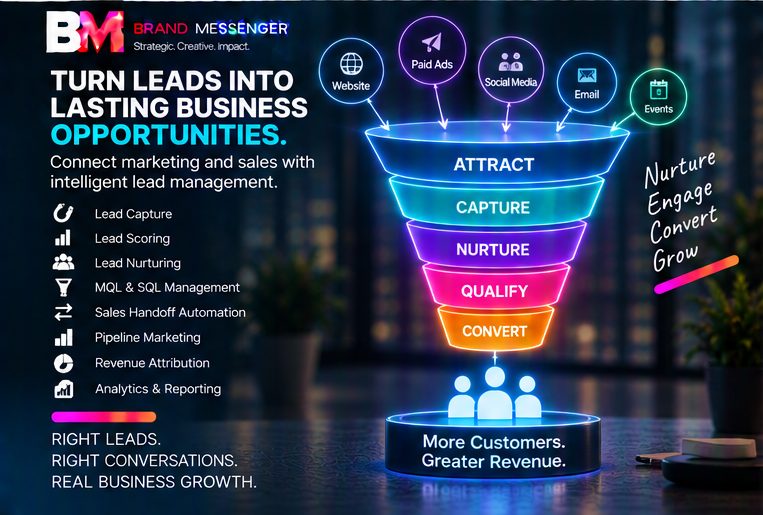
From Lead Capture, Lead Scoring, Lead Qualification, Lead Routing, and Lead Nurturing to Marketing Qualified Lead (MQL) Management, Sales Qualified Lead (SQL) Management, Sales Handoff Automation, Pipeline Marketing, and Revenue Attribution, we help organizations manage the complete progression from initial interest to measurable business opportunity.
Our approach connects:
Audience → Engagement → Lead Capture → Qualification → Scoring → Nurturing → MQL → SQL → Sales → Opportunity → Pipeline → Revenue → Attribution
Capture Better Leads. Prioritize Real Opportunities. Connect Marketing to Revenue.
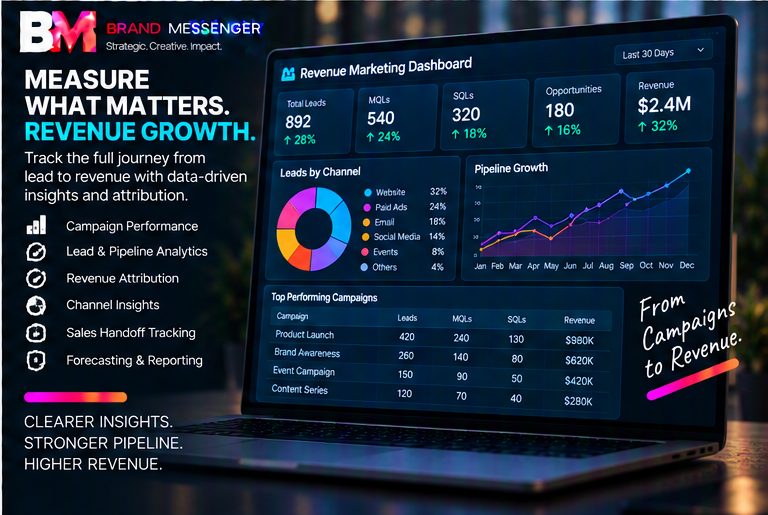
Our Lead Management & Revenue Marketing Services
Brand Messenger provides comprehensive capabilities across:
Lead Capture
Lead Scoring
Lead Qualification
Lead Routing
Lead Nurturing
MQL Management
SQL Management
Sales Handoff Automation
Pipeline Marketing
Revenue Attribution
Lead Database Management
Lead Enrichment
Lead Segmentation
Behavioral Lead Intelligence
Predictive Lead Scoring
Lead Lifecycle Management
Lead Assignment
Lead Follow-Up Automation
Lead Re-Engagement
Account & Opportunity Alignment
CRM Lead Integration
Marketing-to-Sales Alignment
Pipeline Analytics
Lead Conversion Analytics
Revenue Intelligence
AI-Assisted Lead Intelligence
Lead & Revenue Dashboards
Lead Capture
Turn Customer Interest into Actionable Opportunities
Potential customers interact with organizations through many different channels.
Brand Messenger helps create connected Lead Capture environments across:
Websites
Landing Pages
Contact Forms
Request-a-Quote Forms
Demo Requests
Downloads
Newsletter Registrations
Events
Exhibitions
Webinars
Social Campaigns
Paid Advertising
Email Campaigns
Customer Portals
Mobile Applications
Sales Enquiries
Rather than allowing leads to remain isolated inside individual channels, Brand Messenger can connect lead capture with CRM, Marketing Automation, customer data, campaign technology, and sales workflows.
The process becomes:
Customer Interaction → Lead Capture → Customer Record → Qualification → Next Action
Lead Capture Technology
Build a Connected Entry Point into the Revenue Funnel
Different lead sources may require different capture processes.
Brand Messenger can structure technology around:
Lead Forms
Progressive Forms
Landing Pages
Campaign Forms
Event Registration
Demo Requests
Consultation Requests
Quote Requests
Content Downloads
Newsletter Sign-Ups
Contact Requests
Referral Leads
Advertising Leads
CRM Lead Creation
Lead source and campaign information can also be retained where technically available so teams can better understand where opportunities originated.
Lead Database Management
Build a Structured Foundation for Lead Intelligence
Lead information becomes more valuable when it is organized consistently.
Brand Messenger can help structure lead records around information such as:
Contact Information
Organization
Lead Source
Campaign
Product or Service Interest
Customer Segment
Geographic Market
Engagement History
Lead Status
Lead Score
Qualification Status
Assigned Sales Representative
Lifecycle Stage
Opportunity Status
This creates a stronger foundation for segmentation, scoring, nurturing, routing, CRM management, and reporting.
Lead Enrichment
Add Useful Context to Lead Records
Where appropriate and permitted, lead information can be enriched with additional business or behavioral context.
This may include:
Company Information
Industry
Company Size
Geographic Information
Product Interest
Campaign History
Website Activity
Content Engagement
Previous Interactions
Account Relationships
Customer Lifecycle Information
The objective is to help marketing and sales teams understand more than a name and email address.
Lead Scoring
Prioritize Leads According to Their Potential
Not every lead should receive the same level of attention.
Brand Messenger can create Lead Scoring models that evaluate relevant characteristics and behaviors to help prioritize opportunities.
Scoring factors can include:
Profile Signals
Industry
Company Type
Company Size
Role
Market
Geographic Location
Product Fit
Behavioral Signals
Website Visits
Repeat Visits
Product Page Activity
Pricing Page Activity
Content Downloads
Email Engagement
Event Attendance
Demo Requests
Campaign Engagement
Intent Signals
Request for Proposal
Quote Request
Consultation Request
Product Comparison
Repeated Product Interest
High-Intent Content Engagement
A structured score can help determine which leads require nurturing and which may be ready for sales engagement.
AI & Predictive Lead Scoring
Identify Stronger Opportunities Through Customer Intelligence
Traditional lead scoring often relies on manually defined rules.
Brand Messenger can also connect Lead Management with its AI Marketing & Personalization capabilities to support predictive lead intelligence where sufficient data is available.
AI-assisted scoring can analyze combinations of:
Lead Profile + Behavioral Data + Engagement + Customer Journey + Historical Conversion Patterns
This can help identify:
Higher-Intent Leads
Conversion Propensity
Product Affinity
Engagement Strength
Potential Customer Value
Sales Readiness
Lead Prioritization
The purpose is not to replace sales judgment, but to provide teams with additional intelligence for prioritizing opportunities.
Lead Qualification
Separate Interest from Genuine Opportunity
Lead generation can create large numbers of enquiries, but volume alone does not create a strong pipeline.
Brand Messenger helps organizations establish structured qualification frameworks based on factors such as:
Customer Fit
Product or Service Relevance
Business Need
Engagement
Purchase Intent
Customer Profile
Organization Type
Decision-Making Role
Market Eligibility
Sales Readiness
Lead Score
Qualification criteria can be aligned with the organization's sales model rather than applying one generic definition to every business.
The objective is to identify:
Who should continue nurturing?
Who requires more information?
Who should move to sales?
Who should be excluded or deprioritized?
Lead Segmentation
Create Different Strategies for Different Leads
Leads can be segmented according to:
Lead Source
Product Interest
Industry
Market
Customer Type
Campaign
Engagement
Lead Score
Funnel Stage
Purchase Intent
Company Size
Customer Value Potential
Different segments can then receive different content, campaigns, nurturing journeys, offers, and sales follow-up.
Instead of:
All Leads → Same Communication
Brand Messenger helps organizations move toward:
Lead Context → Segment → Relevant Journey → Appropriate Next Action
Lead Routing
Get the Right Lead to the Right Team
Once a lead becomes ready for sales engagement, it needs to reach the correct person quickly.
Brand Messenger can create automated Lead Routing rules based on:
Geographic Territory
Product
Service
Industry
Customer Segment
Account
Company Size
Lead Score
Lead Source
Sales Team
Sales Representative
Existing Customer Relationship
Priority Level
The process can operate as:
Qualified Lead → Routing Rules → Correct Sales Team → Assignment → Notification → Follow-Up
This reduces manual lead distribution and can improve response coordination.
Intelligent Lead Assignment
Combine Business Rules with Lead Intelligence
Organizations may require more sophisticated lead assignment than simple geographic routing.
Assignment can consider multiple conditions:
Territory + Product + Lead Value + Customer Type + Sales Capacity + Existing Account Relationship
This can help organizations distribute opportunities according to their sales structure and business priorities.
Lead Nurturing
Build Relationships Before Asking for the Sale
Many leads are interested but not immediately ready to purchase.
Brand Messenger can connect Lead Management with Marketing Automation, Content Marketing Technology, Omnichannel Marketing, and Customer Journey Orchestration to create structured nurturing programs.
Lead Nurturing can include:
Welcome Communication
Educational Content
Product Information
Case Studies
Thought Leadership
Product Demonstrations
Customer Stories
Event Invitations
Offers
Follow-Up
Sales Education
Re-Engagement
A nurturing journey might operate as:
New Lead → Welcome → Education → Product Interest → Engagement → Qualification → Sales
Behavioral Lead Nurturing
Let Lead Activity Influence What Happens Next
Lead nurturing does not need to follow one fixed sequence.
Behavioral triggers can help determine the next action.
For example:
Lead Downloads Guide → Educational Journey
Lead Visits Product Page Repeatedly → Product-Specific Nurturing
Lead Visits Pricing Page → Intent Signal → Score Increases
Lead Requests Demo → Qualification → Sales Notification
Lead Becomes Inactive → Re-Engagement Journey
This creates a more responsive relationship between lead behavior and marketing activity.
MQL Management
Create a Clear Marketing Qualification Stage
A Marketing Qualified Lead (MQL) is generally a lead that meets the organization's defined marketing qualification criteria and demonstrates sufficient fit, engagement, or intent to progress further in the lead lifecycle.
Brand Messenger can help establish MQL processes around:
Qualification Criteria
Lead Scores
Behavioral Signals
Engagement Thresholds
Product Interest
Customer Fit
Lifecycle Stage
Campaign Activity
MQL Status
CRM Synchronization
Sales Review
The process can become:
Lead → Nurturing → Engagement → Qualification Criteria Met → MQL
Clear MQL definitions can improve alignment between marketing and sales.
MQL Lifecycle Management
Manage What Happens After Marketing Qualification
Becoming an MQL should not simply change a label inside the CRM.
Brand Messenger can create workflows such as:
MQL Created → CRM Updated → Sales Alert → Review → Accepted / Recycled / Disqualified
If an MQL is not ready for sales, it can return to an appropriate nurturing journey instead of disappearing from the pipeline.
This creates a continuous lifecycle rather than a one-directional funnel.
SQL Management
Identify Leads Ready for Direct Sales Engagement
A Sales Qualified Lead (SQL) represents a lead that has progressed to the organization's defined sales-ready stage.
Brand Messenger can structure SQL management around:
Sales Acceptance
Qualification
Customer Need
Product Fit
Purchase Intent
Opportunity Potential
Decision-Making Context
Sales Activity
Follow-Up Status
Opportunity Creation
The lifecycle can become:
Lead → MQL → Sales Review → SQL → Opportunity → Customer
Definitions and thresholds should be adapted to each organization's sales process.
MQL-to-SQL Conversion
Understand Where Marketing Becomes Sales Opportunity
The transition between MQL and SQL is one of the most important points in the revenue funnel.
Brand Messenger can help measure:
MQL Volume
MQL Acceptance
MQL-to-SQL Conversion
Rejected Leads
Recycled Leads
Qualification Time
Sales Response Time
SQL Conversion
Opportunity Creation
This provides insight into both lead quality and marketing-to-sales alignment.
Sales Handoff Automation
Make the Transition from Marketing to Sales Faster and Clearer
When a lead becomes sales-ready, important information should move with it.
Brand Messenger can automate appropriate handoff processes:
Qualified Lead → CRM Update → Sales Assignment → Notification → Lead Context → Follow-Up Task
Sales teams can receive information such as:
Lead Profile
Lead Source
Campaign
Product Interest
Engagement History
Content Activity
Lead Score
Qualification Information
Customer Journey
Previous Communication
This gives sales greater context before the first direct conversation.
Sales Follow-Up Automation
Reduce the Risk of Qualified Leads Being Forgotten
Lead management can include automated follow-up controls such as:
New Lead Alerts
MQL Notifications
SQL Notifications
Follow-Up Tasks
Response Reminders
Escalation Rules
Lead Status Updates
Inactivity Alerts
Lead Recycling
The objective is to maintain momentum after marketing has generated a valuable opportunity.
Lead Recycling & Re-Engagement
A Lead That Is Not Ready Today May Become Valuable Later
Not every lead rejected by sales should be permanently discarded.
Brand Messenger can create lead recycling processes for leads that:
Need More Time
Lack Immediate Budget
Have Future Interest
Require More Education
Become Temporarily Inactive
Are Not Yet Sales-Ready
The lifecycle can become:
Sales Review → Not Ready → Return to Marketing → Nurturing → New Intent Signal → Requalification
This helps preserve the long-term value of acquired leads.
Marketing-to-Sales Alignment
Create One Connected Revenue Process
Marketing and sales often operate with different systems, metrics, terminology, and objectives.
Brand Messenger helps connect both sides around a shared lifecycle:
Marketing Audience → Lead → MQL → SQL → Opportunity → Customer → Revenue
Alignment can include:
Shared Lead Definitions
Qualification Criteria
MQL Definitions
SQL Definitions
Lead Routing Rules
Sales Acceptance
Response Expectations
CRM Status
Pipeline Stages
Revenue Reporting
Feedback Loops
This helps transform lead generation into a coordinated revenue process.
Pipeline Marketing
Manage Marketing Around Revenue Opportunities not Only Leads
Lead volume alone does not indicate business impact.
Pipeline Marketing focuses on how marketing activity contributes to qualified opportunities and revenue progression.
Brand Messenger can help organizations analyze and manage:
Lead Pipeline
MQL Pipeline
SQL Pipeline
Opportunities
Pipeline Value
Pipeline Stage
Sales Progression
Marketing-Sourced Pipeline
Marketing-Influenced Pipeline
Conversion Rates
Pipeline Velocity
Revenue Outcomes
The model becomes:
Marketing Activity → Qualified Demand → Sales Opportunity → Pipeline → Revenue
Pipeline Stage Intelligence
Understand Where Revenue Opportunities Progress or Stall
Brand Messenger can analyze movement through stages such as:
Lead → MQL → SQL → Opportunity → Proposal → Negotiation → Won / Lost
Pipeline intelligence can help identify:
Stage Conversion Rates
Pipeline Bottlenecks
Stalled Opportunities
Average Stage Duration
Lead-to-Opportunity Conversion
Opportunity-to-Customer Conversion
Pipeline Velocity
Campaign Contribution
Channel Contribution
This provides a clearer picture of how marketing-generated demand progresses toward revenue.
Account & Opportunity Alignment
Connect Lead Activity with Wider Business Opportunities
In B2B and enterprise environments, multiple leads may belong to the same organization.
Brand Messenger can help connect:
Individual Leads → Accounts → Opportunities → Pipeline
This can support:
Account-Level Engagement
Multiple Stakeholder Tracking
Account Interest
Opportunity Association
Account Nurturing
Sales Coordination
Pipeline Intelligence
This is particularly valuable for complex B2B buying journeys involving multiple decision-makers.
Revenue Attribution
Understand Which Marketing Activities Contribute to Revenue
Marketing teams need to understand more than clicks, impressions, and leads.
Brand Messenger Revenue Attribution helps connect marketing activity with downstream business outcomes.
The attribution path can include:
Campaign → Lead → MQL → SQL → Opportunity → Customer → Revenue
Analysis can consider:
Lead Source
Campaign
Channel
Content
Advertising
Customer Journey
Marketing Touchpoints
Opportunity
Revenue
This helps organizations understand which marketing activities are associated with meaningful commercial outcomes.
Multi-Touch Revenue Attribution
Recognize the Full Customer Journey
Many customers interact with multiple marketing activities before becoming customers.
For example:
Paid Search → Website → Content Download → Email → Webinar → Sales → Revenue
Another customer might follow:
Social Campaign → Landing Page → WhatsApp → CRM → Demo → Opportunity → Revenue
Brand Messenger can help structure multi-touch attribution models that recognize the contribution of multiple interactions rather than assigning all credit to a single touchpoint.
Marketing-Sourced & Marketing-Influenced Revenue
Understand Different Types of Marketing Contribution
Revenue reporting can distinguish between different forms of marketing contribution.
Marketing-Sourced
Opportunities originating from marketing-generated demand.
Marketing-Influenced
Opportunities where marketing contributed meaningful interactions during the customer journey.
This distinction can provide a more complete understanding of marketing's role in revenue creation.
Lead Conversion Analytics
Measure the Entire Lead Funnel
Brand Messenger can analyze:
Visitor-to-Lead Conversion
Lead-to-MQL Conversion
MQL-to-SQL Conversion
SQL-to-Opportunity Conversion
Opportunity-to-Customer Conversion
Lead-to-Revenue Conversion
Conversion Time
Lead Source Performance
Campaign Performance
Channel Performance
Segment Performance
The complete funnel becomes:
Visitor → Lead → MQL → SQL → Opportunity → Customer → Revenue
This allows teams to identify exactly where performance is strong and where improvement is needed.
Pipeline Velocity
Understand How Quickly Opportunities Move Toward Revenue
Revenue performance depends not only on the number of opportunities but also on how efficiently they progress.
Brand Messenger can help analyze:
Time to Qualification
Time from MQL to SQL
Time to Opportunity
Sales Cycle Duration
Stage Duration
Pipeline Progression
Conversion Rates
Opportunity Value
This helps identify delays and bottlenecks within the lead-to-revenue lifecycle.
Revenue Intelligence
Move from Marketing Metrics to Business Intelligence
Brand Messenger can bring together information from:
Marketing Campaigns
Advertising
CRM
Customer Data
Lead Management
Sales Pipeline
Opportunities
Revenue
This creates a broader Revenue Intelligence environment.
Teams can begin asking:
Which audiences create valuable leads?
Which campaigns create pipeline?
Which channels produce customers?
Which lead segments generate higher-value opportunities?
Where does pipeline slow down?
Which marketing activities contribute to revenue?
This moves marketing measurement closer to business performance.
AI-Assisted Revenue Intelligence
Use Data to Identify Opportunities Earlier
Brand Messenger can connect Lead Management & Revenue Marketing with AI-assisted intelligence.
Depending on available data, AI-assisted analysis can support:
Lead Conversion Propensity
Predictive Lead Scoring
Opportunity Prioritization
Customer Value Prediction
Purchase Intent
Pipeline Risk Indicators
Churn Intelligence
Cross-Sell Potential
Upsell Potential
Revenue Forecasting
Campaign Contribution Analysis
The objective is to help teams identify patterns and opportunities that may be difficult to detect manually.
Lead Management & CRM
Put CRM at the Center of the Lead-to-Revenue Lifecycle
Brand Messenger's CRM & Customer Management Technology can serve as an important operational foundation for Lead Management.
The connection can operate as:
Lead Capture → CRM → Lead Score → Qualification → MQL → SQL → Opportunity → Customer
CRM can maintain:
Lead Records
Engagement History
Lead Status
Sales Assignment
Opportunity Information
Customer Relationships
Sales Activity
Pipeline Stages
Conversion Outcomes
Marketing activity can then remain connected with the wider customer and revenue relationship.
Lead Management & Marketing Automation
Marketing Automation can execute many of the workflows required throughout the lead lifecycle.
For example:
Lead Captured → Welcome → Nurturing → Behavior Detected → Score Updated → MQL → Sales Alert
Automation can support:
Lead Follow-Up
Lead Nurturing
Scoring Updates
Qualification Workflows
MQL Creation
Lead Routing
Sales Notifications
Lead Recycling
Re-Engagement
This reduces repetitive manual processes while maintaining structured lead progression.
Lead Management & Customer Data Platform
Brand Messenger's Customer Data Platform & First-Party Data capabilities can provide a richer customer context behind lead management.
The architecture can operate as:
Customer Touchpoints → First-Party Data → CDP → Unified Profile → Lead Intelligence → CRM
This can help connect anonymous or early-stage engagement, where appropriately available, with later identified customer relationships and campaign activity.
Lead Management & Customer Journey Orchestration
Build Different Journeys Around Lead Readiness
Brand Messenger can connect lead stages with Customer Journey Orchestration.
New Lead
Welcome → Education → Engagement
Engaged Lead
Product Content → Case Study → Demo
High-Intent Lead
Qualification → Sales Notification
MQL
Sales Review → Acceptance / Nurturing
SQL
Opportunity → Sales Process
Not Ready
Lead Recycling → Long-Term Nurturing
Customer
Onboarding → Retention → Growth
This creates continuity throughout the lead and customer lifecycle.
Lead Management & AI Marketing
Brand Messenger's AI Marketing & Personalization capabilities can strengthen lead management through:
AI Lead Scoring
Predictive Marketing
Purchase Intent Prediction
Behavioral Segmentation
Lead Conversion Propensity
Next-Best Action
Next-Best Offer
Personalized Nurturing
Customer Value Intelligence
The process can become:
Lead Data → Behavioral Intelligence → AI Analysis → Priority → Journey → Sales / Marketing Action
Lead Management & Customer Intelligence
Customer Intelligence & Behavioral Analytics can provide valuable signals throughout lead progression.
Brand Messenger can analyze:
Website Behavior
Campaign Engagement
Content Interest
Product Interest
Customer Journey
Repeat Activity
Conversion Behavior
Lead Engagement
Channel Behavior
These signals can inform scoring, qualification, nurturing, and sales prioritization.
Lead Management & Campaign Technology
Campaign Management Technology can connect campaign execution directly with lead outcomes.
The relationship becomes:
Campaign → Lead → MQL → SQL → Opportunity → Revenue
This allows campaign performance to be evaluated according to:
Leads Generated
Qualified Leads
Opportunities
Pipeline Value
Customers
Revenue Contribution
Campaign reporting can therefore move beyond surface engagement metrics toward business outcomes.
Connecting MarTech Lead Management with AdTech
Brand Messenger's AdTech capabilities can connect paid acquisition with the wider lead-to-revenue lifecycle.
For example:
Paid Advertising → Landing Page → Lead → CRM → Nurturing → MQL → SQL → Opportunity → Revenue
Conversion and revenue information can also improve advertising measurement:
Revenue Outcome → Attribution → Campaign Intelligence → AdTech Optimization
This creates a closed-loop relationship between media investment, lead generation, pipeline, and revenue.
Closed-Loop Revenue Marketing
Connect Marketing Investment with Final Business Outcomes
Brand Messenger's wider MarTech and AdTech ecosystem can create a continuous measurement loop:
Audience
↓
Advertising & Marketing Campaign
↓
Lead Capture
↓
Lead Intelligence
↓
MQL
↓
SQL
↓
Opportunity
↓
Customer
↓
Revenue
↓
Attribution & Analytics
↓
Marketing Optimization
This helps organizations understand marketing not simply as a cost center or lead-generation function, but as a measurable contributor to customer acquisition and revenue development.
Lead & Revenue Marketing Dashboards
See the Entire Funnel from Lead Generation to Revenue
Brand Messenger can develop dashboards for marketing teams, sales teams, revenue teams, and executives.
Lead Generation
New Leads • Lead Sources • Campaigns • Cost per Lead • Conversion
Lead Qualification
Lead Scores • Qualified Leads • MQLs • Qualification Rate • High-Intent Leads
Sales Handoff
MQL Acceptance • SQLs • Assigned Leads • Response Time • Follow-Up
Pipeline
Opportunities • Pipeline Value • Pipeline Stage • Pipeline Velocity
Conversion
Lead → MQL → SQL → Opportunity → Customer
Revenue Attribution
Campaign Revenue • Channel Contribution • Marketing-Sourced Revenue • Marketing-Influenced Revenue
Executive Revenue Intelligence
Leads • Qualified Pipeline • Customers • Revenue • Marketing Contribution • Growth Trends
This provides a connected view of marketing activity, lead quality, sales progression, pipeline, and revenue.
Lead Management & Revenue Marketing Across Brand Messenger MarTech
Lead Management & Revenue Marketing can operate as the demand-to-revenue layer of the Brand Messenger MarTech ecosystem.
It can connect with:
Marketing Automation
CRM & Customer Management Technology
Customer Data Platform & First-Party Data
Omnichannel Marketing Technology
Customer Journey Orchestration
AI Marketing & Personalization
Customer Intelligence & Behavioral Analytics
Campaign Management Technology
Content Marketing Technology
Marketing Analytics
Marketing Dashboards & Business Intelligence
MarTech Integration & Data Infrastructure
Brand Messenger AdTech
Together:
Audience → Campaign → Lead → Intelligence → Nurturing → MQL → SQL → Opportunity → Customer → Revenue → Attribution → Optimization
Lead Management Across the Complete Revenue Lifecycle
Attract
Advertising • Content • Campaigns • Events • Digital Experiences
Capture
Forms • Landing Pages • Enquiries • Registrations • Requests
Understand
Lead Data • Behavioral Intelligence • Customer Context
Score
Fit • Engagement • Intent • Predictive Intelligence
Qualify
Lead → MQL → SQL
Nurture
Content • Email • SMS • WhatsApp • Customer Journeys
Route
Territory • Product • Account • Sales Team
Convert
SQL → Opportunity → Customer
Measure
Pipeline • Revenue • Attribution • Conversion
Optimize
Audience • Campaign • Journey • Lead Quality • Revenue Performance
This creates one continuous lead-to-revenue framework.
Industries We Serve
Brand Messenger Lead Management & Revenue Marketing can support:
B2B & Enterprise
Technology & SaaS
Professional Services
Financial Services
Telecommunications
Real Estate
Automotive
Healthcare
Education
Travel & Hospitality
Retail & E-Commerce
Manufacturing & Industrial
Media & Entertainment
Events & Exhibitions
Franchise Businesses
Subscription Businesses
Membership Organizations
Government & Public Sector
Non-Profit Organizations
Startups & Scale-Ups
Benefits of Lead Management & Revenue Marketing
Brand Messenger helps organizations:
Capture leads across multiple channels
Centralize lead information
Improve lead data quality
Score and prioritize opportunities
Qualify leads systematically
Route leads to the appropriate sales teams
Automate lead nurturing
Manage MQL and SQL lifecycles
Improve marketing-to-sales handoffs
Reduce lost or forgotten leads
Re-engage leads that are not yet ready
Connect lead activity with CRM
Build stronger marketing-to-sales alignment
Measure pipeline contribution
Understand pipeline velocity
Connect campaigns with opportunities
Attribute marketing activity to revenue
Measure marketing-sourced and influenced revenue
Apply predictive lead intelligence
Connect MarTech and AdTech
Improve revenue visibility
Optimize the complete lead-to-customer journey
Why Choose Brand Messenger?
Brand Messenger combines MarTech, Lead Management, CRM, Marketing Automation, Customer Data Platforms, Customer Journey Orchestration, AI Marketing, Customer Intelligence, Campaign Management, Content Technology, analytics, attribution, sales pipeline integration, and AdTech within one connected Lead Management & Revenue Marketing framework.
We do not view lead management simply as collecting contact information and forwarding it to sales.
We approach it as a complete demand-to-revenue technology lifecycle:
Capture → Understand → Score → Qualify → Nurture → Route → Convert → Attribute → Optimize
Our capabilities span Lead Capture, Lead Scoring, Lead Qualification, Lead Routing, Lead Nurturing, MQL Management, SQL Management, Sales Handoff Automation, Pipeline Marketing, Revenue Attribution, predictive lead intelligence, pipeline analytics, and revenue intelligence.
Because Lead Management & Revenue Marketing operates within the wider Brand Messenger MarTech and AdTech ecosystem, organizations can connect advertising and campaigns with lead capture, customer data, CRM, automation, customer journeys, sales opportunities, pipeline, revenue, and attribution.
The result is not simply more leads.
It is a connected revenue marketing ecosystem designed to help organizations generate meaningful demand, identify stronger opportunities, improve marketing-to-sales alignment, accelerate lead progression, understand pipeline contribution, and connect marketing performance with measurable business growth.
Capture Every Opportunity. Qualify with Intelligence. Accelerate the Pipeline. Connect Marketing to Revenue.