



Event Marketing & Audience Acquisition
Build Awareness. Reach the Right Audience. Drive Registrations. Convert Interest into Attendance.
A successful event begins long before the venue opens.
A conference can have outstanding speakers. A summit can have an important agenda. An exhibition can bring together leading organizations. A product launch can deliver an exceptional experience. But none of these elements create their full value unless the event successfully reaches, attracts and converts the right audience.
Event marketing therefore requires more than announcing a date and publishing occasional social media posts.
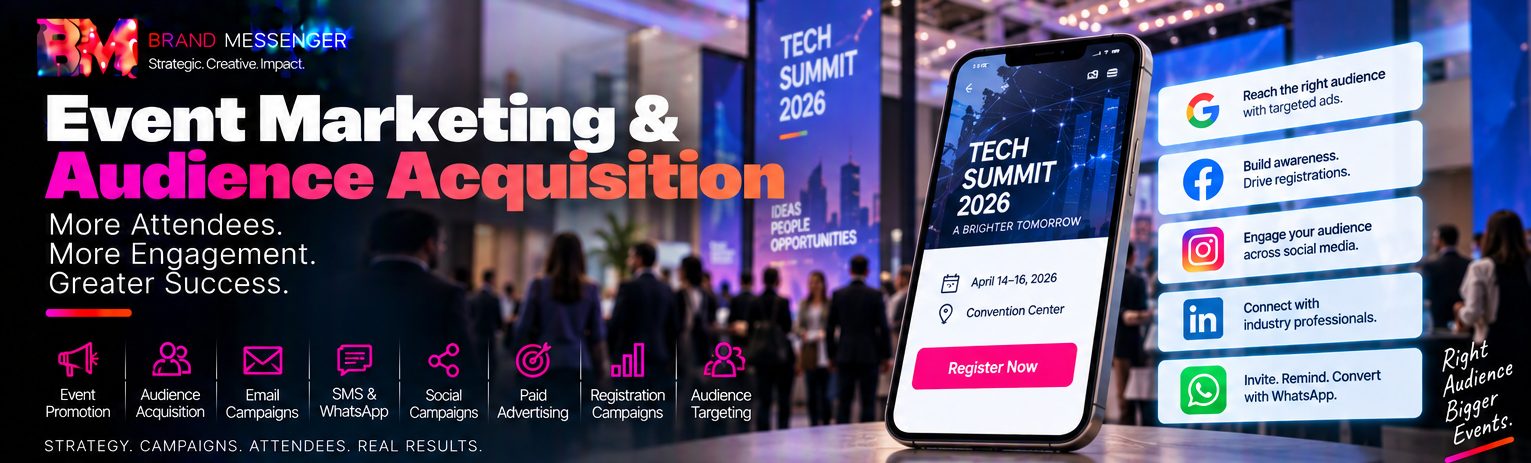
At Brand Messenger, our Event Marketing & Audience Acquisition service combines event promotion, attendee acquisition, email/SMS/WhatsApp campaigns, social campaigns, paid advertising, remarketing, registration campaigns and audience targeting within one connected audience-growth ecosystem.
Our core capabilities include:
Event Promotion
Attendee Acquisition
Email Marketing Campaigns
SMS Campaigns
WhatsApp Campaigns
Social Media Campaigns
Paid Advertising
Remarketing & Retargeting
Registration Campaigns
Audience Targeting
Our wider capabilities can extend across event positioning, campaign strategy, audience segmentation, landing pages, registration funnels, speaker-led campaigns, sponsor and partner amplification, content marketing, SEO, search advertising, social advertising, display advertising, native advertising, programmatic advertising, video advertising, geographic targeting, B2B audience acquisition, account-based event marketing, CRM campaigns, marketing automation, abandoned-registration recovery, referral campaigns, influencer and creator amplification, PR, conversion optimization, attribution, predictive analytics, campaign dashboards and post-event audience development.
Our approach connects:
Event → Audience → Awareness → Interest → Registration → Confirmation → Attendance → Engagement → Follow-Up → Relationship
The objective is not simply:
Generate More Registrations.
It is:
Reach the Right People, Give Them a Compelling Reason to Attend, Convert Interest into Registration and Turn Registration into Meaningful Event Participation.
What Is Event Marketing & Audience Acquisition?
Event Marketing & Audience Acquisition is the coordinated process of identifying potential attendees, building awareness, creating demand, converting prospects into registrants and encouraging registered delegates to actually attend.
It connects:
Marketing Strategy
Audience Intelligence
Content
Paid Media
CRM & Marketing Automation
Registration Technology
Conversion Optimization
Analytics
into one event-growth system.
The complete journey becomes:
Discover → Consider → Register → Confirm → Attend → Engage → Continue
Event Marketing Is More Than Event Promotion
Promotion is one part of event marketing.
A complete strategy can involve:
Positioning → Audience → Message → Channel → Campaign → Landing Page → Registration → Attendance → Measurement
Promotion creates visibility.
Audience acquisition turns that visibility into measurable event participation.
Brand Messenger Event Marketing & Audience Acquisition Services
Our capabilities can include:
Event Marketing Strategy
Event Promotion Strategy
Audience Acquisition Strategy
Attendee Acquisition
Delegate Acquisition
Event Positioning
Event Messaging
Target Audience Development
Audience Segmentation
Audience Intelligence
Event Campaign Planning
Event Launch Campaigns
Registration Campaigns
Early-Bird Campaigns
Speaker Announcement Campaigns
Agenda Announcement Campaigns
Sponsor Announcement Campaigns
Exhibitor Campaigns
Countdown Campaigns
Last-Chance Registration Campaigns
Email Marketing
SMS Marketing
WhatsApp Marketing
CRM Campaigns
Marketing Automation
Social Media Marketing
Organic Social Campaigns
Paid Social Advertising
Search Advertising
Display Advertising
Native Advertising
Programmatic Advertising
Video Advertising
Remarketing & Retargeting
Website Visitor Retargeting
Registration Abandonment Campaigns
Geographic Targeting
B2B Targeting
Account-Based Event Marketing
Partner Marketing
Sponsor Amplification
Speaker-Led Promotion
Influencer & Creator Campaigns
Referral Marketing
Content Marketing
Event SEO
Digital PR
Media Outreach
Event Landing Pages
Registration Funnel Optimization
Conversion Rate Optimization
A/B Testing
Audience Suppression
Campaign Attribution
Cost-per-Registration Analysis
Cost-per-Attendee Analysis
Registration-to-Attendance Analysis
Campaign Dashboards
Predictive Event Marketing
Post-Event Audience Development
Event Marketing Strategy
Build the Audience Before Building the Campaign
Every event has a different audience and a different reason for attendance.
Brand Messenger begins by understanding:
What is the event?
Why does it matter?
Who should attend?
What value does attendance provide?
Which audience segments matter most?
Where can those audiences be reached?
What should persuade them to register?
What should encourage them to actually attend?
The architecture becomes:
Event Objective → Audience → Value Proposition → Message → Channel → Registration → Attendance
Event Positioning
Before promoting an event, Brand Messenger can define how it should be positioned.
A potential attendee should quickly understand:
What Is the Event?
Who Is It For?
What Will I Learn or Experience?
Who Will I Meet?
Why Should I Attend?
Why Is It Relevant Now?
Strong positioning gives every campaign a clearer foundation.
Event Value Proposition
Different events create different types of value.
A business summit may offer:
Leadership + Industry Intelligence + Networking
A trade show may offer:
Products + Suppliers + Buyers + Business Opportunities
A conference may offer:
Knowledge + Speakers + Professional Development
A product launch may offer:
Discovery + Demonstration + Experience: Brand Messenger can translate these benefits into campaign messaging.
Target Audience Strategy
Reach People Who Have a Reason to Attend
Large reach does not automatically create a successful event.
The relevant question is:
Are We Reaching People for Whom This Event Has Genuine Value?
Brand Messenger can develop target audiences based on appropriate factors such as:
Industry
Professional Role
Organization Type
Business Interest
Customer Relationship
Geographic Market
Event Topic
Previous Event Engagement
First-Party Audience Data
Audience Segmentation
Different audiences may require different messages.
For example:
Executives
Leadership • Strategy • Industry Outlook • Executive Networking
Investors
Investment • Opportunities • Companies • Deal Flow
Professionals
Knowledge • Skills • Networking • Career Development
Buyers
Products • Suppliers • Solutions • Meetings
Existing Customers
Community • Product Updates • Relationships • Exclusive Experiences
The structure becomes:
Audience Segment → Relevant Value Proposition → Relevant Campaign
Audience Intelligence
Brand Messenger can combine appropriate:
CRM Data
Registration Data
Website Behavior
Campaign Engagement
Previous Event Data
First-Party Audience Data
to understand audience patterns and improve campaign planning.
The objective is not to collect every possible data point.
It is:
Use Relevant Audience Intelligence to Make Event Marketing More Relevant.
Attendee Acquisition
Turn Potential Audiences into Registered Attendees
Attendee acquisition connects marketing activity directly with event registration.
The funnel becomes:
Target Audience → Campaign Exposure → Event Interest → Landing Page → Registration → Confirmation → Attendance
Brand Messenger can optimize each stage rather than focusing only on traffic.
Delegate Acquisition
For professional conferences and business events, delegate acquisition may require more targeted approaches.
Potential channels can include:
LinkedIn and Professional Social Campaigns
Paid Media
Industry Partnerships
Associations
Speaker Networks
Sponsor Networks
Content Marketing
PR
Direct Outreach where appropriate
This is particularly relevant for:
Conferences
Business Summits
Executive Forums
B2B Events
Industry Conventions
Registration Campaigns
Turn Event Interest into a Completed Registration
Registration campaigns can be structured around the event lifecycle.
Potential campaign stages include:
Event Launch: Introduce the event.
Early Registration
Encourage early commitment.
Speaker Announcements
Build credibility and interest.
Agenda Announcements
Demonstrate content value.
Sponsor & Partner Announcements
Expand visibility.
Countdown
Create increasing relevance as the event approaches.
Final Registration
Reach remaining eligible prospects.
The message should evolve as the event develops.
Registration Funnel
A typical event funnel can become:
Ad / Email / Social / Search → Event Landing Page → Event Information → Registration Start → Registration Completion → Confirmation → Attendance
Each stage can be measured separately.
Registration Funnel Optimization
Brand Messenger can investigate:
Landing-Page Clarity
CTA Visibility
Form Length
Mobile Experience
Page Speed
Registration Friction
Ticket Structure
Payment Flow where applicable
Confirmation Experience
The objective is to remove unnecessary barriers between interest and registration.
Registration Abandonment
A prospective attendee may:
Visit Registration → Start Form → Leave
Brand Messenger can analyze the journey and, where appropriate, use:
Marketing Automation
Remarketing
CRO
to support registration recovery.
The better question is not only:
How Do We Retarget Them?
but also:
Why Did the Registration Journey Break?
Event Landing Pages
Give Every Campaign a Strong Destination
Brand Messenger can create or optimize event landing experiences around:
Event Value Proposition
Date & Location
Speakers
Agenda
Audience
Benefits
Sponsors
FAQs
Registration CTA
The page should help a potential attendee decide whether the event is relevant.
Message Match
Campaign messaging and landing-page messaging should connect.
For example:
Ad: Meet Global Technology Leaders → Landing Page: Technology Leadership Summit + Speakers + Networking
creates stronger continuity than sending the visitor to a generic event homepage.
The principle is:
Campaign Promise → Landing Experience → Registration Action
Email Marketing for Events
Build Direct Communication Throughout the Event Journey
Email can support the complete event lifecycle.
Awareness
Event Introduction
Consideration
Speakers • Agenda • Benefits
Registration
Registration CTA
Confirmation
Event Details
Attendance
Reminders • Venue • Schedule
Post-Event
Content • Survey • Follow-Up
This makes email more than a promotional channel.
It becomes part of the attendee journey.
Email Audience Segmentation
Different messages can be created for:
Prospects
Existing Customers
Previous Attendees
Registered Delegates
Non-Registered Prospects
Sponsors
Exhibitors
Speakers
VIPs
where appropriate.
This reduces irrelevant communication.
SMS Event Campaigns
SMS can support concise, time-sensitive communication such as:
Registration Reminders
Confirmation
Event Reminders
Important Updates
Selected Event-Day Information
where recipients have appropriate permissions and SMS is suitable for the event.
WhatsApp Event Campaigns
Connect Event Communication with a High-Engagement Messaging Environment
Where appropriate and permission-based, WhatsApp can support:
Registration Information
Confirmation
Event Updates
Agenda Information
Reminders
Venue Information
Selected Post-Event Follow-Up
The objective should be useful communication rather than excessive promotional messaging.
Email + SMS + WhatsApp
Brand Messenger can coordinate communication across channels.
For example:
Detailed Event Information → SMS
Time-Sensitive Reminder → WhatsApp
Relevant Event Update
The principle is:
Use Each Channel for the Communication It Handles Best.
Marketing Automation for Events
Build Communication Around the Attendee Journey
Brand Messenger can develop automated workflows triggered by appropriate events such as:
Registration
Registration Abandonment
Ticket Purchase
Session Selection
Event Date
Attendance
Post-Event Follow-Up
The architecture becomes:
Customer / Attendee Signal → Workflow → Relevant Communication → Next Action
Pre-Event Automation
Potential workflows can include:
Registration → Confirmation
Registration → Event Information
7 Days Before → Reminder
1 Day Before → Final Information
Exact timing should reflect the event and communication strategy.
Social Media Event Campaigns
Build Conversation Before, During and After the Event
Social campaigns can support:
Before
Awareness • Speakers • Registration • Countdown
During
Live Updates • Audience Engagement • Highlights
After
Recaps • Content • Testimonials • Future Events
This creates a continuous social event lifecycle.
Organic Social Promotion
Organic content can include:
Event Announcements
Speaker Reveals
Agenda Highlights
Sponsor Announcements
Behind-the-Scenes
Countdown Content
Venue Content
Registration Reminders
Videos
Interviews
The objective is to build an ongoing event narrative.
Paid Social Advertising
Paid social campaigns can support:
Event Awareness
Website Traffic
Registration
Video Promotion
Remarketing
Audience Expansion
depending on platform capabilities and campaign objectives.
Brand Messenger can connect paid social with wider audience and conversion measurement.
Speaker-Led Event Marketing
Turn Speakers into Part of the Event Discovery Strategy
Speakers often have relevant professional communities.
Brand Messenger can create speaker marketing kits containing:
Announcement Graphics
Social Posts
Short Videos
Event Links
Session Information
Promotional Assets
Speakers can then choose to share the event with their networks.
Speaker Announcement Campaigns
Instead of announcing every speaker at once, selected events can develop a content sequence:
Speaker 01 → Topic
Speaker 02 → Topic
Speaker 03 → Topic
This creates multiple communication moments throughout the campaign.
Sponsor & Partner Amplification
Sponsors and partners can extend event reach through their own audiences.
Brand Messenger can develop partner toolkits containing:
Event Graphics
Registration Links
Social Content
Email Assets
Speaker Information
Event Copy
This creates a distributed promotion network.
Exhibitor-Led Promotion
Trade shows and exhibitions can provide exhibitors with campaign assets to promote:
We Are Exhibiting
Visit Our Booth
Meet Our Team
This can help exhibitors bring their own customer communities into the wider event audience.
Referral Campaigns
Existing:
Delegates
Customers
Partners
Communities
can sometimes help introduce the event to relevant new audiences.
Referral mechanisms should be designed around genuine recommendations rather than deceptive or unwanted messaging.
Influencer & Creator Event Campaigns
Where relevant to the event audience, Brand Messenger can coordinate appropriate creator or influencer partnerships for:
Event Awareness
Event Coverage
Behind-the-Scenes Content
Audience Engagement
Registration Campaigns
Paid or sponsored relationships should be disclosed appropriately.
Event Content Marketing
Build Demand Through Useful Content
An event can begin as a content conversation before registration.
Potential content can include:
Articles
Industry Insights
Speaker Interviews
Videos
Podcasts
Research
Discussion Topics
Agenda Previews
The journey becomes:
Useful Content → Event Discovery → Interest → Registration
This can be particularly effective for professional and B2B events.
Event SEO
Brand Messenger can optimize event-related search visibility through:
Event Pages
Relevant Keywords
Speaker Pages
Agenda Content
Location Information
Technical SEO
Structured Event Information where appropriate
SEO is a longer-term acquisition channel and does not guarantee particular rankings.
Search Advertising
Reach People Actively Searching for Relevant Events or Topics
Paid search can support event acquisition where relevant search demand exists.
Potential campaign themes can include:
Event Name
Conference Category
Industry Topic
Location-Based Event Searches
Professional Event Searches
Search advertising can be particularly useful for capturing existing demand.
Display Advertising
Display advertising can build event awareness across appropriate websites and digital environments.
Potential uses include:
Awareness
Speaker Promotion
Registration
Remarketing
Countdown Campaigns
This connects with Brand Messenger's dedicated Display Advertising capabilities.
Native Advertising
Native advertising can promote event-related content through eligible content-discovery environments.
For example:
Industry Article → Event Content → Registration Opportunity
This can support events that benefit from education before conversion.
Programmatic Advertising
Brand Messenger can use programmatic advertising technology to purchase eligible digital media across appropriate inventory.
Programmatic campaigns can support:
Event Awareness
Audience Targeting
Geographic Campaigns
Video
Display
Native
Retargeting
depending on available inventory and technology.
Video Advertising
Event trailers, speaker videos and highlight films can be used as paid advertising creative.
The journey becomes:
Video → Event Story → Interest → Landing Page → Registration
This connects Event Marketing with Brand Messenger's Event Content, Media & Live Production capabilities.
Geographic Event Targeting
Concentrate Marketing Around Relevant Markets
Local or regional events can target appropriate geographic areas.
For example:
Country → Region → City → Event Catchment Area
depending on the event.
This can help reduce advertising outside realistic attendance markets.
International Event Marketing
International events may require:
Multi-Country Campaigns
Multi-Language Content
Market-Specific Messaging
International SEO
Geographic Media Strategy
Time-Zone-Aware Communication
The architecture becomes:
Global Event → Market → Audience → Language → Campaign → Registration
B2B Event Audience Acquisition
Reach Professional Audiences with Greater Precision
B2B events often require smaller but more strategically relevant audiences.
Brand Messenger can build campaigns around:
Industry
Organization Type
Professional Function
Seniority where appropriately supported
Business Interest
Existing Customer / Prospect Data
The objective is not always:
Maximum Attendance.
For many B2B events, it is:
Relevant Attendance.
Account-Based Event Marketing
For selected enterprise events, event promotion can connect with Account-Based Marketing.
The architecture becomes:
Target Accounts → Relevant Decision-Makers → Personalized Event Proposition → Registration / Meeting
This can be useful for:
Executive Forums
Enterprise Conferences
Private Business Events
Industry Roundtables
Executive Audience Acquisition
Senior-level events may require a different acquisition approach from mass consumer events.
Potential channels can include:
Personalized Invitations
Executive Networks
Professional Platforms
Industry Associations
Partner Introductions
Direct Outreach
Account-Based Campaigns
The message should reflect the value of the event to senior participants.
Event Remarketing & Retargeting
Reconnect with People Who Showed Interest but Did Not Register
A potential attendee may:
See Campaign → Visit Event Website → Explore Speakers → Leave
Brand Messenger can create eligible retargeting audiences to continue the journey.
The architecture becomes:
Interest → Website Visit → Retargeting → Return → Registration
Registration Remarketing
Retargeting can focus on appropriate audiences such as:
Event Website Visitors
Speaker Page Visitors
Agenda Visitors
Registration Page Visitors
Registration Abandoners
where tracking, permissions and advertising-platform capabilities support it.
Dynamic Event Remarketing
Different audiences can receive different creative.
For example:
Speaker Visitor → Speaker / Session Creative
Agenda Visitor → Program Creative
Registration Abandoner → Registration Reminder
This can create more relevant re-engagement.
Audience Suppression
Stop Advertising When the Message Is No Longer Relevant
Once a person registers, they may no longer need:
Register Now: advertising.
Where platform and data capabilities allow, Brand Messenger can suppress registered attendees from acquisition campaigns.
They can instead enter:
Registered Delegate Communication: This can reduce wasted advertising and improve the attendee experience.
Registered Does Not Mean Attended
One of the most important event marketing distinctions is:
Registration / Attendance: A campaign can generate large registration numbers while actual attendance remains significantly lower.
Brand Messenger therefore considers:
Registration Rate
and:
Registration-to-Attendance Rate: as separate stages.
Registration-to-Attendance Marketing
After registration, marketing changes from:
Why Should You Register?
to:
Why Should You Attend?
Communication can reinforce:
Speakers
Sessions
Networking
Event Experience
Venue Information
Practical Details
This helps maintain attendee commitment.
No-Show Reduction Strategy
Potential no-show reduction measures can include:
Confirmation Communication
Calendar Integration
Event Reminders
Agenda Updates
Personalized Session Information
Practical Venue Information
The appropriate strategy depends on whether the event is free, paid, virtual or physical.
Free vs. Paid Event Acquisition
Free and paid events can behave differently.
Free Event
Registration friction may be lower, but no-show rates can be a greater concern.
Paid Event
Purchase creates stronger commitment, but acquisition requires a stronger value proposition.
Marketing strategy should reflect the event economics.
Ticket & Pricing Campaigns
For paid events, Brand Messenger can support campaign structures around:
Early-Bird Tickets
Standard Registration
Group Registration
Corporate Packages
VIP Packages
where appropriate.
Urgency messaging should be accurate and should not use fabricated scarcity.
Conversion Rate Optimization
Improve the Path from Campaign Click to Registration
Brand Messenger can connect event acquisition with its Conversion Rate Optimization capabilities.
Potential areas include:
Landing-Page Behavior
CTA Testing
Form Optimization
Registration Funnel
Mobile Experience
Checkout Experience
A/B Testing
The architecture becomes:
Traffic → Event Page → Registration → Friction → Optimization → Conversion
A/B Testing
Brand Messenger can test appropriate campaign variables such as:
Headline
Creative
CTA
Landing Page
Registration Message
where sufficient traffic and testing conditions exist.
Testing should focus on meaningful business outcomes rather than superficial differences.
Audience Acquisition + Event Content
Brand Messenger's Event Content, Media & Live Production service can provide campaign assets including:
Event Trailers
Speaker Videos
Interviews
Social Clips
Highlight Films
Photography
Motion Graphics
These assets can become the creative engine behind audience acquisition.
Previous Event Content
For recurring events, previous-event media can be particularly valuable.
For example:
Previous Event Highlights → Future Event Campaign → Registration
This allows prospective attendees to see the actual event experience.
Audience Acquisition + Event Audience Engagement
Marketing should communicate not only what attendees will watch, but what they can experience.
Brand Messenger's Event Audience Engagement & Interactive Experiences capabilities can provide promotional value through:
Networking
Interactive Sessions
Competitions
Gamification
Exhibitions
Personalized Experiences
These become part of the event proposition.
Audience Acquisition + Conferences, Summits & Business Forums
For professional events, Brand Messenger can connect:
Conference Theme + Speakers + Agenda + Networking + Audience Acquisition
into one campaign ecosystem.
The conference program becomes one of the strongest marketing assets.
Audience Acquisition + CRM
Connect Event Marketing with Existing Relationships
CRM data can help distinguish:
Existing Customers
Prospects
Partners
Previous Attendees
Leads
This allows communication to reflect the existing relationship.
The architecture becomes:
CRM → Segment → Event Campaign → Registration → Attendance → Follow-Up
Audience Acquisition + CDP
Where a Customer Data Platform is available, Brand Messenger can connect appropriate signals from:
Website
CRM
Previous Events
Marketing Campaigns
Customer Interactions
into more structured event audience segments.
First-Party Event Audiences
Organizations may already have valuable first-party audiences through:
Customer Databases
Previous Attendees
Newsletter Subscribers
Members
Partners
Website Audiences
These can become an important foundation for event marketing where appropriate permissions allow.
Consent-Based Event Marketing
Email, SMS, WhatsApp, audience activation and remarketing can involve personal information and communication permissions.
Brand Messenger can structure campaigns around appropriate:
Consent
Communication Preferences
Purpose
Audience Eligibility
Data Retention
Platform Requirements
Applicable Privacy and Marketing Rules
The principle is:
Reach Relevant Audiences Without Treating Permission as an Afterthought.
AI-Powered Event Audience Intelligence
AI-assisted analysis can help Brand Messenger examine:
Registration Trends
Audience Segments
Campaign Performance
Channel Performance
Conversion Patterns
Attendance Patterns
Historical Event Data
to support better campaign decisions.
AI provides decision support.
It does not guarantee registrations or attendance.
Predictive Registration Intelligence
Where sufficient reliable historical and current data exists, predictive analytics can help estimate:
Registration Demand
Registration Pace
Potential Attendance
Campaign Response Patterns
The architecture becomes:
Historical Data + Current Campaign Signals + Registration Data → Predictive Model → Forecast
Forecasts remain estimates rather than guarantees.
Registration Pacing
Brand Messenger can monitor:
Registrations to Date
against:
Time Remaining: and appropriate historical or planning benchmarks.
This can help determine whether campaign strategy requires adjustment.
Campaign Budget Allocation
Marketing budgets can be distributed across:
Search
Social
Display
Programmatic
Native
Video
Other Eligible Channels
according to event strategy and measurable performance.
The objective is:
Allocate Budget According to Evidence not Channel Habit.
Bid Optimization
For paid event campaigns, Brand Messenger can connect with its Budget & Bid Optimization capabilities.
The architecture becomes:
Audience → Campaign → Bid → Registration → Attendance → Performance → Optimization
Optimization should consider the actual event objective rather than simply the lowest possible click cost.
Cost per Registration
A simplified metric can be:
Marketing Spend ÷ Registrations Attributed to Marketing: This can help compare campaign efficiency.
But registration is not always the final objective.
Cost per Attendee
A more meaningful metric for some events may be:
Marketing Spend ÷ Actual Attendees Attributed to Marketing
This moves measurement from:
Registration
toward:
Attendance.
Cost per Qualified Attendee
For selected B2B events, even attendance may not be sufficient.
The organization may care about attracting:
Buyers
Investors
Decision-Makers
Target Accounts
Qualified Professionals
where appropriate qualification criteria are defined.
This can create:
Campaign → Registration → Attendance → Qualified Audience
Event Marketing Attribution
A registration may involve:
Social Post → Speaker Video → Search → Website → Email → Registration
Attribution can help assign contribution across these touchpoints.
Brand Messenger can connect event marketing with its Advertising Measurement & Attribution capabilities.
Attribution Is Not Causation
If an advertisement appears before a registration, that does not automatically prove the advertisement caused it.
Brand Messenger therefore distinguishes:
Attribution
from:
Incremental Effect.
Where appropriate methods and sufficient data exist, incrementality testing can provide additional insight.
Channel Performance Analysis
Brand Messenger can compare channels across metrics such as:
Reach
Traffic
Registration
Cost per Registration
Attendance
Cost per Attendee
Qualified Attendees where defined
This can provide a more complete acquisition view.
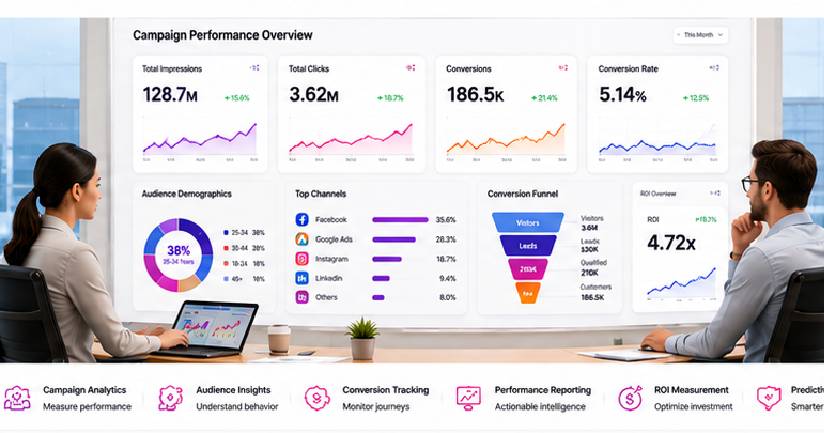
Event Marketing Dashboard
A Brand Messenger dashboard can combine:
Awareness
Reach Impressions Video Engagement
Traffic
Visitors Landing-Page Sessions
Registration
Starts Completions Conversion Rate
Acquisition
Channel Campaign Audience
Cost
Spend Cost per Registration
Attendance
Confirmed Checked-In Actual Attendance
Audience Quality
Relevant Segments Qualified Attendees where defined
Business
Leads Opportunities Revenue where measurable
Executive Audience Acquisition Dashboard
Senior management may need a simplified funnel:
Marketing Investment → Registrations → Attendees → Engagement → Leads / Relationships → Business Outcome
This helps connect event marketing with the wider purpose of the event.
AI Event Intelligence + Audience Acquisition
Brand Messenger can connect pre-event marketing with its AI Event Intelligence & Audience Analytics service.
The architecture becomes:
Campaign Audience → Registration → Attendance → Visitor Activity → Session / Event Engagement → Post-Event Intelligence
This helps answer an important question:
Did the Audience We Acquired Actually Participate in the Event?
Registration Data + Attendance Analytics
Combining registration and attendance can reveal:
Registered & Attended
Registered & Did Not Attend
Attendance by Audience Segment
Attendance by Acquisition Channel
where reliable data is available.
This creates a more complete event acquisition model.
Event Marketing + Face Signatures
Where appropriate within the event environment, Face Signatures by Messenger2050 Technologies may provide a supporting physical-space analytics layer for selected event intelligence applications.
Brand Messenger can use appropriate aggregated insights around areas such as:
Visitor Traffic
Event Attendance Patterns
Movement
Zone Activity
Dwell
Engagement
to understand the physical-event experience.
This can connect:
Marketing Acquisition → Registration → Physical Attendance → Event Engagement
Many event-marketing questions can be answered with aggregated information without identifying individuals.
Our principle remains:
Use Identity When Identity Is Necessary. Use Aggregated Intelligence When It Is Enough.
Post-Event Audience Development
Attendance Can Be the Beginning of the Relationship
After the event, audiences can enter appropriate journeys such as:
Thank-You Communication
Event Highlights
Session Content
Surveys
Product Information
Sales Follow-Up
Community
Future Events
The lifecycle becomes:
Prospect → Registrant → Attendee → Engaged Audience → Lead / Customer / Community Member → Future Attendee
depending on the event objective.
Attendee vs. Non-Attendee Follow-Up
Different journeys can be created.
Attended
Thank You → Relevant Content → Follow-Up
Registered but Did Not Attend
Highlights → Selected Content → Future Opportunity
This is more relevant than treating both groups identically.
Lead Generation from Events
For B2B events:
Campaign → Registration → Attendance → Engagement → Lead → MQL → SQL → Opportunity → Customer
can connect with Brand Messenger's Lead Management & Revenue Marketing capabilities.
Attendance alone should not automatically qualify someone as a sales-ready lead.
Event Marketing + Customer Journey Analytics
The complete journey may become:
Paid Social → Event Website → Speaker Content → Email → Registration → Event Attendance → Session → Networking → Website → Sales Follow-Up → Customer
Brand Messenger's Customer Journey Analytics can help connect these touchpoints where reliable data is available.
Event Marketing + Revenue Performance
For commercially focused events, Brand Messenger can connect:
Marketing Investment → Attendee Acquisition → Engagement → Lead → Opportunity → Revenue
where CRM and revenue data support the analysis.
This moves event marketing from a communications activity toward measurable business performance.
Event Audience Acquisition Maturity Model
Level 01 — Event Promotion
Announcements + Social + Email
Level 02 — Multi-Channel Acquisition
Email + Social + Search + Paid Media + Registration Campaigns
Level 03 — Performance Event Marketing
Audience Segmentation + Retargeting + CRO + Cost per Registration
Level 04 — Connected Audience Acquisition
CRM + CDP + Automation + First-Party Data + Registration + Attendance
Level 05 — Business-Outcome Event Marketing
Campaign → Attendee → Engagement → Lead → Opportunity → Revenue
Level 06 — AI-Powered Event Growth Intelligence
Audience Intelligence + Predictive Analytics + Dynamic Segmentation + Media Optimization + Attendance Intelligence + Executive BI
The objective is not simply:
Acquire the Largest Possible Audience.
It is:
Build the Audience That Creates the Greatest Value for the Event and Its Participants.
Complete Brand Messenger Event Marketing & Audience Acquisition Process
A comprehensive engagement can follow:
Event Objective → Event Positioning → Target Audience → Audience Research → Segmentation → Event Value Proposition → Campaign Strategy → Event Website / Landing Page → Content Production → Email / SMS / WhatsApp → Organic Social → Paid Social → Search Advertising → Display / Native / Programmatic / Video → Speaker / Sponsor / Partner Amplification → PR & Content Marketing → Remarketing → Registration Funnel → CRO → Registration → Confirmation → Attendance Marketing → Event Attendance → Audience Engagement → AI Event Intelligence → CRM / CDP → Post-Event Follow-Up → Lead / Customer Journey → Attribution & Performance Reporting → Audience Learning → Future Event Growth
The lifecycle becomes:
Position → Target → Reach → Engage → Register → Confirm → Attend → Participate → Measure → Follow Up → Grow
Across the Brand Messenger Event Marketing Ecosystem
Event Marketing & Audience Acquisition connects Brand Messenger's event, AdTech, MarTech and intelligence capabilities:
Event Strategy
Define the Event → Branding & Positioning
Create the Event Proposition → Event Content, Media & Live Production
Create Campaign Assets → Event Marketing & Audience Acquisition
Promotion • Attendee Acquisition • Email • SMS • WhatsApp • Social • Paid Media • Remarketing • Registration • Audience Targeting → AdTech
Programmatic • Display • Native • Paid Media • Audience Targeting • Bid Optimization → MarTech
CRM • CDP • Marketing Automation • Omnichannel Communication → Remarketing & Retargeting
Reconnect Interested Audiences → Landing Page Optimization & CRO
Turn Interest into Registration → Conferences, Summits & Business Forums
Deliver the Professional Event Experience → Event Audience Engagement & Interactive Experiences
Turn Attendees into Participants → AI Event Intelligence & Audience Analytics
Measure Attendance, Flow, Dwell and Engagement → Lead Management & Revenue Marketing
Connect Event Relationships with Business Opportunities → Customer Journey Analytics
Understand the Complete Event Journey → Predictive Analytics
Add Forward-Looking Audience Intelligence → Marketing Dashboard & KPI Reporting
Turn Event Marketing Data into Executive Intelligence
The complete architecture becomes:
Audience → Campaign → Registration → Attendance → Engagement → Relationship → Business Outcome → Future Audience Growth
Events We Can Market
Brand Messenger Event Marketing & Audience Acquisition can support appropriate applications across:
Conferences
Business Summits
Executive Forums
Conventions
Seminars
Symposiums
Trade Shows
Exhibitions
Corporate Events
Product Launches
Brand Activations
Award Shows
Film Festivals
Entertainment Events
Festivals
Sports Events
Roadshows
Pop-Up Events
Investor Events
Customer Events
Partner Events
Dealer & Distributor Events
Association Events
Educational Events
Professional Events
Government & Institutional Events
Fundraising Events
Hybrid Events
Virtual Events
International Events
Multi-Day Events
Multi-City Events
Benefits of Event Marketing & Audience Acquisition
Brand Messenger can help organizations:
Define event positioning and audience strategy
Build event promotion campaigns
Develop attendee and delegate acquisition
Segment potential audiences
Activate appropriate first-party audiences
Create registration campaigns
Build event landing pages
Optimize registration funnels
Develop email campaigns
Build SMS and WhatsApp communication
Create organic and paid social campaigns
Run search advertising
Develop display, native and programmatic campaigns
Use event video in paid media
Build speaker-led promotion
Activate sponsors, exhibitors and partners
Develop remarketing campaigns
Recover eligible registration abandoners
Suppress registered audiences from irrelevant acquisition advertising
Develop registration-to-attendance campaigns
Reduce avoidable no-shows
Integrate CRM and CDP
Build marketing automation workflows
Measure cost per registration
Measure cost per attendee
Analyze acquisition-channel performance
Connect acquisition with actual event engagement
Develop event marketing dashboards
Use predictive analytics where appropriate
Continue audience relationships after the event
Build intelligence for future event campaigns
Why Choose Brand Messenger?
Brand Messenger combines Event Promotion, Attendee Acquisition, Email, SMS, WhatsApp, Social Media, Paid Advertising, Remarketing, Registration Campaigns, Audience Targeting, AdTech, MarTech, CRM, CDP, Marketing Automation, Conversion Optimization, Event Intelligence and Performance Analytics within one connected event-growth ecosystem.
We do not approach event marketing as:
Create Some Posts → Run Some Ads → Collect Registrations.
We approach it as:
Understand the Event → Define the Audience → Build the Value Proposition → Create the Campaign → Reach Relevant People → Convert Interest into Registration → Convert Registration into Attendance → Measure Participation → Continue the Relationship → Learn for the Next Event.
The distinction matters.
Event Promotion builds awareness.
Attendee Acquisition converts awareness into measurable audience growth.
Email, SMS & WhatsApp Campaigns support direct communication throughout the event journey.
Social Campaigns create discovery, conversation and ongoing visibility.
Paid Advertising expands audience reach through appropriate digital channels.
Remarketing & Retargeting reconnects eligible people who demonstrated previous interest.
Registration Campaigns turn event demand into completed registrations.
Audience Targeting concentrates marketing on people for whom the event has genuine relevance.
CRM, CDP & Marketing Automation connect event acquisition with existing and future customer relationships.
CRO reduces unnecessary friction in the registration journey.
AI Event Intelligence connects marketing acquisition with actual attendance and event engagement.
And Marketing Analytics & KPI Reporting helps management understand which campaigns, audiences and channels contributed to event growth.
The result is not simply more advertising for an event.
It is a connected audience acquisition system designed to move the right people from discovery to registration, from registration to attendance and from attendance into an ongoing relationship.
Build the Audience. Create the Demand. Drive the Registration. Convert Registration into Attendance. Turn Attendance into Lasting Relationships.
Event Promotion. Attendee Acquisition. Email. SMS. WhatsApp. Social Campaigns. Paid Advertising. Remarketing. Registration Campaigns. Audience Targeting. One Connected Event Audience Acquisition Ecosystem.