


Sampling & Product Demonstrations
Put the Product in Their Hands. Show It in Action. Turn Curiosity into Experience, Experience into Confidence and Confidence into Customer Action.
Some products are difficult to understand through advertising alone.
A photograph can show the product. A video can explain it. An advertisement can create awareness. But for many categories, the most persuasive marketing moment happens when a potential customer can taste it, touch it, try it, test it, experience it or watch it work in front of them.
That is the role of Sampling & Product Demonstrations.
Sampling and demonstration marketing brings brands, products and customers together in physical environments through product sampling, roadshows, live demonstrations, mall activations, retail experience booths and other carefully designed product experiences.
For enterprise organizations, however, this requires much more than distributing samples or placing a promoter beside a display.
A successful activation can require audience strategy, location planning, trained representatives, product education, creative environments, inventory management, customer engagement, lead capture, retail coordination, digital integration, field reporting, CRM connectivity and campaign measurement.
The marketing question becomes:
How Do We Turn a Physical Product Interaction into a Meaningful Brand Experience and Connect That Experience with Customer Acquisition, Sales, Data and Long-Term Marketing?
At Brand Messenger, our Sampling & Product Demonstrations service combines experiential strategy, product sampling, demonstration campaigns, roadshows, mall activations, retail experience booths, field marketing, brand representatives, creative production, lead generation, CRM, digital amplification, analytics and AI-assisted activation intelligence.
Our core capabilities include:
Product Sampling
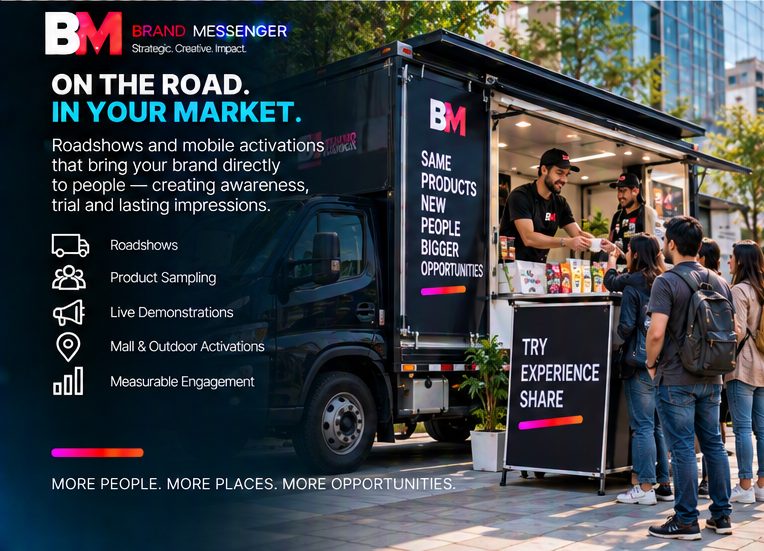
Roadshows
Live Demonstrations
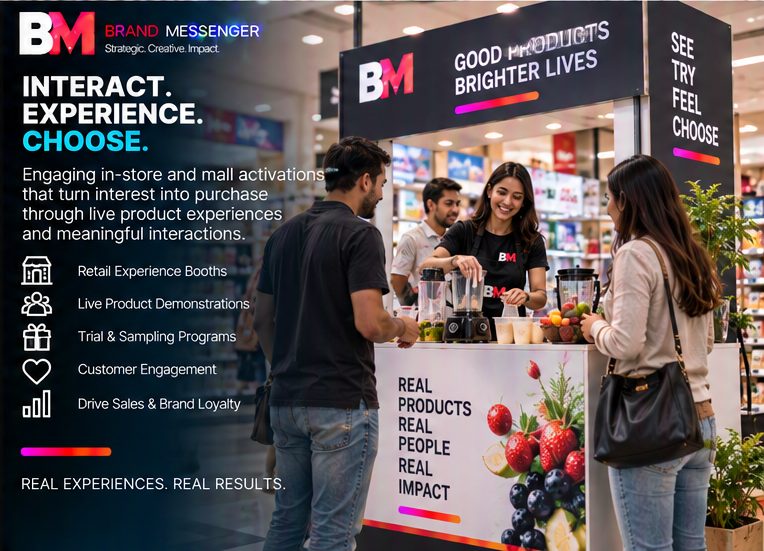
Mall Activations
Retail Experience Booths
Our wider capabilities can support product launches, free trials, tasting campaigns, test-and-try programs, pop-up demonstrations, mobile activations, in-store experiences, technology demonstrations, beauty trials, food and beverage sampling, consumer-electronics demonstrations, B2B demonstrations, exhibition demonstrations and multi-location activation campaigns.
The architecture becomes:
Product → Audience → Location → Experience → Trial / Demonstration → Understanding → Interaction → Action → Data → Relationship → Intelligence
The objective is not simply:
Give Away Samples.
It is:
Create a Structured Product Experience That Helps Customers Understand the Product, Experience Its Value and Take an Appropriate Next Step.
What Are Sampling & Product Demonstrations?
Sampling & Product Demonstrations are marketing activities designed to let potential customers directly experience a product or see how it works.
Sampling
Allows people to:
Taste
Try
Test
Use
Experience
an appropriate portion, trial or version of a product.
Product Demonstration
Allows people to:
See the Product in Action
Understand Features
Learn How It Works
Ask Questions
Compare Capabilities
Experience Benefits
Together, they create:
Experience Before Decision.
Sampling Is More Than Free Product Distribution
Simply handing products to the largest possible number of people does not necessarily create an effective sampling campaign.
Brand Messenger approaches sampling through:
Right Product → Right Audience → Right Environment → Right Experience → Right Follow-Up
A well-designed sampling program should consider:
Who Should Experience the Product?
Where Should Sampling Happen?
What Should the Customer Understand?
How Should the Product Be Presented?
What Should Happen After the Trial?
How Will Performance Be Measured?
The sample is therefore the beginning of the interaction not necessarily the end of the campaign.
Product Demonstration Is More Than Explaining Features
A demonstration should help customers understand:
What the Product Does, How It Works and Why It May Be Relevant to Them.
The journey can become:
Attention
↓
Introduction
↓
Demonstration
↓
Understanding
↓
Questions
↓
Trial
↓
Interest
↓
Customer Action
Brand Messenger Sampling & Product Demonstration Services
Our capabilities can include:
Sampling Strategy
Product Sampling
Consumer Sampling
Retail Sampling
In-Store Sampling
Food & Beverage Sampling
Beauty & Personal Care Sampling
Product Trial Campaigns
Test-and-Try Programs
Free Trial Activations
Product Demonstrations
Live Demonstrations
Technology Demonstrations
Electronics Demonstrations
Appliance Demonstrations
Automotive Product Experiences
B2B Product Demonstrations
Software & Technology Demo Events
Roadshows
Mobile Roadshows
Product Launch Roadshows
Corporate Roadshows
Mall Activations
Shopping Center Activations
Retail Experience Booths
In-Store Experience Booths
Pop-Up Product Experiences
Brand Kiosks
Demo Stations
Product Experience Zones
Exhibition Demonstrations
Trade Show Demonstrations
Event Demonstrations
Brand Representatives
Product Specialists
Sales Promoters
Sampling Teams
Demonstration Teams
Activation Teams
Promotional Staffing Coordination
Activation Concept Development
Experience Design
Booth Creative
Kiosk Creative
Environmental Graphics
3D Activation Visualization
Product Presentation
Demonstration Scripts
Customer Engagement Scripts
Training & Briefing
Location Strategy
Territory Planning
Multi-Location Activation
Sampling Inventory Planning
Sample Distribution Tracking
Lead Capture
QR Integration
Digital Registration
CRM Integration
Marketing Automation
Social Media Amplification
Creator Integration
Paid Media Support
Campaign Reporting
Sampling Analytics
Demonstration Analytics
Location Performance
Lead Analytics
Conversion Analysis where measurable
AI-Assisted Activation Intelligence
The Brand Messenger Sampling & Demonstration Architecture
A connected campaign can follow:
Business Objective
↓
Product
↓
Target Audience
↓
Location
↓
Activation Concept
↓
Brand Representative / Product Specialist
↓
Product Trial / Demonstration
↓
Customer Interaction
↓
Question / Feedback
↓
Purchase / Lead / Trial / Registration
↓
CRM
↓
Follow-Up
↓
Measurement
↓
Activation Intelligence
The central principle is:
Create the Experience and Build a Marketing Journey Around It.
Product Sampling
Let Customers Experience the Product Directly
Sampling can be particularly effective when the value of a product becomes easier to understand through actual use.
Brand Messenger can develop sampling programs around appropriate:
Food
Beverages
Beauty Products
Personal Care
Consumer Products
Household Products
Lifestyle Products
Other Suitable Categories
Sampling campaigns can include:
Location Planning
Team Deployment
Product Presentation
Distribution
Customer Engagement
Feedback
Reporting
Digital Follow-Up
Consumer Sampling
Consumer sampling can take place across appropriate:
Retail Stores
Shopping Malls
Events
Exhibitions
Universities
Corporate Environments
Entertainment Venues
Other Authorized Locations
The objective is not:
Maximum Samples Distributed.
It is:
Maximum Relevant Product Experiences Within the Campaign Objective.
Targeted Product Sampling
A product may be more relevant to particular:
Locations
Customer Groups
Occasions
Activities
Retail Environments
Brand Messenger can structure sampling around contextual relevance.
For example:
Audience + Location + Occasion + Product Relevance → Sampling Opportunity
This can make product distribution more meaningful than random mass sampling.
In-Store Sampling
Create the Product Experience Close to the Purchase Opportunity
Retail sampling can connect:
Product Trial → Customer Question → Product Shelf / Display → Purchase Opportunity
Brand Messenger can coordinate:
Sampling Station
Brand Representative
Product Presentation
Customer Interaction
Retailer Requirements
Campaign Reporting
This can reduce the distance between experience and purchase.
Food & Beverage Sampling
Taste can be difficult to communicate through conventional advertising.
Sampling can allow customers to directly experience:
Flavor
Texture
Product Format
Serving Experience
Brand Messenger can structure campaigns around:
See → Taste → Understand → Decide
Appropriate food handling, hygiene, storage, allergen information and local requirements should be incorporated into campaign planning by the responsible parties.
Beauty & Personal Care Sampling
Beauty and personal-care products may benefit from:
Product Trial
Texture Demonstration
Shade / Product Exploration
Application Demonstration
Sample Distribution
Brand representatives should avoid unsupported cosmetic, health or medical claims.
The principle is:
Demonstrate the Product Honestly. Let the Experience Support the Decision.
Product Trial Campaigns
Some products can be experienced through a limited trial rather than a conventional sample.
Brand Messenger can develop:
Trial Stations
Demo Units
Test Experiences
Temporary Access
Guided Product Trials
The architecture becomes:
Interest → Trial → Experience → Evaluation → Action
Live Product Demonstrations
Show the Product Working in Real Time
Live demonstrations can be especially valuable when products require explanation.
Brand Messenger can support demonstrations for appropriate:
Technology
Electronics
Appliances
Equipment
Consumer Products
Business Solutions
Software
Other Demonstrable Products
The journey becomes:
See → Understand → Ask → Try → Decide
Demonstration Strategy
Before a demonstration begins, Brand Messenger can help define:
What Should Be Demonstrated?
What Is the Main Customer Problem?
Which Features Matter?
What Should the Customer Remember?
What Questions Are Likely?
What Is the Desired Next Step?
The objective is:
Demonstrate What Creates Understanding not Every Feature the Product Contains.
Demonstration Scripts
A structured demonstration script can help maintain consistency across multiple representatives and locations.
The framework can include:
Opening
↓
Customer Need
↓
Product Introduction
↓
Key Demonstration
↓
Benefits
↓
Questions
↓
Call to Action
The script should guide the experience without making every customer conversation feel mechanically identical.
Product Specialists
Some demonstrations require deeper knowledge.
Brand Messenger can structure product-specialist teams for appropriate:
Technology Products
Electronics
Appliances
Business Solutions
Technical Products
Product specialists can receive:
Product Training
Demo Procedures
Key Messages
Approved Claims
FAQs
Escalation Procedures
The principle is:
Knowledge Builds Confidence. Accuracy Protects the Brand.
Technology Demonstrations
Technology products often need to move customers from:
What Does It Do?
to:
How Would I Use It?
Brand Messenger can develop demonstrations around:
Features
Workflows
Use Cases
Interfaces
Integrations where available
Business Benefits
The objective is:
Translate Technology into an Understandable Customer Experience.
B2B Product Demonstrations
B2B demonstrations can focus on:
Business Problem
Solution
Workflow
Operational Benefit
Use Case
Integration
Next Step
The architecture becomes:
Business Need → Demonstration → Stakeholder Questions → Qualified Interest → Sales Opportunity
Brand Messenger can connect the demonstration directly with B2B lead-generation and CRM workflows.
Roadshows
Take the Product Experience to Multiple Markets
Roadshows allow brands to bring product demonstrations and experiences directly to different:
Cities
Territories
Retail Networks
Business Markets
Communities
Events
The roadshow architecture becomes:
Campaign → City → Location → Experience → Audience → Data → Next Market
Product Launch Roadshows
A new product can be introduced across multiple markets through:
Product Presentations
Demonstrations
Sampling
Local Media
Creator Content
Retail Activation
Customer Engagement
Brand Messenger can connect roadshows with our wider Startup Marketing, Product Launch, Field Marketing and Event Marketing capabilities.
Mobile Roadshows
Mobile activation environments can move between selected locations.
Potential applications can include:
Demonstration Vehicles
Mobile Product Displays
Branded Experience Units
Temporary Activation Spaces
where appropriate and authorized.
The architecture becomes:
Mobile Brand Experience → Location → Audience → Interaction → Next Location
Roadshow Route Strategy
A roadshow should not necessarily visit locations simply because they are geographically convenient.
Brand Messenger can consider:
Market Opportunity
Customer Concentration
Retail Presence
Event Calendar
Audience Relevance
Operational Requirements
The objective is:
Take the Product Where the Relevant Market Is.
Roadshow Marketing
The roadshow itself can be supported through:
Social Media
Paid Media
Local Advertising
CRM
Influencers / Creators
Retail Partners
Event Promotion
The journey becomes:
Campaign Awareness → Roadshow Visit → Product Experience → Lead / Purchase → Follow-Up
Mall Activations
Turn Shopping Environments into Product Experience Environments
Shopping centers provide a setting where customers can encounter products outside a traditional shelf environment.
Brand Messenger can create mall activations around:
Product Launches
Sampling
Demonstrations
Brand Experiences
Competitions where appropriate
Lead Generation
Retail Campaigns
The architecture becomes:
Mall Traffic → Activation → Attention → Interaction → Product Experience → Customer Action
Mall Activation Design
A mall activation can combine:
Branded Booth
Product Display
Demonstration Area
Sampling Station
Digital Screens
Interactive Elements
Brand Representatives
QR Experiences
The objective is:
Create an Environment People Understand Quickly and Want to Approach.
Mall-to-Retail Conversion
Where the product is available within the same shopping environment, Brand Messenger can connect:
Mall Activation
↓
Product Trial
↓
Retail Direction
↓
Store
↓
Purchase Opportunity
This helps connect experience with commerce.
Retail Experience Booths
Create a Dedicated Space for Product Discovery
Retail experience booths can provide a branded environment for:
Product Display
Demonstration
Sampling
Customer Questions
Lead Generation
Purchase Support
The architecture becomes:
Retail Customer → Booth → Product → Experience → Conversation → Action
Experience Booth Design
Brand Messenger can develop booth concepts around:
Brand Identity
Product Visibility
Customer Flow
Demonstration
Digital Content
Interaction
Lead Capture
The booth should function as a marketing environment—not simply a branded counter.
Product Experience Zones
Larger retail or event environments can create multiple stages:
Discovery Zone
↓
Demonstration Zone
↓
Trial Zone
↓
Consultation Zone
↓
Action Zone
This can be useful for products requiring more substantial customer education.
Pop-Up Product Experiences
Temporary pop-up environments can support:
New Product Launches
Limited Campaigns
Market Testing
Seasonal Products
Brand Experiences
Brand Messenger can connect:
Temporary Space + Product + Content + People + Digital Marketing
into one activation.
Brand Kiosks
Brand kiosks can support:
Demonstration
Product Information
Lead Capture
Product Sales where applicable
Customer Support
Kiosk design should prioritize customer experience and operational functionality alongside visual impact.
In-Store Demonstration Programs
For retail networks, Brand Messenger can develop recurring demonstration programs across multiple locations.
The architecture becomes:
Central Campaign → Retail Network → Store → Demonstrator → Customer → Reporting
This can support enterprise-scale product education.
Multi-Location Sampling Campaigns
Enterprise sampling programs may need to operate across:
Multiple Stores
Multiple Cities
Multiple Regions
Multiple Teams
Brand Messenger can coordinate:
Campaign Standards
↓
Territories
↓
Locations
↓
Teams
↓
Sampling
↓
Reporting
↓
Central Dashboard
The objective is:
One Campaign. Many Locations. Consistent Product Experience.
Sampling Team Management
Sampling teams can be structured around:
Territories
Locations
Shifts
Products
Campaign Objectives
Team management can include:
Briefing
Scheduling
Product Allocation
Activity Tracking
Reporting
Supervisor Review
Brand Representatives
Brand representatives can become the human connection between product and customer.
Their responsibilities can include:
Greeting Customers
Introducing the Product
Explaining the Experience
Offering Samples
Demonstrating Features
Answering Approved Questions
Capturing Feedback
Supporting Customer Action
The principle is:
Represent the Product Professionally Without Pressuring the Customer.
Representative Training
Brand Messenger can develop training around:
Product Knowledge
Brand Story
Demonstration
Customer Interaction
Sampling Procedures
Approved Claims
FAQs
Lead Capture
Reporting
Professional Conduct
The architecture becomes:
Train → Practice → Deploy → Support → Review → Improve
Customer Engagement
Turn the Product Encounter into a Conversation
A customer interaction can follow:
Welcome
↓
Understand Interest
↓
Introduce Product
↓
Sample / Demonstrate
↓
Answer Questions
↓
Invite Appropriate Action
The objective is:
Help the Customer Experience the Product not Trap the Customer in a Sales Pitch.
Sampling Inventory Management
Large sampling campaigns can involve significant product quantities.
Operational planning can consider:
Samples Allocated
Samples Delivered
Samples Distributed
Remaining Inventory
Damaged / Unusable Inventory where applicable
The architecture becomes:
Inventory → Location → Team → Distribution → Reconciliation
This can help reduce waste and improve campaign visibility.
Sample Distribution Tracking
Campaign teams can record appropriate information such as:
Location
Date
Shift
Quantity
Product Variant
to understand distribution.
The number of samples distributed should not be confused with the number of meaningful customer engagements.
Sampling Efficiency
A campaign can examine:
Samples Distributed
versus:
Relevant Interactions
versus:
Customer Actions
The objective is not necessarily:
Maximum Distribution.
It is:
Efficient Distribution to Relevant Potential Customers.
Product Feedback
Sampling and demonstrations can provide direct feedback.
Customers may comment on:
Taste
Design
Ease of Use
Features
Packaging
Product Understanding
Purchase Intent
Brand Messenger can structure feedback capture for later analysis.
Feedback Is a Signal not Automatically the Market
People participating in an activation are a specific audience in a specific environment.
Therefore:
Activation Feedback Can Inform Market Understanding, but It Should Not Automatically Be Treated as Representative of the Entire Market.
Customer Surveys
Short surveys can be used where appropriate to capture:
Product Reaction
Awareness
Experience
Interest
Feedback
The survey should remain proportionate to the interaction.
A customer who accepts a small product sample should not need to complete an unnecessarily long research questionnaire.
Lead Generation Through Demonstrations
For higher-value products and B2B solutions, demonstrations can generate leads.
The journey becomes:
Product Experience → Customer Interest → Lead Capture → CRM → Sales Follow-Up
Lead information should be collected transparently and for defined purposes.
QR-Connected Sampling
Physical activations can connect to digital experiences using QR codes.
The journey can become:
Sample → QR → Product Information → Offer / Registration / Content → CRM
This can help extend the campaign beyond the physical encounter.
Sampling + CRM
Continue the Relationship After the Sample Is Gone
Where a customer voluntarily enters a direct marketing relationship, Brand Messenger can connect:
Sampling
↓
Registration
↓
CRM
↓
Product Education
↓
Offer / Follow-Up
↓
Customer Relationship
The principle is:
Receiving a Free Sample Is Not Automatic Consent for Unlimited Future Marketing.
Sampling + Marketing Automation
Appropriate automated journeys can support:
Thank-You Messages
Product Information
Usage Guidance
Offers
Feedback Requests
Follow-Up
where the customer has appropriately entered the communication journey.
Automation should add value after the experience rather than immediately overwhelming the customer with promotional messages.
Product Demonstrations + Sales CRM
B2B and high-consideration demonstrations can connect:
Demo → Lead → Qualification → Opportunity → Follow-Up → Customer
This helps integrate live demonstration activity with the wider sales process.
Sampling + Retail Marketing
Sampling can connect naturally with:
Retail Promotions
Product Displays
Merchandising
In-Store Advertising
Sales Promoters
The complete journey becomes:
See → Sample → Understand → Find → Buy
Sampling + Field Marketing
Brand Messenger's wider Field Marketing capabilities can support:
Team Deployment
Retail Visits
Market Activation
Sales Promoters
Territory Management
Field Reporting
Sampling & Product Demonstrations can therefore operate as a specialized service within a larger field-marketing ecosystem.
Sampling + Experiential Marketing
A sample can become part of a wider experience.
For example:
Brand Environment → Activity → Product Trial → Content → Customer Interaction
The objective becomes more than distribution.
It becomes:
Create a Memory Around the Product Experience.
Sampling + Ambient Advertising
Brand Messenger can connect sampling campaigns with Ambient Advertising.
For example:
Floor Graphics → Activation Booth → Sampling → QR → Digital Experience
or:
Escalator Campaign → Mall Activation → Product Demonstration → Retail Store
This can create a connected physical journey.
Sampling + Event Marketing
Sampling and demonstrations can be integrated into:
Conferences
Exhibitions
Festivals
Sporting Events
Entertainment Events
Corporate Events
Product Launches
The event provides the audience environment.
The activation provides the product experience.
Sampling + Sports Marketing
Sports environments can support appropriate:
Product Sampling
Sponsor Activation
Fan Experiences
Demonstrations
Brand Messenger can connect these campaigns with our wider Sports Marketing capabilities.
Sampling + Tourism & Destination Marketing
Appropriate tourism environments can support relevant sampling and product experiences across:
Hotels
Resorts
Attractions
Events
Visitor Areas
where the product and destination context genuinely align.
Sampling + Lifestyle Marketing
Sampling can be particularly relevant across lifestyle categories such as:
Fitness
Fashion
Food
Travel
Gaming
Wellness
Brand Messenger can connect the physical trial with broader lifestyle content, community and digital campaigns.
Sampling + Startup Marketing
For startups launching physical products, sampling can support:
Product Introduction
Market Testing
Customer Feedback
Launch Campaigns
Early Customer Acquisition
The architecture becomes:
New Product → Trial → Feedback → Learning → Customer Acquisition
Sampling results can provide useful signals, but they should not alone be treated as proof of product-market fit.
Sampling + Creator Marketing
Creators can extend product experiences beyond the physical location.
A campaign can connect:
Creator Awareness
↓
Activation
↓
Product Experience
↓
Creator Content
↓
Audience Discovery
Commercial relationships should be appropriately transparent.
Sampling + Social Media
Live activations can generate:
Photos
Videos
Reactions
Demonstration Clips
Customer Content where appropriately permitted
The architecture becomes:
Physical Experience → Content → Social Reach → Additional Product Discovery
User-Generated Content
Customers may choose to share their product experience.
Brand Messenger can create campaign mechanisms encouraging appropriate UGC.
Commercial reuse of customer content should consider the necessary rights and permissions.
Sampling + Paid Media
Brand Messenger's AdTech capabilities can support activations before, during and after the physical campaign.
Before
Build Awareness
During
Drive Relevant Audiences toward the Activation
After
Reconnect with Appropriate Engaged Audiences
The architecture becomes:
Digital Awareness → Physical Experience → Digital Follow-Up
Geo-Relevant Activation Advertising
Paid campaigns can promote appropriate nearby activations based on geographic campaign strategy and available platform capabilities.
For example:
Local Audience → Mall Activation Campaign → Visit → Demonstration
The targeting strategy should remain privacy-aware and proportionate.
Sampling & Product Demonstrations + AdTech
Brand Messenger can connect activations with:
Paid Search
Paid Social
Display
Programmatic Advertising
Video
DOOH
Remarketing where appropriate
Advertising Measurement
This creates a wider media environment around the physical product experience.
Sampling & Product Demonstrations + MarTech
Brand Messenger's MarTech ecosystem can connect appropriate activation interactions with:
CRM
Marketing Automation
Omnichannel Marketing
Customer Journey Orchestration
Campaign Management
Analytics
The architecture becomes:
Physical Experience → Customer Data → CRM → Communication → Customer Journey
Sampling Campaign Measurement
Measure More Than How Many Samples Left the Box
Brand Messenger can measure appropriate indicators across:
Distribution
Samples Distributed
Product Variants
Locations
Campaign Periods
Engagement
Customer Interactions
Demonstrations
Trials
Questions
Digital
QR Interactions
Landing Page Visits
Registrations
Lead Generation
Leads
Qualified Leads where applicable
Commerce
Purchases or redemptions where directly measurable
Feedback
Customer Responses
Product Reactions
The measurement framework should follow the actual campaign objective.
Demonstration Performance
Product demonstration campaigns can evaluate:
Demonstrations Completed
Customer Engagement
Questions
Leads
Trial Participation
Defined Customer Actions
A high number of demonstrations does not automatically mean high product understanding.
Quality of interaction matters.
Location Performance
Different activation locations can be compared using appropriate:
Footfall Signals
Interactions
Samples
Demonstrations
Leads
Customer Actions
The objective is:
Understand Which Environments Create the Most Valuable Product Experiences not Simply Which Locations Have the Most People.
Sampling Conversion
Where tracking allows, Brand Messenger can analyze:
Sample → Offer / Retail Visit / Purchase
or:
Demonstration → Lead → Opportunity → Customer
The ability to measure this connection will depend on the campaign design and available data.
Sampling Attribution
A customer may experience:
Advertisement → Mall Activation → Sample → Search → Retail Store → Purchase
Brand Messenger can connect measurable touchpoints where available.
However:
Sampling Before a Purchase Does Not Automatically Prove the Sample Caused the Purchase.
Attribution should remain evidence-based.
Activation Dashboard
A Brand Messenger activation dashboard can potentially combine:
Locations
Teams
Samples
Demonstrations
Interactions
Leads
Digital Engagement
Conversions where measurable
↓
Sampling & Product Demonstration Intelligence
This can provide management with a connected view across multiple activation locations.
Roadshow Dashboard
Multi-city campaigns can organize performance as:
Country
↓
City
↓
Location
↓
Activation
↓
Team
↓
Interactions
↓
Leads / Customer Actions
This helps management compare performance across the roadshow.
Live Activation Reporting
Field teams can report during campaigns using appropriate:
Mobile Forms
Dashboards
Activity Reports
Inventory Updates
Issue Reports
This can help campaign managers identify operational issues while the campaign is still active.
AI-Assisted Sampling & Demonstration Intelligence
Turn Physical Product Experiences into Marketing Learning
AI can assist with appropriate analysis across:
Activation Reports
Customer Feedback
Location Performance
Product Questions
Sampling Patterns
Demonstration Performance
Lead Data
The architecture becomes:
Activation Data → AI Analysis → Patterns → Insights → Human Review → Marketing Decision
AI-Assisted Customer Feedback Analysis
Large sampling campaigns may generate substantial customer feedback.
AI can help categorize recurring themes around:
Product Experience
Questions
Preferences
Objections
Packaging
Usage
This can help marketing teams identify patterns.
The patterns should remain subject to human interpretation.
AI-Assisted Location Intelligence
Where sufficient data exists, analytics can compare:
Locations
Times
Campaign Formats
Team Activity
Customer Response
to identify potential activation opportunities.
The objective is:
Use Data to Improve Location Decisions not Assume the Algorithm Knows the Market Better Than the People Operating in It.
Predictive Activation Intelligence
Historical data may support estimates around:
Expected Interaction
Sample Demand
Staffing Requirements
Location Performance
These estimates can support planning.
They do not guarantee campaign outcomes.
Responsible Product Sampling
Brand Messenger's approach should consider:
Product Suitability
Only sample products appropriate for the intended audience and environment.
Product Information
Provide relevant product information where necessary.
Customer Choice
Participation should remain voluntary.
Safety
Sampling and demonstration environments should be appropriately managed.
Hygiene
Food, beverage, cosmetic and other applicable categories require appropriate handling procedures.
Accuracy
Representatives should use approved product claims.
Privacy
Collect customer information only for defined purposes.
Transparency
Make commercial activity clear.
Environmental Responsibility
Consider sample packaging and campaign waste where practical.
Human Oversight
Keep operational and marketing decisions under professional management.
Sampling and Children
Campaigns involving products intended for or likely to attract children require additional care.
Appropriate considerations can include:
Product Suitability
Location
Parental / Guardian Requirements
Data Collection
Promotional Practices
Children should not be pressured into transactions or unnecessary personal-data collection.
Food, Beverage & Consumable Sampling
Relevant campaigns should establish appropriate operational procedures around:
Product Storage
Preparation
Handling
Hygiene
Ingredient / Allergen Information where applicable
Waste Management
according to the product, venue and applicable requirements.
Brand Messenger can integrate these operational requirements into campaign planning with the responsible client, venue and specialist teams.
Health & Product Claims
Representatives should communicate only approved and supportable claims.
Sampling teams should not improvise claims around:
Health
Medical Benefits
Performance
Safety
Product Outcomes
The principle is:
Demonstrate What the Product Can Support not What the Promoter Thinks Will Make the Sale.
Activation Safety
Mall booths, demonstration areas and roadshows should consider:
Customer Flow
Equipment
Electrical Requirements
Accessibility
Emergency Routes
Product Handling
Installation Stability
The creative experience should not compromise the physical environment.
Environmental Considerations
Large sampling campaigns can generate:
Packaging
Cups
Containers
Promotional Materials
Disposable Items
Campaign planning can consider appropriate:
Material Selection
Collection
Recycling where available
Waste Reduction
The principle is:
Create Product Trial Without Creating Unnecessary Campaign Waste.
Sampling & Product Demonstration Maturity Model
Level 01 — Basic Sampling
Product + Promoter + Distribution
Level 02 — Structured Product Experience
Target Audience + Location + Trained Team + Demonstration + Reporting
Level 03 — Connected Activation
Sampling + Roadshows + Mall Activations + Retail + Digital Lead Capture
Level 04 — Omnichannel Product Experience
Physical Activation + AdTech + Social + CRM + MarTech + Automation
Level 05 — Activation & Conversion Intelligence
Location → Experience → Interaction → Lead / Purchase → Customer Journey → Analytics
Level 06 — AI-Assisted Activation Intelligence
Connected Activation Data + Customer Feedback + Location Analytics + Predictive Planning + Executive Dashboards + Human Oversight
The objective is not:
Distribute More Samples.
It is:
Create Better Product Experiences, Learn from Customer Interaction and Connect Physical Trial with the Wider Customer Journey.
Complete Brand Messenger Sampling & Product Demonstration Process
A comprehensive engagement can follow:
Business Objective
↓
Product
↓
Audience
↓
Market
↓
Location Strategy
↓
Activation Concept
↓
Experience Design
↓
Booth / Roadshow / Demo Environment
↓
Product & Inventory Planning
↓
Team Selection
↓
Training
↓
Campaign Promotion
↓
Deployment
↓
Sampling / Demonstration
↓
Customer Interaction
↓
Feedback / Lead / Purchase Opportunity
↓
CRM
↓
Follow-Up
↓
Field Reporting
↓
Analytics
↓
AI-Assisted Activation Intelligence
↓
Learning
↓
Optimization
↓
Scale
The lifecycle becomes:
Plan → Promote → Invite → Experience → Demonstrate → Try → Engage → Capture → Follow Up → Measure → Learn → Scale
Across the Brand Messenger Sampling & Product Demonstration Ecosystem
Product & Brand Strategy
Define What the Customer Should Understand
↓
Audience & Location Strategy
Determine Who Should Experience It and Where
↓
Experience Design
Create the Physical Product Journey
↓
Sampling & Product Demonstrations
Product Sampling • Roadshows • Live Demonstrations • Mall Activations • Retail Experience Booths
↓
Field Marketing
Deploy Brand Representatives, Product Specialists and Activation Teams
↓
Retail Marketing
Connect Product Experience with Purchase Environments
↓
Experiential Marketing
Turn Trial into a Wider Brand Experience
↓
Ambient Advertising
Use the Physical Environment to Attract Attention
↓
Events & Exhibitions
Create Concentrated Demonstration Opportunities
↓
Content & Social Media
Extend the Physical Experience into Digital Content
↓
AdTech
Drive Relevant Audiences toward Activations and Extend Campaign Reach
↓
MarTech & CRM
Connect Product Interactions with Customer Relationships
↓
Analytics
Measure Sampling, Demonstrations, Leads and Customer Actions
↓
AI-Assisted Activation Intelligence
Turn Physical Campaign Data into Better Future Decisions
The complete architecture becomes:
Product → Place → People → Experience → Understanding → Interaction → Action → Relationship → Intelligence → Growth
Industries We Can Support
Brand Messenger Sampling & Product Demonstrations can support appropriate applications across:
FMCG
Food
Beverages
Consumer Products
Beauty
Personal Care
Cosmetics
Household Products
Retail
Fashion & Lifestyle
Consumer Electronics
Appliances
Technology
Telecommunications
Automotive
Software & Technology
B2B Products
Financial & Digital Services where appropriate
Hospitality
Tourism
Entertainment
Sports
Education
Startups
New Product Launches
Multi-Location Brands
Other Suitable Consumer and Business Categories
Activation Environments We Can Support
Campaigns can be developed for appropriate:
Shopping Malls
Retail Stores
Supermarkets
Hypermarkets
Brand Stores
Department Stores
Exhibitions
Trade Shows
Conferences
Corporate Events
Product Launches
Festivals
Sports Events
Entertainment Venues
Hotels
Resorts
Tourism Locations
Campuses
Business Environments
Roadshows
Pop-Ups
Other Authorized Commercial and Event Environments
Benefits of Sampling & Product Demonstrations
Brand Messenger can help organizations:
Put products directly into customer hands
Create meaningful product trials
Explain complex products
Demonstrate products live
Launch new products
Build sampling campaigns
Develop multi-location sampling programs
Create roadshows
Develop mall activations
Build retail experience booths
Create pop-up product experiences
Deploy trained brand representatives
Deploy product specialists
Coordinate demonstration teams
Support in-store activation
Connect sampling with retail
Generate leads from demonstrations
Capture structured customer feedback
Connect physical experiences with CRM
Develop automated follow-up
Extend activations through social media
Support campaigns with paid media
Connect activations with Ambient Advertising
Integrate campaigns with Field Marketing
Build activation dashboards
Measure location performance
Analyze sampling efficiency
Connect demonstrations with customer journeys
Apply AI-assisted activation intelligence
Scale successful activation programs across markets
Why Choose Brand Messenger?
Brand Messenger combines product marketing, experiential strategy, sampling, live demonstrations, roadshows, mall activations, retail experience design, field marketing, creative production, brand representatives, lead generation, retail marketing, AdTech, MarTech, CRM, analytics and AI-assisted intelligence within one connected Sampling & Product Demonstration ecosystem.
We do not approach sampling as:
Open the Box → Hand Out the Product → Count the Samples → End the Campaign.
And we do not approach product demonstrations as:
Show Every Feature → Deliver a Sales Pitch → Move to the Next Customer.
We approach them as:
Understand the Product → Identify the Audience → Select the Environment → Design the Experience → Train the Team → Build Awareness → Invite Interaction → Demonstrate or Sample → Answer Questions → Capture Appropriate Feedback or Interest → Connect the Customer Journey → Measure → Learn → Optimize → Scale.
The distinction matters.
Product Sampling lets customers experience appropriate products directly.
Roadshows take product experiences into multiple cities, territories and markets.
Live Demonstrations turn product features into understandable real-world experiences.
Mall Activations create high-visibility product encounters within major consumer environments.
Retail Experience Booths create dedicated spaces for product discovery, demonstration and customer interaction.
Field Marketing provides the trained people and operational structure behind the activation.
Experiential Marketing transforms product trial into a wider brand experience.
Ambient Advertising helps use the physical environment to attract customers toward the activation.
Events & Exhibitions create concentrated environments for demonstrations and customer acquisition.
Social Media & Content extend physical experiences beyond the activation location.
AdTech can build awareness, drive appropriate audiences toward activations and extend campaign reach.
MarTech, CRM & Automation allow customer relationships to continue after the physical interaction.
Analytics & BI connect locations, teams, samples, demonstrations, leads and measurable customer actions.
And AI-Assisted Activation Intelligence can help identify patterns across locations, customer feedback, demonstration activity and campaign performance while keeping marketing and operational decisions under human oversight.
The result is not simply product sampling.
It is a connected product experience ecosystem designed to let customers discover products, experience them directly, understand their value, interact with the brand and continue the customer journey across physical and digital channels.
Put the Product in Their Hands. Show It in Action. Create the Experience. Start the Conversation. Connect the Customer Journey. Measure What Happens Next.
Product Sampling. Roadshows. Live Demonstrations. Mall Activations. Retail Experience Booths. One Connected Sampling & Product Demonstration Ecosystem.