





Landing Page Optimization
Turn Campaign Traffic into Action. Build Focused Landing Experiences. Reduce Friction. Improve Conversion. Get More Business Value from Every Click.
Every paid campaign eventually reaches a critical moment.
The advertisement has generated attention. The audience has clicked. The media investment has already been made.
Now the landing page must perform.
A strong advertising campaign can lose valuable opportunities when visitors arrive on a page that is slow, confusing, too general, poorly matched with the advertisement, overloaded with navigation, unclear about the offer or difficult to convert through. Likewise, increasing advertising spend cannot compensate indefinitely for a weak post-click experience.
At Brand Messenger, our Landing Page Optimization service connects campaign strategy, audience intent, messaging, user experience, conversion design, behavioral analytics, experimentation, technical performance and revenue measurement to create landing experiences designed around specific business objectives.
Our six core capabilities are:
Sales Landing Pages
Lead Capture Pages
A/B Testing
CTA Optimization
Performance Optimization
Conversion Landing Pages
Our wider capabilities can extend across campaign landing pages, PPC landing pages, paid-social landing pages, display and programmatic landing pages, product landing pages, service landing pages, B2B landing pages, e-commerce landing pages, event and registration pages, mobile landing experiences, form optimization, message-match optimization, content hierarchy, trust and proof architecture, user behavior analysis, heatmaps, funnel analysis, page-speed optimization, personalization, AI-assisted optimization, predictive conversion intelligence and revenue-performance measurement.
Our approach connects:
Campaign → Audience → Intent → Ad Message → Landing Page → Value Proposition → CTA → Conversion → Customer → Revenue → Measurement → Optimization
The objective is not simply:
Build a Beautiful Page.
It is:
Build the Right Post-Click Experience for the Right Audience, Campaign and Conversion Objective.
What Is Landing Page Optimization?
Landing Page Optimization is the systematic process of improving a dedicated digital page so that relevant visitors can understand the offer, evaluate it and complete the intended action with less unnecessary friction.
A landing page may be designed around:
Purchase
Lead Submission
Demo Request
Quote Request
Consultation
Registration
Subscription
Download
Product Discovery
Service Inquiry
Event Registration
Other Defined Conversion Actions
The basic journey becomes:
Traffic Source → Landing Page → Conversion Action
But an enterprise optimization framework goes further:
Audience → Campaign → Message → Landing Experience → User Behavior → Conversion → Customer Quality → Revenue
Landing Page Optimization vs. Website Development
Brand Messenger can provide landing-page development within wider website and digital-experience projects.
However, Landing Page Optimization deserves its own specialist service because landing pages frequently perform a different role from conventional website pages.
A corporate website may need to support:
Brand Discovery
Navigation
Multiple Services
Company Information
Resources
Customer Support
Multiple User Journeys
A campaign landing page usually has a much more focused objective:
One Audience. One Campaign Context. One Primary Value Proposition. One Defined Conversion Journey.
Website development creates the broader digital environment.
Landing Page Optimization focuses specifically on making critical campaign destinations perform more effectively.
Landing Page Optimization + Paid Campaigns
Landing pages are particularly important for:
Paid Search
Google Ads
Paid Social
Display Advertising
Programmatic Advertising
Native Advertising
Remarketing
Email Campaigns
Influencer Campaigns
Affiliate Campaigns
Product Launches
The advertising investment creates the visit.
The landing page determines what experience happens next.
Media Creates the Opportunity. The Landing Page Must Convert the Opportunity.
Brand Messenger Landing Page Optimization Services
Our capabilities can include:
Landing Page Strategy
Landing Page Consulting
Landing Page Audits
Campaign Landing Pages
Sales Landing Pages
Lead Capture Pages
Conversion Landing Pages
PPC Landing Pages
Paid Search Landing Pages
Paid Social Landing Pages
Display Campaign Landing Pages
Programmatic Campaign Landing Pages
Remarketing Landing Pages
Product Landing Pages
Service Landing Pages
B2B Landing Pages
SaaS Landing Pages
E-Commerce Landing Pages
Product Launch Pages
Event Registration Pages
Webinar Landing Pages
Download / Resource Pages
Demo Request Pages
Quote Request Pages
Consultation Pages
Mobile Landing Pages
Landing Page UX
Landing Page UI
Conversion Copy Structure
Value Proposition Optimization
Headline Optimization
Message-Match Optimization
CTA Optimization
Form Optimization
Trust & Proof Optimization
Content Hierarchy Optimization
Navigation Strategy
A/B Testing
Multivariate Testing where appropriate
User Behavior Analysis
Heatmaps
Scroll Analysis
Click Analysis
Funnel Analysis
Drop-Off Analysis
Technical Performance Optimization
Mobile Performance Optimization
Page-Speed Optimization
Conversion Tracking
CRM Integration
Marketing Automation Integration
Personalization
AI-Assisted Landing Page Analysis
Predictive Conversion Integration
Revenue Performance Analysis
Landing Page Dashboards
Continuous Optimization
Sales Landing Pages
Build Focused Pages Designed to Move Prospects Toward a Commercial Decision
Sales landing pages are designed around a specific:
Product
Service
Offer
Package
Promotion
Commercial Campaign
Rather than requiring visitors to navigate through an entire website, a sales landing page can organize the information needed to evaluate a specific offer.
The journey becomes:
Campaign → Sales Page → Value Proposition → Benefits → Evidence → Offer → CTA → Conversion
Sales Landing Page Architecture
A strong page may include:
Campaign Message: Why has the visitor arrived?
Primary Headline
What is being offered?
Value Proposition
Why should the visitor care?
Benefits
What value can the customer receive?
Product / Service Information
What exactly is included?
Evidence
Why should the visitor have confidence?
Offer
What is the commercial proposition?
CTA
What should happen next?
The exact structure should be adapted to the audience, offer and buying journey.
Sales Landing Page Copy
Landing-page copy should prioritize clarity.
Brand Messenger can develop copy around:
Problem → Solution → Value → Evidence → Action
or other structures appropriate to the campaign.
The objective is not to make every landing page short.
It is to provide:
The Information Necessary to Support the Decision Without Unnecessary Distraction.
Short-Form vs. Long-Form Sales Pages
Some offers can be understood quickly.
Others require:
Detailed Explanation
Features
Benefits
Case Studies
FAQs
Technical Information
Commercial Context
Brand Messenger can determine page depth according to:
Customer Awareness
Product Complexity
Purchase Risk
Price
Funnel Stage
Traffic Source
There is no universal rule that shorter landing pages always convert better.
Testing should guide the decision.
Lead Capture Pages
Turn Campaign Interest into Qualified Business Opportunities
Lead Capture Pages focus on collecting appropriate prospect information in exchange for a relevant next step.
Conversions can include:
Contact Request
Demo Request
Quote Request
Consultation
Webinar Registration
Report Download
Newsletter Subscription
Event Registration
The architecture becomes:
Traffic → Value Proposition → Lead Offer → Form → Submission → CRM / Marketing Automation
Lead Capture Is Not Just Form Completion
A campaign can generate thousands of inexpensive submissions while producing few qualified opportunities.
Brand Messenger therefore looks beyond:
Form Conversion Rate
toward:
Form Submission → Lead → MQL → SQL → Opportunity → Customer
This connects Landing Page Optimization with Lead Management & Revenue Marketing.
Lead Quality Optimization
Landing pages should balance:
Conversion Volume
and
Lead Quality
For example, removing every qualification field might increase form completion but reduce the business usefulness of those submissions.
The objective becomes:
Generate the Right Conversions not Simply the Largest Number of Conversions.
Form Strategy
Brand Messenger can evaluate:
Required Fields
Optional Fields
Field Order
Multi-Step Forms
Form Instructions
Error Handling
Mobile Forms
Qualification Questions
CTA Language
The form should request information appropriate to the stage of the customer relationship.
Progressive Lead Capture
Where CRM and marketing technology support it, organizations may not need to collect every piece of information during the first interaction.
The journey can become:
Initial Conversion → Relationship → Additional Context → Qualification
This can reduce unnecessary first-interaction friction while allowing the customer relationship to develop.
Conversion Landing Pages
Design Every Element Around a Clearly Defined Conversion Objective
A Conversion Landing Page begins with one question:
What meaningful action should the visitor be able to complete?
That action might be:
Buy
Register
Subscribe
Request a Demo
Request a Quote
Book a Consultation
Download
The page is then structured around helping the appropriate visitor understand and complete that action.
Conversion Architecture
The architecture can become:
Attention → Relevance → Understanding → Value → Confidence → Action → Confirmation
Each stage should support the next.
One Primary Conversion Objective
Landing pages often perform better strategically when the primary objective is clearly defined.
This does not necessarily mean a page can contain only one link.
It means the experience should have a clear hierarchy.
For example:
Primary CTA
Request a Demo
Supporting CTA
View Features
The visitor should understand which action represents the main conversion goal.
Message-Match Optimization
Connect the Advertisement with the Landing Experience
One of the most important principles in campaign landing-page strategy is message match.
If an advertisement says:
Enterprise CRM Automation: but the click opens a generic corporate homepage covering dozens of unrelated services, the visitor must rediscover the reason they clicked.
A stronger architecture is:
Ad Message → Landing Page Headline → Value Proposition → CTA
The experience should feel continuous.
Search Ad → Landing Page
For paid-search campaigns:
Search Intent → Keyword / Theme → Ad → Landing Page
The landing page should reflect the searcher's likely objective rather than simply route all paid traffic to the homepage.
Display Ad → Landing Page
For Brand Messenger's Display Advertising campaigns:
Visual Creative → Campaign Message → Landing Page → Conversion
The design, message and offer should maintain continuity from banner to page.
Programmatic Ad → Landing Page
Programmatic campaigns may reach different:
Audiences
Contexts
Funnel Stages
Brand Messenger can create landing experiences appropriate to those campaign strategies.
Paid Social → Landing Page
Social advertising often introduces audiences to offers within highly visual, fast-moving environments.
The landing page should continue the:
Message
Creative Theme
Offer
CTA
rather than create an entirely disconnected experience.
Remarketing → Landing Page
A returning visitor may already understand the brand.
Therefore, remarketing traffic may require a different landing experience from first-time prospecting traffic.
The architecture can become:
Previous Interaction → Remarketing → Relevant Landing Experience → Conversion Opportunity
CTA Optimization
Make the Next Step Clear, Relevant and Easy to Understand
A Call to Action tells the visitor what happens next.
Examples include:
Buy Now
Request a Demo
Request a Quote
Book a Consultation
Start Free Trial
Register
Subscribe
Download the Guide
Contact Sales
CTA optimization can examine:
Wording
Placement
Hierarchy
Context
Repetition
Mobile Visibility
Relationship with Page Content
CTA Clarity
A CTA should communicate an understandable action.
For example:
Submit
may be less informative than:
Request a Consultation: when the form is specifically for consultation requests.
The appropriate language depends on the actual action.
CTA Placement
Brand Messenger can analyze CTA placement across:
Hero
Mid-Page
After Key Benefits
After Customer Proof
Bottom of Page
Sticky Mobile Experiences where appropriate
The strongest placement should be determined through behavior analysis and testing rather than universal assumptions.
Primary vs. Secondary CTA
Complex customer journeys may require multiple actions.
For example:
Primary: Request a Demo
Secondary: Explore Features
Brand Messenger can create a hierarchy that supports different readiness levels without allowing secondary actions to overwhelm the main conversion objective.
CTA + Funnel Stage
CTA strategy should reflect customer readiness.
TOFU
Learn More
Explore
MOFU
View Solution
Download Guide
BOFU
Request a Demo
Get a Quote
Buy Now
This connects Landing Page Optimization with Marketing Funnel Optimization.
A/B Testing
Replace Landing Page Guesswork with Structured Experimentation
A/B testing compares alternative landing experiences against a defined outcome.
For example:
Version A
Existing Headline
versus
Version B
New Value Proposition
The process becomes:
Observation → Hypothesis → Variation → Experiment → Measurement → Learning
Landing Page Elements We Can Test
Brand Messenger can develop experiments around:
Headlines
Subheadlines
Value Propositions
Hero Sections
Images
Video
CTA Language
CTA Placement
Page Length
Forms
Form Length
Product Information
Pricing Presentation
Customer Proof
Content Order
Navigation
Layout
Tests should begin with a meaningful hypothesis rather than arbitrary visual changes.
Landing Page Testing Hypothesis
For example:
Observation: Many visitors begin a demo form but do not complete it.
Hypothesis
The form may request more information than necessary at this stage.
Test
Current Form vs. Reduced Form
Primary KPI
Qualified Demo Requests
Guardrail KPI
Lead Quality
This prevents the team from celebrating more submissions if the resulting leads are substantially weaker.
Statistical + Business Significance
Brand Messenger considers both:
Statistical Evidence: Is the observed difference sufficiently reliable?
Business Significance
Does the difference materially improve the business outcome?
A statistically detectable increase in button clicks may have little value if customer acquisition or revenue does not improve.
Multivariate Testing
Where traffic volume supports it, Brand Messenger can evaluate combinations such as:
Headline × Hero Visual × CTA: Multivariate experiments can require substantially more traffic than conventional A/B testing and should therefore be used selectively.
Continuous Landing Page Experimentation
Landing Page Optimization should not end after one test.
The lifecycle becomes:
Measure → Hypothesize → Test → Learn → Improve → Measure Again
Over time, the organization builds an evidence base about what its audiences actually respond to.
User Behavior Analysis
Understand What Happens Between the Click and the Conversion
Brand Messenger's Conversion Rate Optimization (CRO) capabilities can add behavioral intelligence to landing-page optimization.
We can analyze:
Page Interaction
Click Behavior
Scroll Behavior
CTA Interaction
Form Behavior
Drop-Off
Conversion Paths
This helps identify where optimization opportunities may exist.
Heatmaps
Heatmaps can help visualize:
Click Concentration
Scroll Depth
Interaction Patterns
For example:
High Engagement Above the Fold
but
Very Low Exposure to the Main CTA
may suggest that page hierarchy deserves investigation.
Heatmaps indicate behavior patterns; they do not automatically explain user motivation.
Scroll Analysis
Brand Messenger can analyze whether visitors reach:
Product Information
Benefits
Customer Proof
Pricing
Forms
CTAs
This helps determine whether important information is positioned appropriately.
Click Analysis
Click analysis can identify:
Popular CTAs
Ignored CTAs
Unexpected Clicks
Navigation Distractions
Competing Actions
These patterns can inform experimentation.
Landing Page Funnel Analysis
A page can be viewed as a mini conversion funnel.
For example:
Page Visit → Content Engagement → CTA Interaction → Form Start → Form Completion → Qualified Lead
This provides more insight than measuring only:
Visit → Conversion
Drop-Off Analysis
Brand Messenger can identify where visitors leave the conversion journey.
Potential friction may exist around:
Page Message
CTA
Form
Pricing
Technical Performance
Mobile Experience
Checkout
Data identifies where the issue occurs.
Further investigation helps determine why.
Performance Optimization
A Conversion Landing Page Must Also Perform Technically
A compelling campaign can still lose opportunities when the landing experience is technically weak.
Brand Messenger can coordinate optimization around:
Page Loading
Mobile Performance
Asset Optimization
Image Optimization
Script Efficiency
Layout Stability
Interaction Responsiveness
Form Reliability
Tracking Reliability
Technical performance should be considered alongside creative and marketing performance.
Page Speed + Conversion Experience
Users should not have to wait unnecessarily for critical content or forms.
Brand Messenger can identify technical issues that may affect:
User Experience
Engagement
Conversion
The goal is not simply to chase a technical score.
It is to improve the actual experience.
Mobile Landing Page Optimization
Design for the Device the Customer Actually Uses
Paid campaigns can generate substantial mobile traffic.
Brand Messenger can optimize:
Mobile Hero Sections
CTA Visibility
Form Entry
Navigation
Content Hierarchy
Image Loading
Touch Interaction
Checkout / Registration
A desktop landing page reduced to a smaller screen is not necessarily a strong mobile experience.
Responsive Landing Experiences
Landing pages should adapt across:
Desktop
Tablet
Mobile
while preserving:
Message
Conversion Objective
Content Hierarchy
Usability
Brand Messenger can design responsive experiences around the actual customer journey.
Form Optimization
Forms are one of the most important conversion components for lead-generation landing pages.
Brand Messenger can evaluate:
Form View → Form Start → Field Interaction → Error → Completion
This can reveal unnecessary friction.
Form Length
The objective should not automatically be:
Use the Fewest Possible Fields.
Instead:
Ask for the Information Necessary for the Current Stage of the Customer Relationship.
An enterprise quote request may legitimately require more information than a newsletter signup.
Multi-Step Forms
Complex lead forms can sometimes be divided into logical stages:
Contact Information → Business Requirement → Project Details → Submission
Whether this improves performance should be tested.
Trust & Confidence Optimization
Visitors may hesitate to convert when they do not have enough confidence in the offer or organization.
Depending on the business, relevant trust elements may include:
Customer Testimonials
Case Studies
Client Examples
Certifications
Awards
Security Information
Privacy Information
Guarantees where genuinely offered
Transparent Business Information
Brand Messenger should use only authentic, supportable trust signals.
Social Proof
Appropriate social proof can help customers evaluate an offer.
Potential elements include:
Testimonials
Customer Stories
Case Studies
Usage Information
Reviews
Claims should be accurate and verifiable.
Conversion Copy Optimization
Landing-page copy should answer key questions quickly:
What is this?
Is it relevant to me?
What value does it provide?
Why should I trust it?
What should I do next?
The content architecture becomes:
Relevance → Value → Understanding → Confidence → Action
Headline Optimization
The headline often determines whether the visitor immediately understands the page.
Brand Messenger can test:
Benefit-Led Headlines
Problem-Solution Headlines
Product-Led Headlines
Outcome-Led Headlines
The headline should accurately reflect the offer rather than rely on exaggerated promises.
Value Proposition Optimization
The landing page should communicate:
What You Offer
Who It Is For
Why It Matters
The strongest value proposition depends on the customer and campaign context.
Visual Hierarchy Optimization
Design should guide attention toward the most important information.
Brand Messenger can structure:
Headline → Value Proposition → Supporting Visual → Benefits → Proof → CTA
Visual hierarchy should support comprehension rather than simply make the page visually dramatic.
Navigation Optimization
A campaign landing page may require fewer navigation options than a normal website page.
Excessive navigation can introduce competing paths.
However, removing navigation is not automatically appropriate for every landing page.
Brand Messenger can determine navigation according to:
Campaign Objective
Customer Journey
Brand Trust Requirements
Product Complexity
Landing Page Personalization
Create More Relevant Experiences for Different Audiences
Where appropriate data and technology support it, Brand Messenger can personalize landing experiences according to factors such as:
Campaign
Traffic Source
Customer Segment
Product Interest
Market
Language
Customer Lifecycle Stage
The architecture becomes:
Audience Context → Relevant Landing Experience → Conversion
Campaign-Specific Landing Pages
Rather than sending every advertisement to one generic page:
Campaign A → Landing Page A
Campaign B → Landing Page B
Campaign C → Landing Page C
This allows stronger:
Message Match
Audience Relevance
Measurement
Experimentation
International Landing Pages
Brand Messenger can connect Landing Page Optimization with International SEO and international paid campaigns.
International landing pages may require adaptation around:
Language
Market
Currency
Terminology
Offer
Customer Expectations
The objective should be localization—not simply translation.
Landing Page Optimization + Google Ads
For Google Ads campaigns, Brand Messenger can connect:
Search Intent → Keyword Theme → Ad Message → Landing Page → Conversion
This creates a stronger relationship between the searcher's intent and the post-click experience.
Landing Page Optimization + Display Advertising
Brand Messenger's Display Advertising service can connect:
Banner / Responsive / Rich Media Ad → Landing Page → Conversion
The visual and message transition should remain coherent.
Landing Page Optimization + Programmatic Advertising
Programmatic campaigns can connect:
Audience → Creative → Automated Media Buying → Landing Experience → Conversion
Different audience or campaign strategies may justify different landing experiences.
Landing Page Optimization + Remarketing
Remarketing visitors already have some previous relationship with the brand.
Therefore:
Previous Interaction → Remarketing Creative → Relevant Landing Page → Conversion Opportunity
may provide a stronger experience than returning every audience to a generic page.
Landing Page Optimization + CRO
Landing Page Optimization is closely connected with Brand Messenger's broader Conversion Rate Optimization (CRO) service.
Landing Page Optimization
Focuses specifically on the campaign destination.
CRO
Can optimize the broader digital conversion environment across:
Website
Product Pages
Forms
Checkout
Funnels
Customer Journeys
The relationship becomes:
Landing Page Optimization Is a Specialist Conversion Layer Within the Wider CRO Ecosystem.
Landing Page Optimization + Marketing Funnel Optimization
Different funnel stages require different landing experiences.
TOFU
Awareness / Educational Landing Pages
MOFU
Solution / Product / Lead Capture Pages
BOFU
Sales / Demo / Quote / Purchase Pages
Therefore:
TOFU → MOFU → BOFU
can have distinct landing-page strategies.
Landing Page Optimization + Lead Management
Lead-generation landing pages should connect directly with what happens after submission.
The architecture becomes:
Landing Page → Lead → CRM → MQL → SQL → Opportunity → Customer
This allows Brand Messenger to evaluate landing-page performance according to lead quality and downstream revenue.
Landing Page Optimization + CRM
Forms can connect with CRM workflows for:
Lead Creation
Source Tracking
Campaign Attribution
Lead Routing
Sales Follow-Up
This turns the landing page into part of the broader customer-acquisition infrastructure.
Landing Page Optimization + Marketing Automation
A conversion can trigger an appropriate marketing journey.
For example:
Download → Confirmation → Educational Nurture
or
Demo Request → CRM → Sales Routing
The landing page therefore becomes the entry point into a larger automated customer journey.
Landing Page Optimization + First-Party Data
When visitors appropriately submit information or create customer relationships, landing pages can contribute to the organization's first-party data foundation.
The architecture becomes:
Campaign → Landing Page → Permission / Preference → Customer Data → CRM / CDP
This should follow appropriate privacy and consent requirements.
Landing Page Optimization + Predictive Analytics
Brand Messenger's Predictive Analytics service can add forward-looking intelligence.
Predictive Conversion may help identify behavioral patterns historically associated with conversion.
The relationship becomes:
Behavior → Predictive Signal → CRO Hypothesis → Experiment → Actual Outcome
Predictions should be validated against real results.
Landing Page Optimization + Revenue Performance Marketing
This is one of the most important integrations.
Revenue Performance Marketing focuses on:
Revenue Growth
ROAS
Profit Optimization
CAC Reduction
Landing Page Optimization can influence the post-click economics behind these outcomes.
The architecture becomes:
Advertising Spend → Click → Landing Page → Conversion → Customer → Revenue
Landing Page Optimization + ROAS
If landing-page improvements generate more valuable conversions from the same advertising investment, advertising economics may improve.
The relationship becomes:
Media Spend → Traffic → Landing Page → Revenue → ROAS
The actual impact should be measured.
Landing Page Optimization + CAC
Landing-page conversion can affect customer acquisition economics.
For example:
Same Media Investment
More Qualified Customers
may result in:
Lower Average CAC: However, the organization should monitor customer quality and value not simply conversion volume.
Landing Page Optimization + Revenue Growth
The ultimate performance view can become:
Traffic → Conversion Rate → Customers → Average Customer Value → Revenue
This helps connect landing-page improvements with business performance.
Landing Page Optimization + Customer Lifetime Value
A landing page that produces more customers is not necessarily superior if those customers have substantially weaker long-term value.
Brand Messenger can connect:
Landing Page → Customer → Retention → CLV
where reliable customer-level data is available.
This supports more sustainable optimization.
Landing Page Optimization + Customer Journey Analytics
Landing pages often represent only one touchpoint within a larger journey.
For example:
Display Ad → Landing Page → Exit → Search → Return → Product Page → Conversion
Brand Messenger's Customer Journey Analytics can help understand this broader context.
Landing Page Optimization + Attribution
A landing page may receive traffic from:
Search
Social
Display
Programmatic
Referral
Other Campaigns
Brand Messenger can connect landing-page performance with appropriate attribution and campaign-source information.
AI-Assisted Landing Page Optimization
Use AI to Accelerate Analysis, Ideation and Experimentation
Brand Messenger can use AI to assist with:
Behavioral Pattern Analysis
Headline Variations
Value Proposition Exploration
CTA Variations
Content Structure
Audience Differences
Experiment Ideas
Performance Analysis
Predictive Conversion
The architecture becomes:
Campaign Data + Behavior + Conversion Data → AI Analysis → Hypothesis → Human Review → Experiment
AI should support—not replace—customer understanding and structured testing.
AI Landing Page Creative
Brand Messenger's AI Creative Studio and AI Content Generation capabilities can support:
Visual Concepts
Copy Variations
Landing Page Concepts
Campaign Adaptations
Creative Testing Assets
Human review remains important for:
Brand Accuracy
Product Accuracy
Claims
Quality
Customer Relevance
Landing Page Performance Dashboard
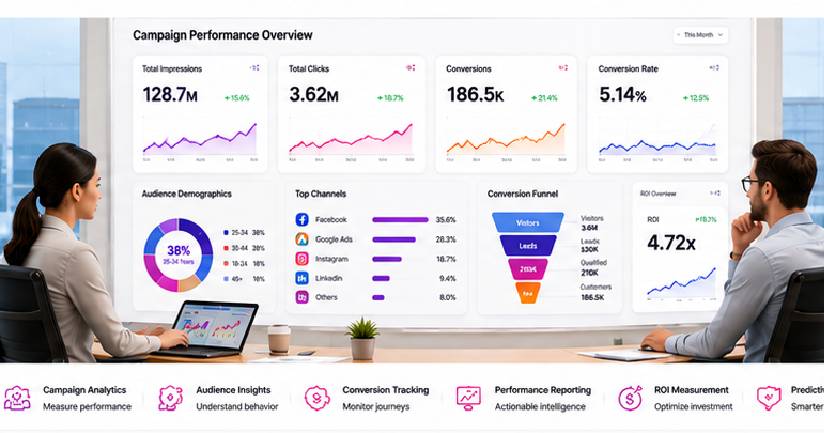
A Brand Messenger dashboard can include:
Acquisition
Traffic Campaign Source Spend
Behavior
Engagement Scroll CTA Interaction
Funnel
Page Visit CTA Click Form Start Form Completion
Conversion
Conversion Rate Conversion Volume Qualified Conversions
Experimentation
Control Variation Performance
Revenue
Customers Revenue ROAS CAC
This creates a connected post-click performance environment.
Landing Page KPIs
Potential KPIs can include:
Landing Page Visitors
Conversion Rate
Conversion Volume
CTA Click Rate
Form Start Rate
Form Completion Rate
Form Abandonment
Qualified Leads
Cost per Conversion
CAC
Revenue
ROAS
The correct KPI depends on the campaign objective.
Conversion Rate Alone Is Not Enough
Consider:
Landing Page A
Conversion Rate: 12% Qualified Customer Rate: Low
Landing Page B
Conversion Rate: 8% Qualified Customer Rate: High
The page with the highest raw conversion rate may not create the strongest business outcome.
Brand Messenger therefore connects:
Conversion Rate → Conversion Quality → Customer → Revenue
Landing Page Optimization Is Not Manipulation
Brand Messenger does not define optimization as using deceptive techniques to force action.
Landing pages should avoid practices such as:
Fake Scarcity
Hidden Charges
Misleading CTAs
Forced Consent
False Testimonials
Difficult Opt-Out
Deceptive Countdown Timers
Our principle is:
Improve Clarity. Increase Relevance. Reduce Friction. Build Confidence. Make the Next Step Easier to Understand.
Privacy-Aware Landing Pages
Landing pages can collect customer information through:
Forms
Analytics
Tracking
Advertising Technologies
Brand Messenger can structure appropriate experiences around:
Data Minimization
Purpose Limitation
Consent / Preferences
Privacy Information
Security
Appropriate Retention
Controlled Access
The objective is to collect the information necessary for the defined customer and business purpose.
Accessibility + Landing Page Optimization
Landing pages should also consider inclusive digital experiences.
Appropriate considerations can include:
Readable Content
Clear Labels
Keyboard Navigation
Form Accessibility
Error Communication
Visual Contrast
Alternative Content
Accessibility should be treated as an important part of digital experience quality, not merely as a conversion technique.
Landing Page Optimization Maturity Model
Level 01 — Basic Campaign Page
Ad → Page → CTA
Level 02 — Conversion-Focused Landing Page
Audience + Message + CTA + Form
Level 03 — Behavioral Optimization
Heatmaps + Funnel Analysis + Form Analysis + Mobile Optimization
Level 04 — Experimentation
A/B Testing + Hypothesis Framework + Performance Optimization
Level 05 — Revenue-Connected Landing Pages
Campaign → Conversion → Customer → Revenue → ROAS → CAC
Level 06 — AI-Powered Landing Page Intelligence
Audience + First-Party Data + Personalization + Predictive Conversion + CRO + Revenue Performance + Executive BI
The objective is not simply to create more landing pages.
It is to build a systematic post-click optimization capability.
Complete Brand Messenger Landing Page Optimization Process
A comprehensive engagement can follow:
Business Objective → Campaign Objective → Conversion Definition → Audience → Traffic Source → Search / Campaign Intent → Ad Message → Landing Page Strategy → Value Proposition → Content Architecture → UX / UI → CTA Strategy → Form / Conversion Mechanism → Trust & Proof → Mobile Optimization → Technical Performance → Tracking & Measurement → Campaign Launch → User Behavior Analysis → Heatmaps → Funnel & Drop-Off Analysis → Hypothesis Development → A/B Testing → Conversion Measurement → Lead / Customer Quality → Revenue, ROAS & CAC Analysis → Continuous Optimization
The lifecycle becomes:
Attract → Match → Engage → Convince → Convert → Measure → Test → Learn → Optimize
Across the Brand Messenger Landing Page Performance Ecosystem
Landing Page Optimization connects Brand Messenger's wider advertising, MarTech and performance capabilities:
Audience Targeting
Reach Relevant Audiences → Paid Search / Google Ads
Capture Search Demand → Display Advertising
Create Visual Reach → Programmatic Advertising
Automate Eligible Media Buying → Remarketing & Retargeting
Reconnect Interested Audiences → Landing Page Optimization
Sales Pages • Lead Capture • A/B Testing • CTA Optimization • Performance Optimization • Conversion Pages → Conversion Rate Optimization
Analyze & Improve the Broader Conversion Experience → Marketing Funnel Optimization
Connect TOFU → MOFU → BOFU
↓
CRM + Marketing Automation
Manage Leads & Customer Journeys → First-Party Data + CDP
Connect Customer Intelligence → Predictive Analytics
Estimate Conversion & Customer Opportunities → Revenue Performance Marketing
Connect Conversion with Revenue, ROAS, Profitability & CAC → Customer Lifetime Value Optimization
Measure Long-Term Customer Value → Marketing Dashboard & KPI Reporting
Turn Landing-Page Performance into Business Intelligence
The complete performance architecture becomes:
Audience → Campaign → Click → Landing Page → Behavior → CTA → Conversion → Customer → Revenue → Measurement → Optimization
Industries & Business Models We Serve
Brand Messenger Landing Page Optimization can support appropriate applications across:
Enterprise Organizations
B2B
E-Commerce
SaaS
Technology
Telecommunications
Financial Services
Professional Services
Real Estate
Automotive
Hospitality
Travel
Retail
Consumer Brands
Media
Entertainment
Events
Education
Healthcare
Subscription Businesses
Membership Organizations
Lead Generation Businesses
Product Launches
Startups
Multi-Location Businesses
International Campaigns
The landing-page architecture should reflect the actual audience, campaign, conversion objective and business model.
Benefits of Landing Page Optimization
Brand Messenger can help organizations:
Create focused sales landing pages
Build lead-capture experiences
Develop conversion-focused campaign pages
Improve paid-search landing experiences
Support Display and Programmatic campaigns
Improve message match
Clarify value propositions
Optimize headlines
Improve CTAs
Optimize forms
Reduce unnecessary conversion friction
Improve mobile landing experiences
Improve technical performance
Analyze user behavior
Use heatmaps and interaction analysis
Identify landing-page drop-off
Develop evidence-based hypotheses
Run A/B tests
Evaluate statistical and business significance
Connect landing pages with CRM
Integrate marketing automation
Build first-party customer relationships
Use AI-assisted optimization
Connect Predictive Conversion intelligence
Improve qualified conversion
Support CAC optimization
Support ROAS improvement
Connect landing pages with revenue
Build performance dashboards
Create a continuous optimization process
Why Choose Brand Messenger?
Brand Messenger combines Sales Landing Pages, Lead Capture Pages, A/B Testing, CTA Optimization, Performance Optimization, Conversion Landing Pages, User Behavior Analysis, CRO, Marketing Funnel Optimization, First-Party Data, CRM, Marketing Automation, Predictive Analytics, AdTech, Revenue Performance Marketing and Executive KPI Reporting within one connected post-click performance ecosystem.
We do not approach landing pages as:
Design a Page → Add a Form → Send Paid Traffic → Hope It Converts.
We approach them as:
Understand the Audience → Understand the Campaign → Match the Message → Define the Conversion → Build the Experience → Reduce Friction → Measure Behavior → Test the Hypothesis → Measure Customer Quality → Connect Revenue → Continuously Optimize.
The distinction matters.
Sales Landing Pages create focused commercial experiences around specific products, services and offers.
Lead Capture Pages turn campaign interest into measurable and appropriately qualified opportunities.
A/B Testing replaces subjective design opinions with structured experimentation.
CTA Optimization makes the next step clearer and more relevant.
Performance Optimization improves the technical and mobile experience behind conversion.
Conversion Landing Pages organize the complete experience around a defined business action.
CRO provides deeper behavioral, funnel and experimentation intelligence.
Marketing Funnel Optimization connects landing pages with TOFU, MOFU and BOFU progression.
CRM and Marketing Automation connect the initial conversion with the broader customer journey.
Predictive Analytics adds forward-looking conversion intelligence.
Revenue Performance Marketing connects the landing page with revenue, ROAS, profitability and CAC.
And Marketing Dashboard & KPI Reporting turns post-click performance into management intelligence.
The result is not simply a better-looking page.
It is a focused performance environment designed to make every relevant campaign click more valuable.
Match the Message. Focus the Experience. Strengthen the CTA. Reduce the Friction. Improve the Conversion.
Sales Landing Pages. Lead Capture Pages. A/B Testing. CTA Optimization. Performance Optimization. Conversion Landing Pages. One Connected Landing Page Performance Ecosystem.